
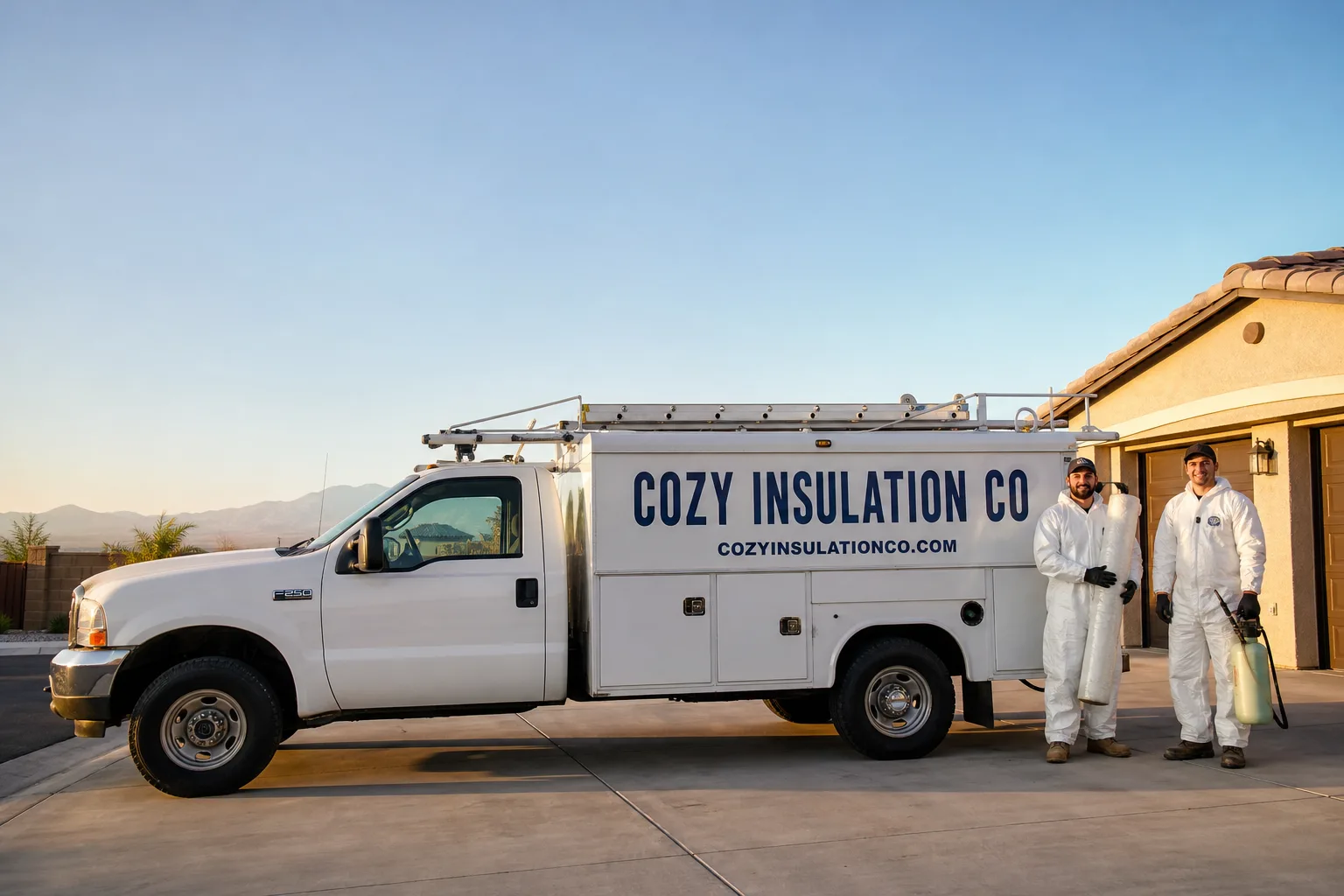
Fast, Reliable Attic Insulation Across Morongo Valley
Attic insulation in Morongo Valley has to be installed differently than it is in the rest of the Coachella Valley. The canyon winds that push through the Morongo Basin corridor drive fine desert sand into vented soffits and ridge vents, burying and compacting loose-fill insulation long before it would fail in Palm Springs or Yucca Valley. Most jobs here need wind-rated baffles, meticulous air sealing, and a crew that understands what the local housing stock demands. We can usually be at a Morongo Valley home within a day or two of your call. For a free estimate, call (855) 382-3925.
Cozy Insulation Co Is Built for Morongo Valley Conditions
We’re not a generalist contractor dropping in from Riverside. Our insulation work in Morongo Valley focuses on the specific ways this town punishes underperforming attics. Homes along Highway 62 and up toward Big Morongo Canyon get hammered by wind-driven sand that filters through gable vents, ridge vents, and unsealed soffit returns. The result? Blown-in insulation gets sand-loaded and compacted, batt insulation collapses, and your attic floor becomes a thermal sink instead of a barrier. We’ve documented this pattern across dozens of Morongo Valley attics. It’s not guesswork at this point – it’s just what the town does to insulation.
Mike Callahan, our owner, has built Cozy Insulation Co around material-matching rather than one-size-fits-all bids. In Morongo Valley, that means leaning on insulation systems that resist wind displacement and perform through the valley’s 30-plus-degree diurnal temperature swings. We stock the products locally so turnaround stays fast.
We serve all of ZIP code 92256, including homes near Morongo Valley Elementary, the Nature Conservancy preserve off East Drive, and the residential pockets off Highway 62 around Big Morongo Canyon Road. If you’re in Morongo Valley, you’re not a satellite service call to us. You’re our geography.
Attic Insulation Removal in Morongo Valley
Attic Insulation removal in Morongo Valley is rarely just a cosmetic job. Here, removal is usually the first step in fixing an insulation system that has been compromised by years of wind-driven sand and dust intrusion. We regularly see attics where the existing fiberglass or cellulose has compacted to half its original depth, with wind-blown sand filling the gaps at eaves and around penetrations. The material still looks like insulation. It just doesn’t work like insulation.
Typical removal pricing in Morongo Valley runs $1.20 – $2.50 per square foot depending on attic access, material type, and how much sand contamination has to be handled. A 1,200-square-foot attic usually lands in the $1,400 – $3,000 range for complete removal, which includes bagging, extraction, and disposal. Older 1950s – 70s desert cabins with tight scuttles or low-slope roofs can push toward the higher end because everything takes longer. Removal also allows us to inspect the attic floor for hidden air leaks, damaged top plates, or rusted-out duct connections that need attention before new insulation goes in.
When Removal Is the Right Call
Most Morongo Valley homeowners need removal if their existing insulation is sand-contaminated, water-damaged from a past roof leak, rodent-soiled, or just too thin after years of settling. If you can see dark streaks in the material or a gritty layer of sand underneath the top surface, removal is usually the smarter move than just blowing more on top. Adding insulation over a failed layer locks the problem in place.
Re-insulation After Removal
Once the old material is out, we typically air-seal every top plate, wire penetration, and duct boot before installing anything new. In Morongo Valley, that sealing step matters as much as the R-value you choose. Then we re-insulate with a system matched to your roof and wind exposure, often Owens Corning blown-in fiberglass or GreenFiber cellulose with wind-rated baffles at every soffit.
Insulation Contractors in Morongo Valley
Finding insulation contractors who understand Morongo Valley’s specific failure modes is harder than it should be. Most companies in the Morongo Basin treat every attic like it’s in a calm suburban tract. It isn’t. The wind loads here, funneled between the Little San Bernardino Mountains and the canyon mouth, stress insulation at every seam, penetration, and attic hatch. We approach the work with that in mind from the first inspection.
As Morongo Valley insulation contractors, we handle the full scope: removal, air sealing, vent baffle installation, and new insulation. Pricing for a complete attic insulation project here typically runs $3,500 – $8,500 depending on attic size, access difficulty, and whether we’re doing spray foam, blown-in, or batt work. A straightforward top-up over existing insulation can start under $2,000, though in Morongo Valley we often recommend against top-ups when the existing material is sand-loaded. You can’t top up what’s already dead.
What Sets Our Work Apart
We install products from eight manufacturers, including Owens Corning, CertainTeed, and Icynene, so the recommendation comes from matching materials to your attic, not from what we happen to have on the truck. For Morongo Valley, that usually means wind-rated baffles from a supplier that understands high-desert conditions and Icynene foam for air-sealing top plates and duct penetrations.
Local Code and Wind Rating
Morongo Valley sits in a wind-exposed zone, and San Bernardino County expects attic ventilation and insulation work to account for wind-driven moisture and debris intrusion. We verify that any new or replacement baffle work meets current wind-resistance standards for the Morongo Basin corridor. That’s been standard practice for us here for years, not a new adjustment.
Trusted Brands We Service in Morongo Valley
We’re authorized to install products from Owens Corning, Johns Manville, Knauf, Rockwool, CertainTeed, Icynene, Demilec, and GreenFiber. In Morongo Valley, we lean on CertainTeed batt products where attics are clean and sealed, Owens Corning blown-in fiberglass where we need solid wind-compaction resistance, and Icynene spray foam for the air-sealing jobs that every older cabin on this end of the valley needs. Demilec closed-cell foam comes into play on homes with unvented roof assemblies or vaulted desert ceilings. The point is: we’re not pushing one product line. Your attic in Morongo Valley gets what it actually needs. And we carry the local stock to keep turnaround tight.
Common Attic Insulation Problems We See in Morongo Valley Homes
- Sand-compacted blown insulation. Years of wind-driven sand through soffit and gable vents fills the attic floor and compacts loose-fill until it loses a third or more of its rated R-value. The insulation is still there; the performance is gone.
- Collapsed batt insulation in older cabins. 1950s – 70s cabins off Big Morongo Canyon Road and along Highway 62 often have original fiberglass batts that have physically slumped from wind pressure and thermal cycling. The thermal barrier is gone at the exact points where the roof loses the most heat.
- Missing or unsealed wind baffles. Most older Morongo Valley homes have no baffles at all, or the baffles have blown loose. That lets gusts displace insulation at the eaves, creating cold spots in rooms directly below.
- Air leaks at attic hatches and top plates. The valley’s 30-degree day-to-night swings make wood framing move, opening seams at top plates and attic hatches. Conditioned air escapes, and desert dust finds its way in. Air sealing is often the single biggest comfort upgrade we do here.
Pricing for Attic Insulation in Morongo Valley, CA
Attic insulation removal in Morongo Valley typically runs $1.20 – $2.50 per square foot. Full re-insulation after removal runs $2.80 – $4.50 per square foot for blown-in fiberglass or cellulose, and $4.50 – $7.00 per square foot for spray foam depending on open-cell or closed-cell. A typical 1,200-square-foot attic here lands between $3,500 and $5,500 for a complete removal-and-reinsulation job using Owens Corning blown-in with wind-rated baffles. Smaller top-up jobs can run under $2,000, though we’ll tell you honestly if a top-up makes sense given the sand intrusion we see across Morongo Valley attics. Every estimate is free. Call (855) 382-3925 and we’ll give you real numbers based on your actual attic.
We Also Serve Cities Near Morongo Valley
Our service area covers the entire Morongo Basin corridor and the desert communities around it. We work regularly in Desert Edge, Garnet, Desert Hot Springs, and Yucca Valley. Each of those towns has its own microclimates and attic realities. In Yucca Valley the wind is less sand-laden. In Desert Hot Springs the heat is more relentless. We adjust for each location, but the standard of work doesn’t change.
Serving Morongo Valley, CA — Our Local Coverage Area
We’re based in the Morongo Valley area and know this community well. Use the map below to see our service coverage — if you’re nearby, we can almost certainly help.
FAQs About Attic Insulation in Morongo Valley
Morongo Valley’s canyon winds cut attic insulation lifespan roughly in half compared to Palm Springs because they push fine desert sand into soffit vents and ridge vents, compacting blown-in material and eroding batt performance within 3 – 5 years. Palm Springs attics fail from heat gradient, not sand loading. In Morongo Valley, wind-rated baffles and air sealing aren’t optional add-ons; they’re what keeps new insulation performing past the first few wind seasons. For an accurate assessment of your attic, call (855) 382-3925.
Closed-cell spray foam like Icynene or Demilec holds up best against wind-driven sand because it forms an air and intrusion barrier in one shot. For blown-in applications, Owens Corning fiberglass installed with wind-rated baffles at every eave is the workhorse we recommend. The material choice matters less than the sealing and baffle work around it. That’s where most Morongo Valley attics fail.
Most attic insulation replacement and top-up work in unincorporated Morongo Valley doesn’t require a separate building permit, but San Bernardino County does expect the work to comply with current ventilation and wind-resistance standards. We confirm that any new baffles and venting meet those requirements before we install. If spray foam is going in, we also verify the assembly complies with the county’s thermal and ignition barrier expectations.
The dirty, sandy look in your Morongo Valley attic is wind-driven desert dust and sand that has been filtering through vents for years. It compacts the insulation and fills air gaps, reducing R-value. If you can see a gritty layer or the material has settled noticeably, removal is usually the right move. Blowing more insulation on top just buries a problem that keeps getting worse. Call (855) 382-3925 and we’ll inspect it and tell you what we’d do if it were our home, which is how we approach every job.
Take a look at the eaves from inside the attic. If you see no baffles at all, or if the baffles are loose, cracked, or buried under insulation, your attic is not set up for Morongo Valley’s wind loads. Proper wind-rated baffles sit tight between the rafters, hold insulation back from the soffit vents, and don’t flap or gap. We check this on every Morongo Valley inspection because missing baffles are the single most common cause of the cold spots and sand intrusion we see here.
Written by Mike Callahan, Owner at Cozy Insulation Co, serving Morongo Valley homeowners with the right insulation system, not just the easiest install.