
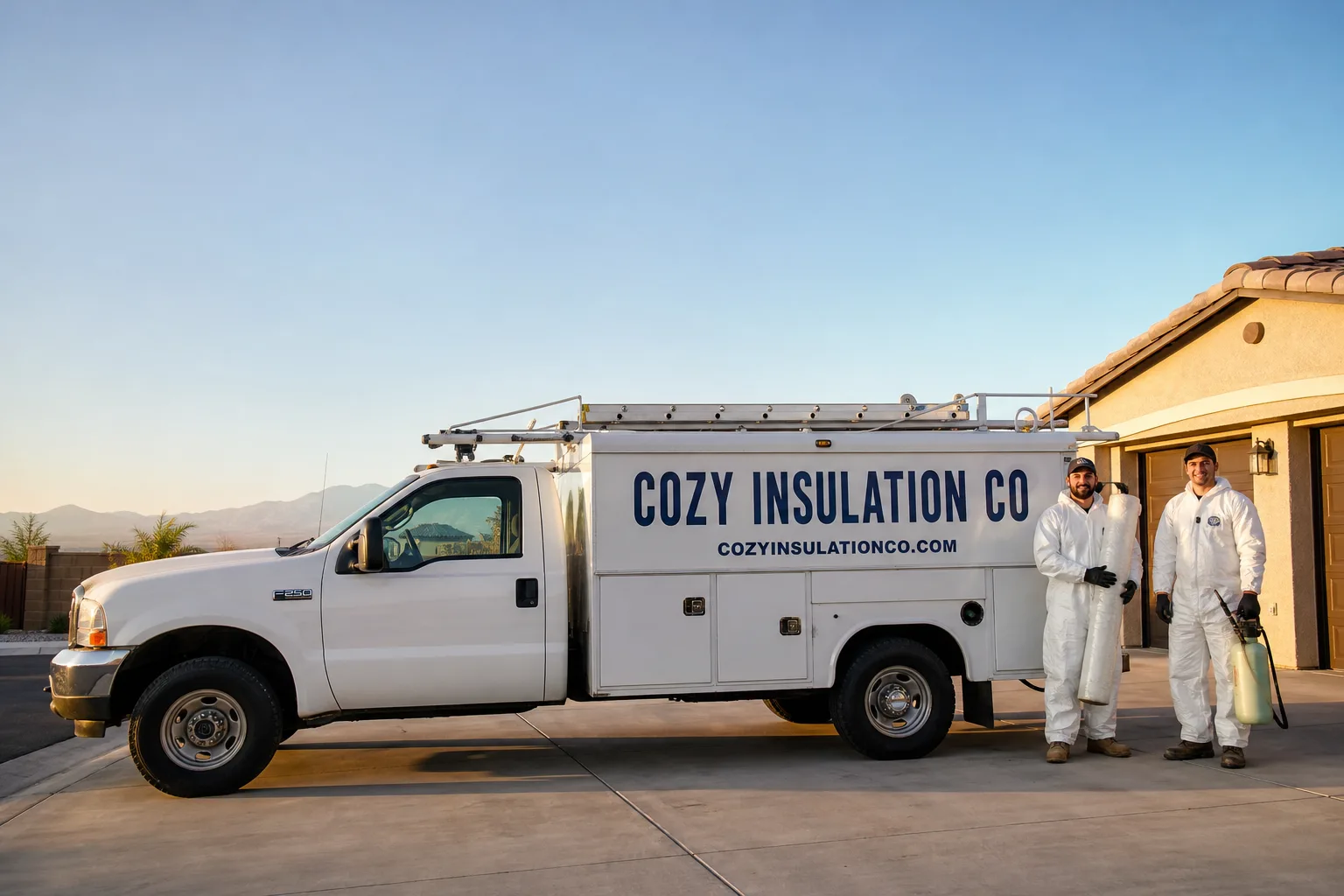
Fast, Reliable Spray Foam Insulation Across Eastvale
Spray foam insulation in Eastvale typically costs $3.00 – $7.50 per square foot depending on the area and foam type, with most garage ceiling and rim joist jobs landing between $1,800 and $4,500. We’re in Corona, about 15 minutes from Eastvale, so we can usually be at your door same-day or next-day for an estimate. Most homes here are 2000s – 2010s two-story tract builds and they all share the same quiet problem: builder-grade R-13 attic batts that were never enough for a valley that regularly clears 100°F. Call us at (855) 382-3925 and we’ll come look at what’s actually going on in your attic and garage.
Eastvale sits in that hot Riverside County corner of the Inland Empire where summer attic temperatures climb past 140°F. That heat doesn’t stay politely in the attic. It presses down through the ceiling, sneaks through uninsulated rim joists, and radiates off garage ceilings into the bedrooms above them. The fix isn’t always the most expensive product. Sometimes it’s closed-cell foam on a garage ceiling, sometimes it’s air-sealing the top plates, sometimes it’s both. We’ll tell you straight what your house needs.
Mike Callahan leads our spray foam crews and he’s the one who walks every Eastvale attic before we quote. You don’t get a sales pitch; you get a diagnosis. That’s why homeowners here trust us with decisions that affect every electric bill they’ll pay for the next 20 years.
Why Cozy Insulation Co Is Eastvale’s Preferred Spray Foam Insulation Company
We’ve spent a lot of hours inside Eastvale attics and garages. The homes off Hamner Avenue, the neighborhoods around Ronald Reagan Elementary, the newer pockets south of Limonite – they’re built on what used to be dairy farms, and the construction patterns are consistent. That consistency is actually useful. After you’ve opened enough 2006 Lennar and KB Home attics, you know exactly where the insulation fails first: around the HVAC package unit, along the top plates, and at the rim joists where the garage meets the house.
Our Eastvale customers tend to call after two or three summers of fighting their cooling bill. They notice the upstairs is always 8 – 10 degrees warmer than downstairs. They notice the garage feels like a kiln by noon. They’ve had an AC tech out twice and nothing changed. That’s when we walk into the picture and show them where the heat is really getting in. The look on a homeowner’s face when they see the gap between their attic insulation and the top plate is something we’re familiar with by now.
Response time to Eastvale matters because once the heat hits, it hits hard. We’re based in Corona and the drive to Eastvale is short – under 20 minutes to most addresses in 92860. Emergency attic work in July isn’t a scheduling headache for us; it’s most of our summer. If you call before noon on a weekday, we can usually have someone at your house that afternoon for an assessment.
We’re authorized to install spray foam systems from Icynene and Demilec, two of the most performance-tested names in spray foam. But we also install fiberglass from Owens Corning and Johns Manville, mineral wool from Rockwool, and GreenFiber cellulose. That matters in Eastvale because not every home here needs foam. Some need the existing batts pulled, the top plates sealed, and new blown-in or batt insulation. We’ll recommend what makes sense for your house, not what’s easiest for our schedule. If you’d like to see what full spray foam coverage looks like, visit our Spray Foam Insulation page for a full breakdown of open and closed cell. But if you’re in Eastvale specifically, keep reading – the local conditions here change the calculus.
Garage Spray Foam Insulation in Eastvale
Garage Spray Foam Insulation in Eastvale is one of the highest-ROI upgrades you can make in a 2000s – 2010s two-story tract home, because the garage shares walls and often a floor-to-ceiling plate line with your living space. Most Eastvale garages were built with drywall on the shared wall and zero insulation anywhere else. The result is that your garage turns into a passive solar oven every summer afternoon, and that heat radiates through the wall into the adjoining family room or upstairs bedrooms after dark. We spray closed-cell foam directly onto the garage ceiling and the rim joists, and the difference is measurable within a day. For a standard Eastvale two-car garage, you’re looking at roughly $1,400 – $2,800 for the complete job, depending on ceiling area and joist bay count.
Hot Wall Relief for Two-Story Floor Plans
Eastvale’s two-story layout is so consistent that we can map the hot walls before we even arrive. The shared wall almost always sits under the master suite or a secondary bedroom. The builder installed insulation on the interior wall but ignored the garage side, so the thermal bridge runs straight through. We fill that side with closed-cell foam and the bedroom thermostat finally holds.
HVAC and Garage Adjacent Issues We Catch
When we’re in an Eastvale garage, we always check the ductwork above. A lot of homes here have return-air plenums running through the garage ceiling chase, and if that chase isn’t sealed, the garage air gets pulled into your HVAC loop. We seal and foam those penetrations while we’re up there, so you’re not breathing whatever’s in your garage all summer.
Closed Cell Spray Foam Insulation in Eastvale
Closed Cell Spray Foam Insulation in Eastvale is the spec we recommend most often for attics that push past 140°F and garages that share walls with conditioned space, because closed-cell provides the strongest thermal break and also acts as an air barrier. Eastvale’s heat is dry and brutal, and in a roof-deck or attic-flange application, closed cell holds its R-value better than fiberglass even when the substrate temperature spikes. You’ll pay roughly $2.00 – $3.50 per square foot for a typical closed-cell job in Eastvale; smaller garage and rim joist work lands between $1,500 and $3,200. It cures hard, seals against air movement, and in our experience it’s the best single material for the specific failures Eastvale homes exhibit.
Correcting Slumped Builder Batts
The original R-13 batts in most Eastvale attics have had 15-plus years to shift. HVAC techs walked over them. They compacted under foot traffic. They got shoved aside to access duct runs. By the time we see them, they’re often doing almost nothing. We remove or pull back the damaged batts and spray the attic floor or the roofline directly. That gap coverage is what stabilizes temperatures.
Rim Joist Sealing for Eastvale Grime and Heat
Eastvale sits low and flat in the Riverside basin, and warm, dusty air finds rim joist gaps like water finds a crack. We see it on nearly every house: small voids along the band board where the framers didn’t seal. Closed-cell fills those voids and locks them permanently. You get a cooler, cleaner home and a much less hospitable environment for pests and air leakage.
Trusted Brands We Service in Eastvale
For Eastvale homeowners, the brand matters more here than in milder climates. We install Demilec closed- and open-cell systems because they perform consistently in high-heat, sun-baked attics like the ones off Archibald Avenue and throughout the 92860 zip code. GreenFiber cellulose is a smart companion in Eastvale when the attic needs air-sealing and a dense pack rather than foam. And when the right call is clean new fiberglass – not every house warrants foam – we stock Owens Corning and Johns Manville in our local warehouse. That means no week-long waits for material when your Eastvale attic is already 130°F.
Why Spray Foam in Eastvale Is a Corrective Upgrade, Not a Legacy Fix
Almost every Eastvale home was built after 1998, and that changes the entire conversation around spray foam. In neighboring Corona or Norco, we see pre-1970s homes with zero insulation and framing built to different standards. Eastvale is different. The home you’re living in was built by a production builder – Lennar, KB, DR Horton, Woodside – during the dairy-land-to-subdivision boom, and it was insulated to the minimum code of its build year. R-13 batts in the attic. Nothing in the garage ceiling. Minimal rim joist sealing. That’s not neglect; that’s the standard of the era. Spray foam in Eastvale is corrective work. It fixes what the builder left short, and it does so in a way that trades your summer cooling pain for comfort that lasts.
We recently sprayed closed-cell foam on the garage ceiling and rim joists of a 2006 Lennar two-story in the Eastvale Ranch area off Schleisman Road. The original R-13 batts had slumped and been kicked loose around the HVAC package unit after years of AC service calls. The homeowner’s garage had been hitting 110°F and pushing heat through the shared wall into the upstairs bedrooms. After we air-sealed the top plates and foamed the band joists, the upstairs cooled dramatically faster and the summer cooling bill dropped noticeably. That’s a standard Eastvale outcome and it’s why we spend the time we do on the details.
For more on how we approach Spray Foam Insulation in Eastvale, head to our city page. It covers the broader service picture.
Common Spray Foam Insulation Problems We See in Eastvale Homes
- Slumped and compressed builder batts. The original R-13 attic insulation was never thick enough for Eastvale’s heat, and years of foot traffic from AC repair techs have flattened it further. Gaps along the top plate are the single most common source of heat infiltration we see.
- Uninsulated garage ceilings radiating into bedrooms. Two-story Eastvale floor plans almost always put living space above or beside the garage, and the builder-grade drywall ceiling does nothing to stop heat transfer. We correct this with a closed-cell coat that turns the garage from a heat source into a buffer.
- Unconditioned attics cooking the HVAC system. When your package unit and flex duct work sit in a 140°F attic, the system works against itself every afternoon. Foam that’s sprayed over unsealed or disconnected ducts just hides the leaks instead of fixing them, so we check everything before we spray.
- Unsealed rim joists pulling in hot, dusty air. Eastvale’s low basin location means warm air and fine dust accumulate at the foundation band. We find obvious rim joist gaps on nearly every house we open up, and closed-cell foam seals them permanently.
Pricing for Spray Foam Insulation in Eastvale, CA
Here’s what Eastvale homeowners should expect to budget. Garage ceiling spray foam runs $1,400 – $2,800 for a standard two-car garage. Rim joist sealing and insulation typically lands between $900 and $1,700 depending on how many joist bays and how accessible they are. Open-cell attic roof deck applications run $1.50 – $2.75 per square foot, and closed-cell roof deck applications run $2.25 – $3.50 per square foot. Attic floor spray foam after pulling old batt runs $2.00 – $4.00 per square foot. Every quote includes an attic inspection and a straight answer about what’s worth doing. Estimates are free and there’s no pressure. Call (855) 382-3925 to schedule yours.
We Also Serve Cities Near Eastvale
Based in Corona, we cover the full Riverside basin. If you’re in Norco, Home Gardens, or Jurupa Valley, we’re already in your area weekly. Those communities share Eastvale’s climate pressures but have different housing stock, so we tailor our recommendations accordingly. If you’re outside Eastvale but nearby, give us a call and we’ll tell you what your specific home needs.
Serving Eastvale, CA — Our Local Coverage Area
We’re based in the Eastvale area and know this community well. Use the map below to see our service coverage — if you’re nearby, we can almost certainly help.
FAQs About Spray Foam Insulation in Eastvale
Yes, and Eastvale is one of the few places where the upgrade pays for itself faster. Your R-13 batts were minimum code in 2005, and in a valley that hits 100°F repeatedly each summer, that minimum is nowhere near enough. Most homes we open in Eastvale show significant batt slumping and top-plate gaps. Spray foam fills those gaps and seals the air leaks that matter most. A typical Eastvale attic correction runs $2,000 – $4,500, and the cooling-season difference is immediate. Call (855) 382-3925 for a free assessment.
Because Eastvale’s two-story floor plans almost always place living space above or directly beside the garage, so an uninsulated garage acts as a heat engine pointed at your bedrooms every afternoon. The garage ceiling can hit 110°F and push heat into the upstairs for hours after the sun sets. Spraying closed-cell on the garage ceiling and rim joists stops that transfer at the source. For most Eastvale garages, the job runs $1,400 – $2,800 and resolves the hot-wall problem permanently.
No, and we won’t. The old R-13 batts have to come out first. They’re almost always compressed, dusty, and displaced around the ductwork, and spraying foam over them traps moisture and hides the gaps instead of sealing them. We pull the damaged batt, inspect the top plates and duct runs, seal what needs sealing, and then spray. That clean substrate is what gives closed-cell its air-sealing power in Eastvale’s 140°F attics.
Eastvale’s sustained summer heat makes spray foam perform better relative to fiberglass than it would in a coastal climate. Fiberglass loses effective R-value when the attic temperature climbs because it only slows heat, it doesn’t stop air movement. Closed-cell foam acts as an air barrier and holds its R-value in high-heat conditions. In a 140°F attic, that’s the difference between insulation that’s working and insulation that’s just lying there. For hot inland locations like Eastvale, this isn’t a marginal improvement – it’s the whole reason to foam.
Open-cell is lighter, less expensive, and good for attic roof deck applications where ventilation is managed. Closed-cell is denser, acts as an air and moisture barrier, and holds its insulation value better under Eastvale’s high attic temperatures. For Eastvale garages, closed-cell is almost always our recommendation because it seals rim joists and blocks heat more effectively in tight spaces. For attic roofs, both can work depending on your roof system, and we’ll walk you through the trade-offs when we inspect. Call (855) 382-3925 to schedule a free estimate.
Schedule Your Eastvale Spray Foam Estimate
If your upstairs runs hot, your garage feels like an oven, or your cooling bill climbs higher every summer, we’re 15 minutes away. Mike Callahan will inspect your attic and garage personally, show you exactly where the heat is getting in, and quote you a real number. No pressure, no mystery pricing. Call (855) 382-3925 today for your free Eastvale spray foam estimate.
Written by Mike Callahan, Owner at Cozy Insulation Co, serving Eastvale and the surrounding Riverside basin.