
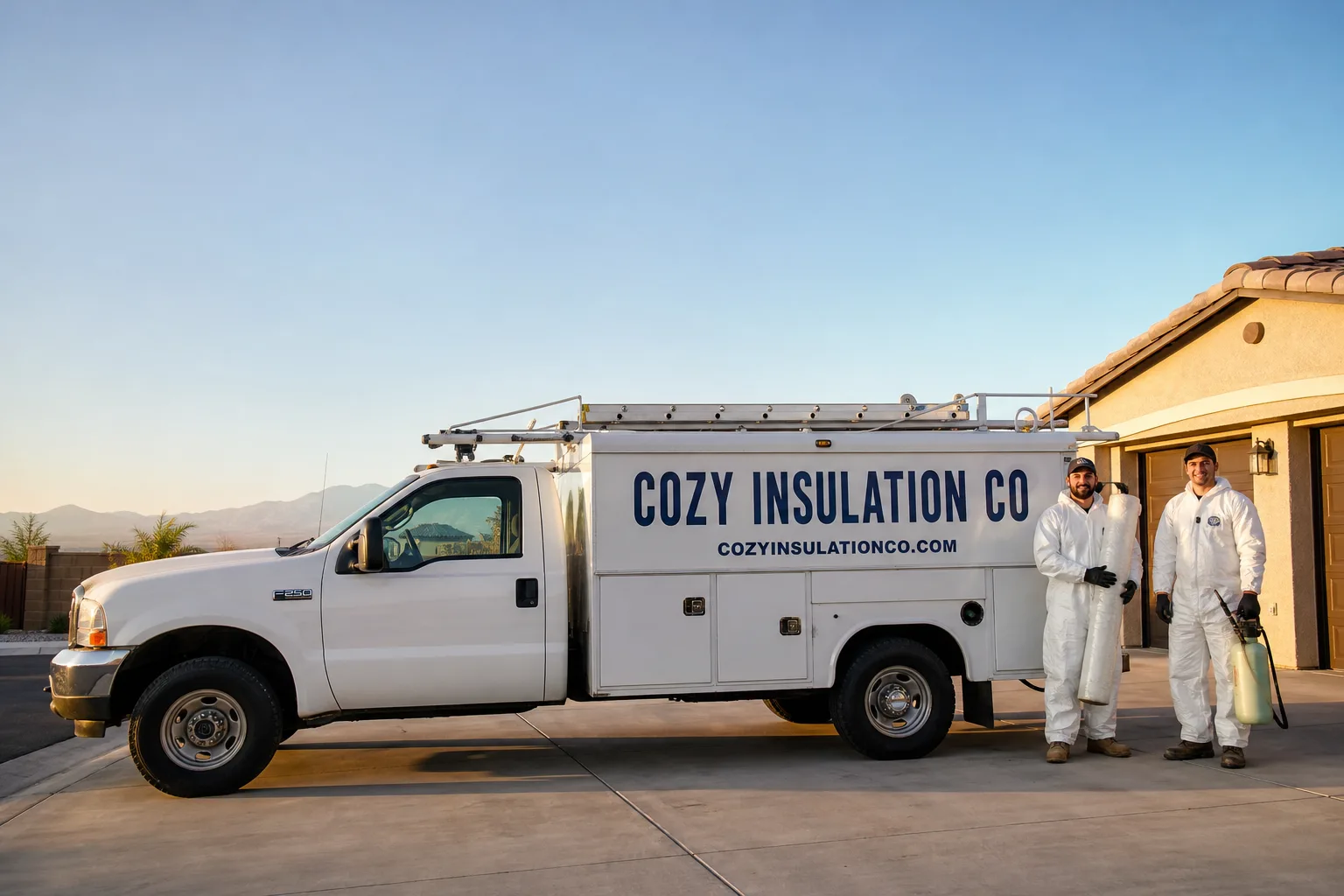
Fast, Reliable Spray Foam Insulation Across Corona
Spray foam insulation in Corona costs between $1.50 and $4.50 per board foot installed, depending on whether you need open-cell or closed-cell foam, and most attic jobs run $2,800 to $7,500. Our crews know Corona’s neighborhoods, from the 92880 corridor near downtown to the Eastvale-adjacent subdivisions south of the 91, and we typically schedule estimates within 48 hours. When a Corona attic hits 140°F in August, the problem isn’t just comfort. It’s heat driving straight through the ceiling and into every room. We fix that. Call us at (855) 382-3925 to talk through what your home actually needs.
Why Cozy Insulation Co Is Corona’s Preferred Spray Foam Insulation Company
Our lead installer, Mike Callahan, has spent years working inside Corona’s attics and crawlspaces, and he knows how this city’s housing stock behaves under load. Mike’s team has sprayed foam in postwar tract homes near the historic downtown core and in the sprawling 1990s-2000s subdivisions that stretch toward Eastvale. The job approach differs wildly between the two housing types, and that’s the kind of knowledge you only get from doing the work here, not reading about it from a corporate office.
We don’t sub out our spray foam work. The same Cozy Insulation Co team that quotes your job shows up to install it. Corona customers mention that consistency in their feedback, along with our willingness to explain why one foam type fits a rim joist job while another belongs on a roof deck. Our response time to Corona is typically same-week for estimates and within 7-10 days for scheduled installs, though attic-only jobs in the north end often go faster.
What builds real trust here is that we work around what’s already in your attic. Solar conduit, radiant barrier remnants, data cables, old blown-in insulation that’s settled to R-19 instead of R-38. In Corona, that’s reality. We plan around it instead of pretending it doesn’t exist.
Spray Foam Wall Insulation in Corona
Spray foam wall insulation in Corona is a job we recommend most often for homes built before the early 2000s, when builders leaned on fiberglass batts that lose effectiveness under this city’s sustained heat load. The work involves either injecting foam into existing wall cavities or applying it during a remodel, and it typically costs $2,400 to $6,000 for a single-story Corona home depending on wall area and access.
Wall insulation matters here more than in coastal SoCal because Corona sits in a thermal trap. Days above 100°F push heat through exterior walls for ten or more hours straight, and nights don’t cool enough to give the wall assembly a chance to shed it. Closed-cell foam addresses that by creating an air seal and a vapor barrier in one pass.
Open-Cell vs. Closed-Cell for Walls
For most Corona wall applications, we use Demilec closed-cell foam because it adds structural rigidity and stops air movement completely. Open-cell runs about $1.50 to $2.20 per board foot and works in interior walls; closed-cell runs $2.80 to $4.50 and is the right call for exterior perimeter walls.
Retrofit Wall Access
Our crew uses small-bore injection methods for occupied Corona homes, which means less drywall repair and a cleaner finish. If you’re already remodeling, we can spray directly into open stud bays before insulation and drywall go back up.
Rim Joist Spray Foam in Corona
Rim joist spray foam in Corona is consistently the highest-ROI insulation job we do, and most homeowners don’t know the rim joist exists until we point it out. The rim joist is the band of wood where your floor framing meets the foundation wall, and in Corona’s older downtown tract homes it’s frequently unsealed or fitted with poorly installed fiberglass. A typical rim joist job runs $900 to $2,200 depending on home size and accessibility.
Why it matters here specifically: Santa Ana wind events push fine dust and ember material against foundation lines for hours at a stretch. Homes on Corona’s northern wildland edges get this worst. Unsealed rim joists let that dust into the crawlspace and eventually up through floor gaps. Mike Callahan and our team use low-expansion closed-cell foam to seal each joist bay completely, cutting off that infiltration path.
The Solar-Conduit Consideration
In Corona’s newer south and east subdivisions, rim joist work overlaps with rooftop solar battery lines and conduit that run down exterior walls and into crawlspaces. We shield those runs before spraying to keep foam clear of heat-generating lines. That’s a step crews without local experience routinely skip, and it’s the kind of oversight that leads to expensive rewiring later.
Air Quality During Fire Season
When smoke sits over the Inland Empire for days, a sealed rim joist system measurably improves indoor air quality. We can’t make that claim about every market, but Corona’s geography and wind patterns make it relevant here.
Trusted Brands We Service in Corona
Cozy Insulation Co installs spray foam systems from Icynene and Demilec, two of the most rigorously tested names in the professional spray foam industry. We also carry Owens Corning and GreenFiber products for hybrid jobs where foam pairs with batt or blown-in material. For Corona customers, we stock commonly needed accessories and material locally so a warranty follow-up doesn’t mean waiting on a shipment from out of state. You get the brand performance you’re paying for, installed by people who understand how it performs at 105°F. For more on our full material lineup, see our Spray Foam Insulation service overview.
Common Spray Foam Insulation Problems We See in Corona Homes
- Foam sprayed directly over solar conduit: In Corona’s solar-heavy subdivisions, we regularly find foam shot over conduit, wiring, and compressor lines. Foam cures exothermically and holds heat, which can degrade wire insulation over time. Proper shielding and technique prevent this entirely.
- Unsealed rim joists in older downtown homes: Homes built near Main Street and the historic core often have fiberglass stuffed into rim joist bays. During Santa Ana events, dust and ember material move straight through. Sealed foam stops the intrusion at the source.
- Thick single-pass application on roof decks: In Corona’s triple-digit heat, foam applied too thick in one pass can trap gas and cure with bubbles. This is a common defect on roof deck undersides. Proper pass depth matters here more than in cooler climates.
- Settled blown-in insulation under solar arrays: The old fiberglass or cellulose has often been flattened by solar installers walking the attic. Once displaced, it stops working. In many Corona homes, it’s been disturbed for a decade and no one noticed until the AC bills climbed.
Pricing for Spray Foam Insulation in Corona, CA
Open-cell spray foam in Corona runs $1.50 to $2.20 per board foot installed. Closed-cell runs $2.80 to $4.50 per board foot. A full attic roof deck with closed-cell foam on a 1,800 sq ft Corona home typically lands between $5,500 and $8,800. Rim joist sealing on that same home usually falls between $1,200 and $1,900. What moves the number? Attic access, solar panel layout, existing insulation removal, and how much prep work the foam surface requires. Estimates are free and the price we quote is the price you pay, assuming site conditions match what we inspected. For an exact quote on your Corona home, call (855) 382-3925.
We Also Serve Cities Near Corona
Beyond Corona, our spray foam team handles jobs in Home Gardens, El Cerrito Corona, Eastvale, and Norco. If you’re on the edge of Corona near the 15 or the 91, we’re close by and can usually combine trips when you schedule with neighbors. See the full Spray Foam Insulation in Corona coverage area for details.
Serving Corona, CA — Our Local Coverage Area
We’re based in the Corona area and know this community well. Use the map below to see our service coverage — if you’re nearby, we can almost certainly help.
FAQs About Spray Foam Insulation in Corona
We shield and isolate all solar conduit, junction boxes, and compressor lines before applying foam, keeping foam clear of heat-generating components. This prevents the foam from trapping heat against wiring, which can degrade insulation over time.
In Corona’s south and east subdivisions, this is the default approach, not an add-on. Any contractor who doesn’t bring it up should make you nervous. Call (855) 382-3925 if you want a crew that plans around your solar array instead of spraying over it.
Yes. Closed-cell foam on the roof deck and rim joists creates an air seal that blocks both radiant heat gain and wind-driven dust and ember intrusion. Homes in the north end of Corona, closer to open wildland, benefit most from this full-seal approach.
We always pair attic foam with a discussion about existing vents and whether they should remain. Fire season changes the calculus on ventilation in this city, and the right answer depends on your roof assembly and location. Call for an assessment.
The most effective approach is removing the settled and displaced blown-in material, air-sealing the attic floor with spray foam, and then either re-blowing fresh insulation or installing a full roof deck foam system. Most 1990s Corona homes have lost 30 to 40 percent of their original insulation R-value to settling and solar-related disturbance.
We quote removal, sealing, and replacement as one job so there’s no finger-pointing between contractors. Estimates are free. Call (855) 382-3925 to have Mike inspect your attic.
We bring compact spray rigs and small-format foam guns that fit through narrow scuttles and around staircase framing. On alley-load townhomes, our hoses run from the alley cleanly and without blocking neighbors.
Corona’s denser pockets, especially around the downtown core and the newer attached-home communities, require a different tool set than open-subdivision single-family work. We’ve built our Corona equipment setup around that reality.
Yes. Corona’s hot, dry conditions accelerate the foam cure, so we adjust pass depth and wait times to avoid bubbles and poor adhesion, especially on roof decks. Proper ventilation during application matters even more in sealed, high-heat attics.
We schedule foam work in Corona for early morning where possible and monitor surface temperatures throughout the cure window. The dry heat can make foam set faster than spec, and an inexperienced crew that ignores that will leave you with a compromised install. Our techs are trained for this specific climate.
Written by Mike Callahan, Owner at Cozy Insulation Co, serving Corona since day one. Call (855) 382-3925 for a free spray foam estimate.