
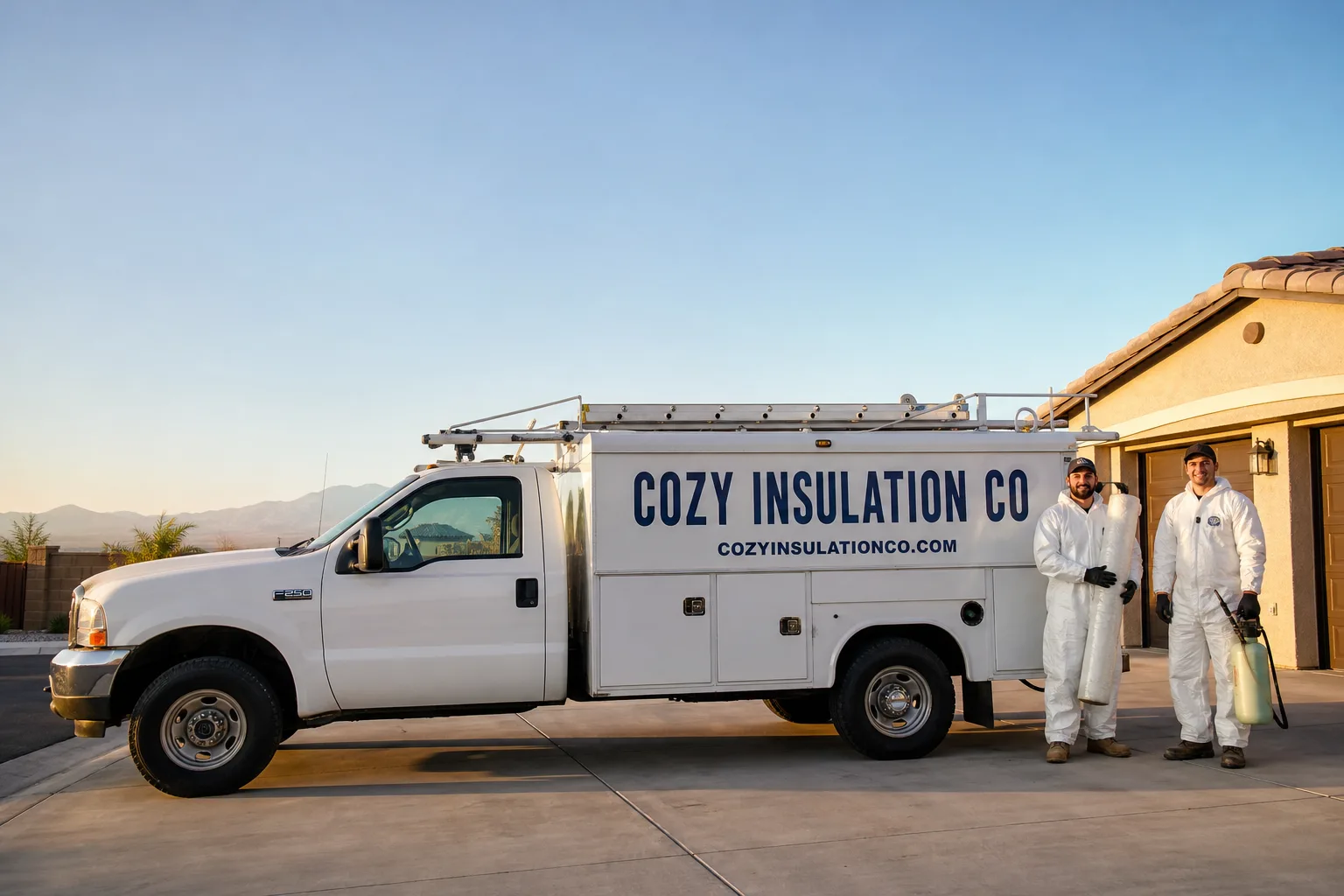
Fast, Reliable Attic Insulation Across Trabuco Canyon
If your attic insulation is thin, patchy, or gone, you’re paying to cool the Santa Ana foothills every August. In Trabuco Canyon, where summer temperatures regularly punch past 95°F and winter nights dip into the low 40s, a properly insulated attic is the difference between a home that holds its temperature and one that fights it. Our Attic Insulation crews work throughout the canyon and the surrounding hillsides, and we’ll typically have someone at your door within one business day of your call. Reach Mike Callahan and the team directly at (855) 382-3925 for a free estimate.
Why Cozy Insulation Co Is Trabuco Canyon’s Preferred Attic Insulation Company
We know Trabuco Canyon homes because we’ve worked inside enough of them to recognize the patterns. The historic cabins along Trabuco Canyon Road were built before insulation was standard, and many still have whatever thin batts a previous owner shoved between the joists decades ago. The newer hillside estates off Plano Trabuco and in Coto de Caza have a different problem: complex roof lines, vaulted ceilings, and attic spaces that look straightforward from the street but hide irregular cavities standard retrofits miss. Homeowners keep calling us because we match the material to the house, not the house to whatever material happens to be on the truck.
We’re authorized to install products from eight nationally recognized manufacturers, including Owens Corning, Johns Manville, and Demilec. That breadth matters in a place like Trabuco Canyon because the right answer for a 1920s cabin is rarely the right answer for a 2005 custom build in a gated community. Mike Callahan built the company around that principle: options, not a one-size pitch. The response time to Trabuco Canyon from our Corona shop is about 40 minutes without traffic, and we schedule work in the canyon almost every week, which means we’re nearby when you need a follow-up or a quick inspection.
Attic Insulation Removal in Trabuco Canyon
Attic insulation removal in Trabuco Canyon is the step most people skip because they don’t realize how much old material is working against them. In this part of the foothills, we regularly pull out fiberglass that’s been compressed, chewed through by rodents, water-stained from a past roof leak, or contaminated with dust and debris from decades of Santa Ana winds. You don’t just lay new insulation over that. You remove it, find out what’s happening underneath, and start clean. Removal in Trabuco Canyon typically runs $1.50 to $2.75 per square foot for attic spaces under 1,500 square feet, with the total landing between $1,800 and $4,200 for most homes.
When Removal Becomes Necessary
Older cabins in Trabuco Canyon’s historic core often have attics that haven’t been touched since the Nixon administration. When insulation sits for 40 or 50 years, it loses its loft, absorbs moisture, and becomes a habitat for pests. If you notice a persistent musty smell upstairs, see droppings or nesting material in the attic, or find that your cooling bills climb every summer despite running the AC constantly, removal is usually the first move.
Air Sealing After Removal
Once the old material is out, we air-seal the attic floor before installing anything new. That means closing gaps around recessed lights, plumbing vents, and top plates where conditioned air escapes into the attic. In Trabuco Canyon, this step matters more than people expect because the temperature differential between a sun-baked attic and the living space below is so extreme during summer. A $3 tube of sealant in the right spot can do more than another inch of insulation in the wrong one.
Insulation Contractors in Trabuco Canyon
Insulation contractors in Trabuco Canyon need to understand two things most Orange County crews don’t think about: fire hardening and Title 24. The first is unique to communities like this one, where the risk of wildfire shapes every building decision. The second applies everywhere in California but gets complicated here because older homes fall under different compliance standards than newer builds. Our company handles both. When you hire us, you get a single crew that can remove old insulation, install new material, upgrade your attic vents to fire-rated models, and verify the whole thing passes local inspection expectations. For a full removal-and-replacement job in Trabuco Canyon, most homeowners spend $2,800 to $6,500 depending on attic size and material choice.
Fire Hardening Expertise
This is where a generic insulation company falls short. Trabuco Canyon’s fire department requires ember-resistant attic vents, which means a simple insulation retrofit often turns into a vent replacement project. We stock fire-rated vent models and install them as part of the job, not as an awkward add-on. When you’re dealing with Santa Ana winds pushing embers toward your roofline, those vents are doing real work.
Old Home Experience
We’ve worked in attics with knob-and-tube wiring, minimal clearance, and roof framing that predates modern building codes. That experience matters because the last thing a historic cabin owner needs is a contractor who panics at the sight of wiring from 1935. The work gets done carefully, correctly, and with respect for the house’s age.
Trusted Brands We Service in Trabuco Canyon
We install and service insulation from Owens Corning, Johns Manville, GreenFiber, and Demilec, among others. For Trabuco Canyon homeowners, that means you’re not locked into whatever a single-brand dealer happens to sell. Need a fiberglass batt replacement that matches the R-value of what you already have? We carry Owens Corning and Johns Manville lines. Want recycled-content blown-in material for an eco-conscious retrofit? GreenFiber cellulose is available. Looking for the performance ceiling in spray foam? We’re certified for Demilec systems, including closed-cell. Because we work in Trabuco Canyon regularly, we keep common materials staged and ready, which shortens lead times on most jobs to under a week.
Common Attic Insulation Problems We See in Trabuco Canyon Homes
- Missing or deteriorated insulation in historic cabins. The early-1900s wood-frame cabins along the canyon floor often have no insulation at all, or a thin layer so degraded it performs like nothing. Attic temperatures in these homes can hit 130°F, and the living space below never really cools off.
- Ember intrusion through standard attic vents. Trabuco Canyon sits in a high fire severity zone, and the local fire department mandates ember-resistant vents. Homes with older mesh or louvers are both a fire risk and an energy leak, especially during Santa Ana wind events when hot air gets pushed into the attic.
- Uneven coverage in hillside estates with vaulted ceilings. Modern custom homes off Plano Trabuco and throughout Coto de Caza often have cathedral ceilings, exposed beams, and irregular attic cavities. Standard batt installation leaves gaps and compressed edges, creating hot spots you can feel from room to room.
- Rodent and pest damage from canyon wildlife. Trabuco Canyon’s scrub oak and open space mean rats, mice, and squirrels find their way into attics. They nest in insulation, shred it, and leave droppings that make the material unsalvageable. Removal and replacement is usually the only real fix.
Pricing for Attic Insulation in Trabuco Canyon, CA
Here’s what we actually see on Trabuco Canyon jobs. Blown-in cellulose or fiberglass for a standard 1,200-square-foot attic runs $1,800 to $3,400. Batt insulation replacement lands between $2,200 and $4,800 depending on access and R-value target. A top-up over existing insulation costs less, typically $900 to $1,800 for most canyon homes. Spray foam is the premium option, starting around $3,500 for a basic open-cell attic and climbing to $7,000 or more for closed-cell applications on complex roof lines. The variables are attic size, material choice, whether removal is needed, and whether we’re upgrading vents or air-sealing as part of the job. Call (855) 382-3925 and Mike will walk you through what your specific home needs, with pricing before any work begins.
We Also Serve Cities Near Trabuco Canyon
Our crews cover the surrounding foothill communities, including Rancho Santa Margarita, Foothill Ranch, Portola Hills, and Coto de Caza. If you’re in Trabuco Canyon or any neighboring city, the process is the same: call, get an estimate, and we’ll handle the rest. See our full Attic Insulation in Trabuco Canyon coverage for details.
Serving Trabuco Canyon, CA — Our Local Coverage Area
We’re based in the Trabuco Canyon area and know this community well. Use the map below to see our service coverage — if you’re nearby, we can almost certainly help.
FAQs About Attic Insulation in Trabuco Canyon
Trabuco Canyon’s fire department requires ember-resistant attic vents because the community sits in a high fire severity zone where wind-driven embers can enter attics through standard vent openings during Santa Ana wind events. This requirement means insulation upgrades in Trabuco Canyon almost always include replacing old vents with fire-rated models, a step not mandated in most neighboring Orange County cities. If you’re planning an insulation project, we’ll include vent replacement in the scope automatically. Call (855) 382-3925 to confirm what your home needs.
Yes, but it requires careful handling. Older cabins in Trabuco Canyon’s historic core often have original knob-and-tube wiring, and insulation cannot simply be packed around it because the wiring needs air circulation to dissipate heat. The correct approach is to remove old material, assess the wiring condition, and install insulation in a way that maintains clearance around active circuits. We’ve done this work in multiple canyon cabins and understand the safety protocols involved. An inspection is the first step, and estimates are free.
For attics in Trabuco Canyon, R-38 to R-49 is the range we recommend for most homes, which aligns with current Title 24 energy standards for this climate zone. The extreme summer heat means higher R-value pays off in cooling savings, and the cool winter nights make it matter for heating too. Older homes with minimal attic clearance may be limited to what fits in the cavity, but a top-up or dense-pack approach can usually get you close. Call us for an attic evaluation and we’ll tell you exactly what your space can handle.
Fire hardening affects insulation choices in two ways. First, it requires ember-resistant vents, which means the insulation installation has to work around vent replacement rather than simply going over whatever exists. Second, it pushes some homeowners toward materials like mineral wool, which carries inherent fire resistance and can contribute to a safer attic assembly. We offer Rockwool for exactly this scenario, and GreenFiber cellulose treated with fire retardant as an alternative. The right choice depends on your home’s construction and the fire department’s specific expectations for your property.
Yes, and the difference is mostly about architecture rather than material. Coto de Caza homes built in the 1980s through 2000s often feature vaulted ceilings, exposed beams, and complex rooflines that create irregular attic cavities. Standard batt installation leaves compression gaps and missed corners in these spaces. Historic cabins, by contrast, usually have simple low-slope attics where the challenge is clearance, old wiring, and absence of existing insulation. We treat them as two different jobs because they are two different jobs.
Written by Mike Callahan, Owner at Cozy Insulation Co, serving Trabuco Canyon and surrounding foothill communities.