
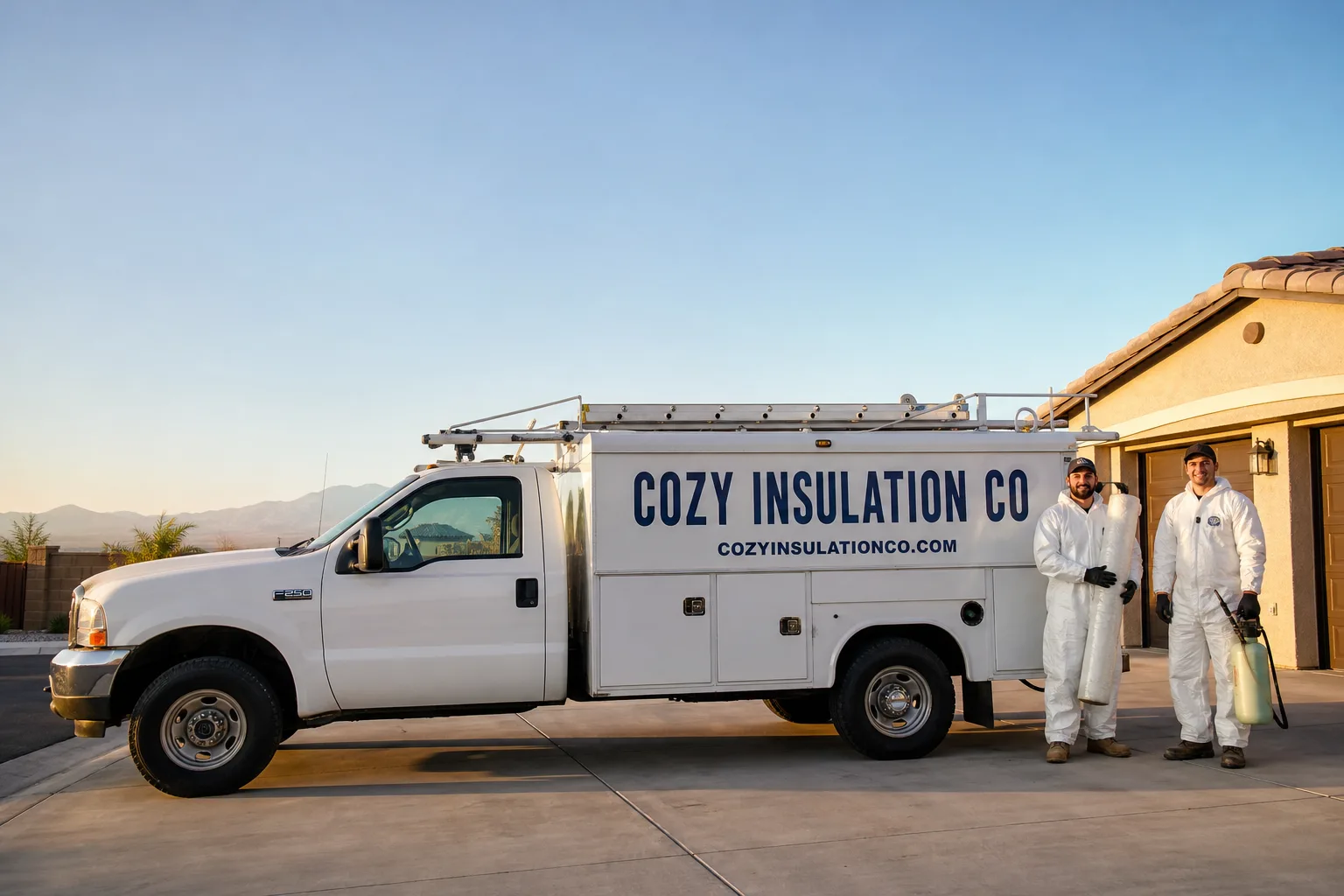
Fast, Reliable Spray Foam Insulation Across Walnut
Spray foam insulation in Walnut typically runs $2,800 to $7,200 for an attic roof deck or rim joist project on a 1970s-90s tract or semi-custom home, and our crews reach most Walnut neighborhoods same-week. If you’re in 91788, 91789, or 91795 and your upstairs rooms heat up by midafternoon while your AC runs nonstop, the problem is usually the attic cavity, not your HVAC. We’re Cozy Insulation Co, and we’ve worked on enough tile-roof homes off Grand Avenue and around the Mt. SAC corridor to know exactly how Walnut heat loads hit an aging attic. Call (855) 382-3925 for a free estimate, and we’ll tell you honestly whether spray foam is the right fix or whether a simpler upgrade gets you there.
Why Cozy Insulation Co Is Walnut’s Preferred Spray Foam Insulation Company
Walnut homeowners call us because we don’t treat every house like a blank rectangle. A 1985 stucco tract home in the Walnut Valley planned tracts needs a different insulation strategy than a hillside semi-custom off Lemon Avenue with a low-slope roof and afternoon sun exposure. Our crews know the difference. We’ve insulated homes throughout 91789 where original R-11 batts had compressed to half their rated thickness under tile roofs, and we’ve fixed spray foam jobs in 91795 where another contractor over-applied closed-cell over existing fiberglass, trapping dust and moisture against the roof deck.
Mike Callahan started Cozy Insulation Co with a simple rule: match the material to the house, not to our margin. That’s why we stock Icynene and Demilec spray foam systems alongside fiberglass, mineral wool, and cellulose. It’s also why we’ll tell you when spray foam isn’t the best use of your money, which happens more than you’d think. Our Spray Foam Insulation team has pulled back more than one failed closed-cell job in Walnut where the foam was applied too thick over dusty batts that should have been removed first. The result was moisture against the tile-roof deck and a homeowner who paid twice for the same attic. We fix that properly.
Response time matters in August. We schedule Walnut jobs on a route that puts us in the city most weeks, and we can often get a technician out within two to three business days for an estimate. Emergency calls, meaning a failed insulation job or a sudden moisture problem, get prioritized. You’re not waiting on a company based forty miles away that treats Walnut as a drive-by stop.
Rim Joist Spray Foam in Walnut
Rim joist spray foam is the single most overlooked upgrade in Walnut hillside homes, because the rim joist, the band board where your floor framing meets the foundation, sits right at the thermal boundary where afternoon radiant heat from the foothill edge gets pulled into the house. On a Walnut home built in the 1980s, the rim joist was typically left uninsulated or stuffed with a thin fiberglass batt that’s now sagging and useless. We see this constantly in the hillside lots off Grand Avenue and around Snow Creek Park, where the afternoon sun beats against the west-facing band and turns the rim joist into a thermal bridge that undoes much of what a good attic upgrade accomplishes. Sealing and foaming the rim joist in Walnut runs roughly $900 to $1,800 depending on linear footage and access, and it’s the first thing we check on a hillside house where the attic was already upgraded but rooms still won’t hold temperature.
Why the hillside rim joist fails first
Walnut’s foothill-edge lots get a double heat load: direct afternoon sun on the exterior band, plus radiant heat rising from the crawl space or basement. In a flat SGV city, the rim joist is mostly an air-sealing problem. On a Walnut hillside, it’s a radiant gain problem, and closed-cell foam with a higher R-value per inch is the right call here. The foam also locks out the dust and field mice that move through unsealed rim cavities in older Walnut homes.
What the job involves
We pull any old fiberglass, air-seal the band with closed-cell foam, and re-cover the rim as needed. On semi-custom Walnut homes with finished basement walls or built-in cabinetry against the band, we protect surrounding trim and work in sections so you’re not tearing out finished space. The job usually takes half a day to a full day, and you’ll feel the difference in the room directly above the garage or crawl space within the first hot week.
Crawl Space Spray Foam Insulation in Walnut
Crawl space spray foam insulation addresses the underside of Walnut homes where vented crawl spaces pull in hot, dusty air all summer and cold air all winter, making floors uncomfortable and driving HVAC runtime up. Many Walnut planned-community homes built in the 1970s-90s have vented crawl spaces with no insulation on the floor framing at all, or with thin, falling-down batts. Sealing the crawl space rim and band with closed-cell spray foam, or insulating the subfloor where appropriate, runs $1,500 to $4,200 in Walnut depending on square footage and the condition of the existing vapor barrier. HOA-governed communities around the Walnut Valley have rules about exterior appearance, but crawl space work is internal to the home and rarely requires design review, which we can help verify with your management company.
When a Walnut crawl space needs foam, not batts
Fiberglass batts in a vented crawl space absorb moisture from the soil and sag within a few years. Closed-cell spray foam bonds to the subfloor and rim, cuts air movement, and won’t hold water. For Walnut homes with hardwood or tile floors directly over a crawl space, this is the difference between floors that feel cold in January and floors that stay within a degree or two of room temperature. We check the existing vapor barrier and drainage first, because foam over a wet crawl space creates a moisture trap.
HOA and access considerations
Walnut’s HOA-heavy planned communities, particularly around the Walnut Valley and the Mt. SAC corridor, often have narrow side yards and limited crawl space access hatches. Our crews carry portable spray rigs and access equipment sized for tight suburban lots, so we’re not dragging a trailer down a hillside driveway. We also keep noise down during school hours out of respect for neighbors in the denser tract pockets.
Trusted Brands We Service in Walnut
We install Icynene and Demilec spray foam systems in Walnut because both brands have long track records in hot-climate roof-deck applications, which is exactly what tile-roof attics here demand. For homeowners who want an eco-conscious alternative or fire-resistant option, we also work with GreenFiber cellulose and Rockwool mineral wool, though those aren’t spray foam products. We don’t push a single brand. We stock the full range of Icynene and Demilec open- and closed-cell kits plus the prep and masking materials Walnut jobs need, so we’re not delaying a project waiting on a parts run from the Valley. If your Walnut attic has a failed foam job from another contractor, we service existing spray foam regardless of brand and can often repair or re-coat rather than tear out and start over.
Common Spray Foam Insulation Problems We See in Walnut Homes
- Closed-cell applied too thick over original 1980s batts. This is the most common failure in Walnut tract homes. The foam traps dust-degraded fiberglass and hides moisture against the tile-roof deck, creating a mold risk the homeowner can’t see until it’s bad. The batts have to come out first, period.
- Rim joist and crawl space foam sprayed without accounting for hillside radiant gain. On foothill-edge lots, the west-facing band stays hot well past sunset. If the rim joist wasn’t included in the attic upgrade, thermal bridging at the band keeps the upstairs hot anyway. We see this on homes where the attic was “done” a year or two ago and the owner can’t figure out why nothing changed.
- Foam overspray and sloppy trim around custom-finished attics. Walnut has a lot of semi-custom homes with finished attic storage, built-in shelving, and smart-home wiring runs. Sloppy masking leaves foam on wood trim, on door casings, on wiring. Premium homeowners notice immediately, and cleanup after the fact is harder than doing it right the first time.
- Flat-attic batt top-offs applied to tile-roof homes. Adding more fiberglass batts on the flat ceiling does almost nothing for a Walnut tile roof, because the heat load lives in the attic cavity itself, not on the ceiling plane. We’re called in after these “upgrades” regularly. The fix is roof-deck spray foam or a properly vented radiant barrier, not more batts.
Pricing for Spray Foam Insulation in Walnut, CA
Roof deck spray foam on a typical Walnut attic runs $3,500 to $7,200 for closed-cell, with open-cell coming in at $2,800 to $5,500. Rim joist work is $900 to $1,800. Crawl space insulation runs $1,500 to $4,200 depending on access and the condition of the existing vapor barrier. What moves the price in Walnut is roof complexity: hillside homes with low-slope or multi-plane roofs add labor time, and 1980s attics with original batts need removal and disposal before we spray, which adds $400 to $900. We give free, written estimates, and we’ll show you the material and labor breakdown so you can compare honestly against any other Walnut contractor. Call (855) 382-3925 to schedule a walk-through; estimates include thermal imaging so you can see exactly where your heat loss or gain is happening.
We Also Serve Cities Near Walnut
Our crews cover the Walnut area and the surrounding San Gabriel Valley. If you’re in Walnut or just over the line in South San Jose Hills, Rowland Heights, West Covina, or Pomona, we’ll be happy to take a look. Walnut’s tile-roof heat-load profile is similar in the nearby foothill communities, so our roof-deck and rim joist expertise transfers directly to homes in those cities too.
Serving Walnut, CA — Our Local Coverage Area
We’re based in the Walnut area and know this community well. Use the map below to see our service coverage — if you’re nearby, we can almost certainly help.
FAQs About Spray Foam Insulation in Walnut
Yes, and in most cases it’s the better choice. Tile-roof houses in Walnut bake the attic cavity far hotter than asphalt-shingle homes elsewhere in the SGV, because the tile and batten assembly holds heat and radiates it downward into the attic. More batts on the flat ceiling don’t address that. Spray foam on the roof deck underside, particularly Demilec or Icynene closed-cell, turns the attic into a conditioned buffer zone and drops the radiative load on your ceiling. Call (855) 382-3925 for a roof-deck assessment: free, with thermal imaging.
Yes. Crawl space and rim joist work is internal to the home and typically doesn’t require design review from Walnut HOAs, which regulate exterior appearance, not the underside of your house. We can check with your management company if you’d like written confirmation. The only exception is if your crawl space access hatch is part of an exterior elevation that the HOA considers a modification, which is rare; call us with your community name and we’ll clarify.
Because on a foothill-edge lot, the rim joist absorbs direct afternoon sun and radiates heat into the floor framing for hours after sunset. If you’ve already upgraded the attic and still feel heat dumping from the walls and floors, the rim joist is the likely culprit. On a hillside home off Grand Avenue or Snow Creek Park, an unsealed rim joist can undo a $5,000 attic upgrade. We check it first. It costs $900 to $1,800 to fix properly with closed-cell foam.
It works better with one, because a variable-speed air handler and zoned smart-home HVAC can only hold setpoints if the thermal envelope isn’t leaking. We were called to a semi-custom home off the Mt. SAC corridor where the homeowners had added a smart-home HVAC system but still felt afternoon heat dumping from the attic; the original R-11 batts had compressed under the tile roof and were dust-degraded. Our crew pulled the failed batts, sealed the top plates and penetrations, and applied Demilec closed-cell spray foam to the roof deck so the new variable-speed air handler could actually hold its setpoint. That’s the pattern we see in Walnut, and the fix is direct.
We mask everything: floor runners, door casings, wood trim, smart-home wiring, and any finished attic surfaces. On Walnut semi-custom homes with carriage-house doors, built-in cabinetry, or finished attic storage, we treat the work area like a finished interior rather than a construction site. Overspray on a wood door or trim is the telltale sign of a careless foam crew, and we’ve been called in to clean up after enough of them to know that Walnut homeowners notice sloppy work immediately.
Get Your Walnut Spray Foam Insulation Estimate
If your Walnut home has a tile roof, a hot upstairs, or an attic that’s never been properly insulated, the fix probably isn’t more of what’s already failing. Call Cozy Insulation Co at (855) 382-3925 for a free, no-pressure estimate. We’ll walk the attic, check the rim joist, take thermal images, and tell you exactly what’s worth doing and what isn’t. You’ll get a written breakdown with material brands and prices, so you can compare apples to apples. Walnut’s heat comes back every summer. Your insulation shouldn’t be the reason it’s still coming into your house.
Written by Mike Callahan, Owner at Cozy Insulation Co, serving Walnut and the San Gabriel Valley with material-matched insulation since day one.