
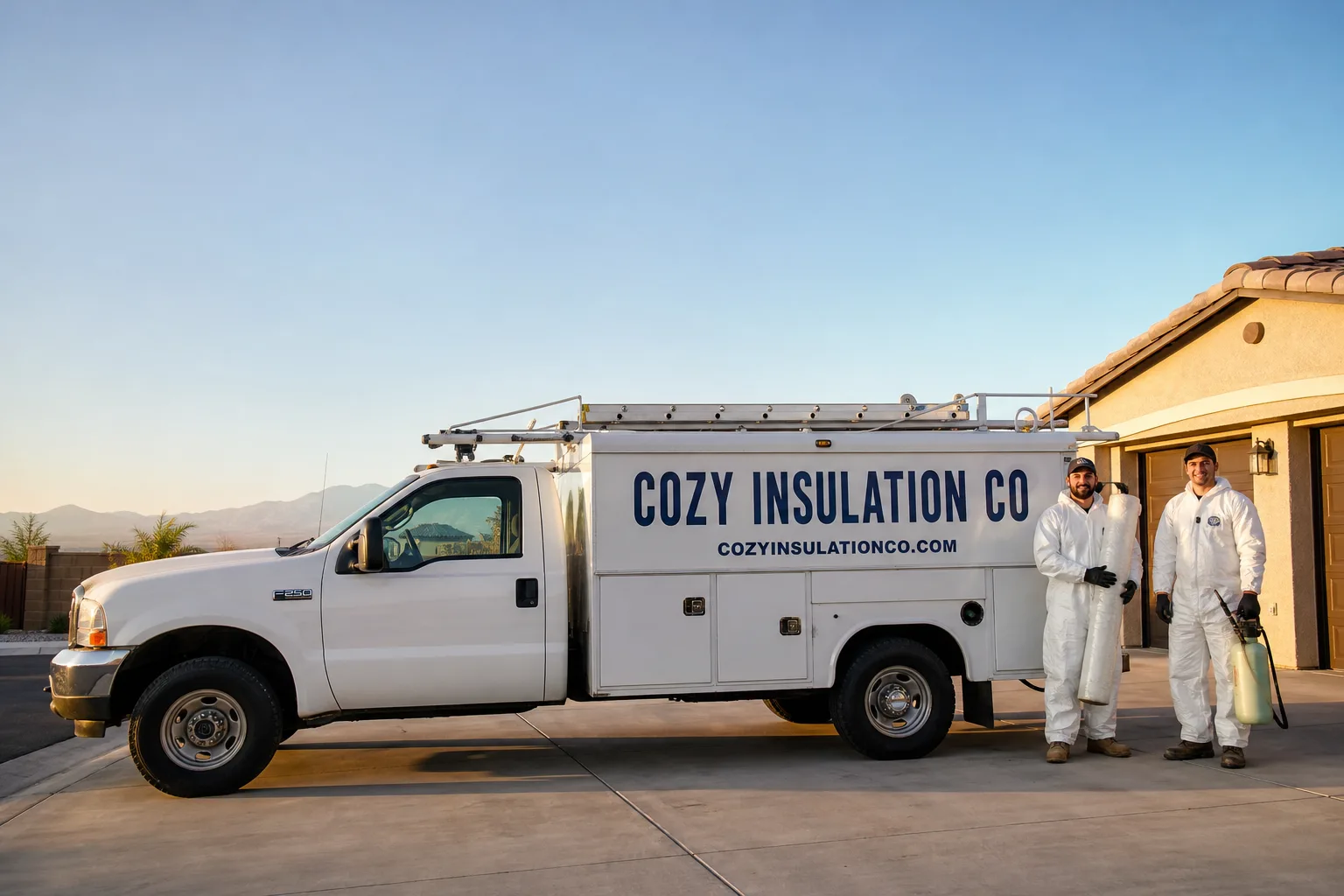
Fast, Reliable Spray Foam Insulation Across Shadow Hills
Spray foam insulation in Shadow Hills typically costs $2,800 to $7,500 for a full wall retrofit and $900 to $2,600 for rim joists, with most jobs completed in one or two days. We get out to 91040 homes quickly and we know the terrain: large-lot ranches off Sunland Boulevard, horse properties along La Tuna Canyon, custom builds tucked up against the Verdugo foothills. The heat here is not a theory. It pours through attic sheathing and unsealed rim joists, and if your 1960s ranch still has its original open-cell foam, there’s a good chance it has pulled away from the framing and stopped doing its job. Call us at (855) 382-3925 and we’ll schedule a probe-first assessment of your whole envelope, not just the wall you called about.
Why Cozy Insulation Co Is Shadow Hills’s Preferred Spray Foam Insulation Company
Shadow Hills is different from the tract neighborhoods down in Sun Valley or over in Burbank. Mike Callahan built Cozy Insulation Co around the idea that the right insulation matches the structure, not the other way around. On large-lot custom homes here, that means probing each assembly before we spray. A 1962 ranch off Wheatland Avenue and a 2010 custom build on a hillside lot need different approaches, and we bring eight brands to the table so we’re never forcing one product into a house it doesn’t fit.
Our repeat work in Shadow Hills comes mostly from neighbors who watched us insulate a barn, a tack room, or a guest structure and then asked us to come handle the main house. That’s the kind of trust you build by showing up with Icynene and Demilec kits, not commodity fiberglass batts, and by treating a horse property’s outbuildings as seriously as the residence. We do not subcontract spray foam work. The crew that arrives is ours, and we have been on enough Shadow Hills parcels to know the drill: park clear of the horse trailer, keep the gate closed, and spray before the valley heats up past 95.
Spray Foam Wall Insulation in Shadow Hills
Spray foam wall insulation in Shadow Hills usually means re-foaming a 1950s or 1960s ranch whose original open-cell has pulled back from the top plate after decades of inland-valley heat cycling. When that happens, you get a hidden convection channel behind the drywall: warm air rising from the living space, slipping past the gap, and hitting the attic. The wall still looks insulated if you shine a flashlight in there, but the thermal envelope is gone. We find this on a significant share of the mid-century ranches we inspect in 91040.
Probe-First Diagnosis
We do not spray without opening a few probe holes first. In Shadow Hills, where home construction varies from stick-framed 2×4 ranches to steel-beam customs, you cannot assume the cavity depth or the sheathing condition. A thermal camera scan plus a few borescope checks tells us whether we’re closing a simple cavity or rebuilding a failed assembly.
Open-Cell vs. Closed-Cell for Valley Heat
Most Shadow Hills wall retrofits lean toward closed-cell spray foam because it adds structural rigidity and acts as a vapor retarder, which matters when daytime highs hit the 100s and nights drop into the 50s. Open-cell still has its place in interior partition walls and sound-dampening applications, but for exterior wall cavities on these older ranch homes, closed-cell from Demilec or Icynene is the workhorse. A typical wall retrofit in Shadow Hills runs $3,200 to $6,800 depending on cavity depth and accessibility.
Rim Joist Spray Foam in Shadow Hills
Rim joist spray foam in Shadow Hills is the highest-value single upgrade for homes with crawl spaces or basements, and it is one of the most common jobs we do on the older ranches and owner-built additions scattered throughout 91040. The rim joist is where the floor framing meets the foundation wall, and on many Shadow Hills homes the band is doubled, notched, or set at a non-standard depth. A one-pass spray leaves gaps at the sill, and ember-driven wind from the surrounding hills finds those gaps. We expect irregular framing here and we probe before we spray, not after.
Why the Rim Joist Matters Here
Shadow Hills sits in a hot, dry inland valley with cool winter nights, and the rim joist is a direct conduit for both heat gain and rodent entry. When we seal it with closed-cell foam, we’re cutting off a stack effect that pulls hot attic air down through wall cavities and cold crawl space air up through the floor in winter. Homeowners notice it most in rooms over a crawl space that never seem to hold temperature.
Costs and What to Expect
A rim joist spray foam job on a typical Shadow Hills ranch runs $1,100 to $2,900, depending on linear footage and how much of the band is accessible. On homes with owner-built additions, expect the unexpected: we have found doubled bands, notch-cut joists, and sill plates that were never sealed at all. We quote after we probe, not from a per-square-foot chart. Most rim joist jobs finish in a single day.
Trusted Brands We Service in Shadow Hills
We service and install spray foam systems from Icynene and Demilec, plus we maintain a working knowledge of CertainTeed and GreenFiber for complementary applications like exterior rigid foam and cellulose in tricky retrofits. That matters in Shadow Hills because a detached barn or tack room often needs a different material than the main house, and we pull from a roster rather than pushing a single canister. We keep parts and consumables stocked for both Icynene and Demilec kits, so a warranty call or a follow-up batch does not sit waiting on a distributor three days out. If we foamed it, we can service it, and we can usually get back to a 91040 address within a couple of days.
Common Spray Foam Insulation Problems We See in Shadow Hills Homes
- Sagged open-cell in mid-century ranch walls. Decades of valley heat cycling break the bond between original foam and the top plate, leaving a channel that reads as insulated but isn’t. Probe holes reveal the gap every time.
- Delaminated foam in barns and tack rooms. Outbuildings here were rarely built to house spec, and foam sprayed onto dusty, unsealed board sheathing peels away within seasons. Prep is the whole job on these structures.
- Gapped rim joists in owner-built additions. Non-standard joist depths and doubled bands mean a single-pass spray leaves ember entry points at the sill. We see this on additions built in the 1970s and 1980s across Shadow Hills.
- Undersized foam for wildfire ember exposure. Homes up against the Verdugo foothills need ignition-resistant assemblies, and standard open-cell does not cut it at sill plates and eave lines where embers accumulate.
Pricing for Spray Foam Insulation in Shadow Hills, CA
Spray foam wall insulation in Shadow Hills runs $2,800 to $7,500 for a full retrofit, rim joists $900 to $2,600, and a detached barn or tack room ceiling deck $1,800 to $4,400. Closed-cell runs about 30 to 45 percent more than open-cell per board foot, but on exterior walls and rim joists in this valley climate, it is usually the right call. What moves your number: cavity depth, framing irregularities, how many structures we’re doing in one visit, and how much prep the sheathing needs. We give free estimates and we honor our written quote. Call (855) 382-3925 and we’ll come probe your assemblies before we put a number in front of you.
We Also Serve Cities Near Shadow Hills
Our crews cover Shadow Hills and the surrounding foothill communities, including Sunland, Tujunga, La Crescenta-Montrose, and Burbank. If you’re in one of those areas and need Spray Foam Insulation work, we can schedule a walkthrough the same week. For Shadow Hills itself, we treat every job as a whole-envelope project, house plus outbuildings. Learn more about our Spray Foam Insulation in Shadow Hills service area or call us directly.
Serving Shadow Hills, CA — Our Local Coverage Area
We’re based in the Shadow Hills area and know this community well. Use the map below to see our service coverage — if you’re nearby, we can almost certainly help.
FAQs About Spray Foam Insulation in Shadow Hills
Yes. Most Shadow Hills jobs are multi-structure, and we routinely foam a ranch house plus a detached barn, tack room, or guest structure on the same trip. We stage the work so the outbuilding is prepped first, then we carry the same kit across the property. Call (855) 382-3925 and tell us what structures you have; we’ll schedule enough time to do all of them.
In most cases, yes. Original open-cell from the 1960s has usually pulled away from the top plate after decades of heat cycling, and a visual check misses the hidden convection channel. We probe before we recommend anything, and we’ll show you exactly what the cavity looks like. Call us for a free assessment; if the old foam is still bonded and performing, we’ll tell you that too.
Both, but dust control depends on proper prep. Foam sprayed onto dusty, unsealed board sheathing delaminates and fails to stop valley dust. We prep every surface, seal the ceiling deck, and close the gaps where dust and embers enter. For a tack room or barn in the hills, the difference is immediate: less dust on tack, more stable temps for animals.
Yes. Homes in the Shadow Hills foothills need ignition-resistant assemblies, especially at sill plates, eave lines, and rim joists where embers accumulate during wind events. Closed-cell spray foam from Demilec or Icynene performs far better in those assemblies than open-cell. We match the foam to the fire-exposure zone, not just the R-value chart.
Repair makes sense when the failure is localized: a sagged section, a gapped rim joist, one wall that reads cold. Re-spray is the better call when the original foam has failed across most of the envelope, which we see frequently on ranches built before 1980. We’ll probe, show you the findings, and give you both options with honest pricing. Estimates are free.
Written by Mike Callahan, Owner at Cozy Insulation Co, serving Shadow Hills and the surrounding foothill communities.