
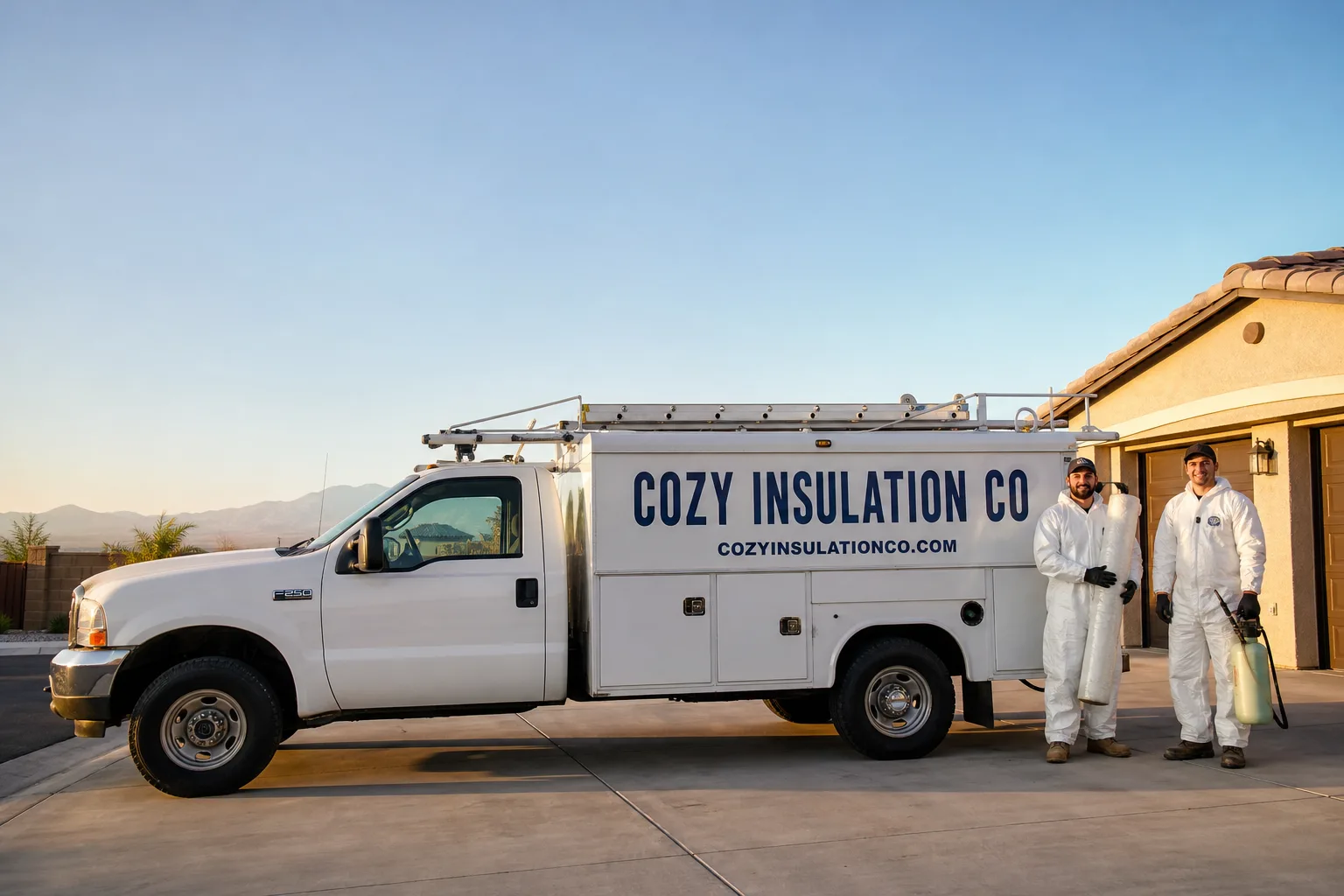
Fast, Reliable Spray Foam Insulation Across Lakeview
Spray foam insulation in Lakeview typically runs $1.80 to $4.40 per board foot installed, with a full attic air-seal and roof-deck application on a typical ranch home landing between $4,800 and $9,600. We get to Lakeview fast, usually within one business day for estimates, because our crews know every back road from Cajalco to the Perris line. The real enemy here isn’t winter cold. It’s the 140°F attic heat that cooks your roof deck from June through September. Call Mike Callahan at (855) 382-3925 and we’ll schedule a free attic inspection while the weather’s still telling you exactly where your insulation is failing.
Why Cozy Insulation Co Is Lakeview’s Preferred Spray Foam Insulation Company
Lakeview homeowners don’t want a sales pitch. They want someone who understands that a ranch on a half-acre lot near the San Jacinto wildlife area heats differently than a house in Perris, and that a detached workshop with a metal roof needs a different foam strategy than a manufactured home’s cathedral ceiling. That’s the work we do every week in 92567.
We’ve built our reputation in Lakeview by showing up when we say we will, inspecting the whole attic or shop before quoting a single number, and never selling foam over degraded batts to save time. Our customers here tend to be hands-on people. They ask good questions about thermal bridging and cure times. We answer them straight, and we leave the job site with the top plates sealed, the eave baffles clear, and the attic temperature on its way down. When we’re finished in Lakeview, we’re usually back within the week to check the work, because a foam job in this heat either works or it shows within days.
We’re insulated, authorized for Demilec and Icynene systems, and we carry manufacturer warranties on every application. Call (855) 382-3925 and you’ll get Mike or our lead estimator on the line, not a call center.
Spray Foam Insulation Contractors in Lakeview
Spray foam insulation contractors in Lakeview do the heaviest lifting in this climate: removing heat-degraded batts, air-sealing every top plate and penetration, and applying closed-cell foam directly to the underside of the roof deck so the radiant heat never enters the conditioned space. On a typical Lakeview ranch, that’s a two-day job: day one for prep and removal, day two for the spray application and trim.
This is not a task for a handyman with a DIY kit. Closed-cell foam requires calibrated equipment, a respirator protocol, and an installer who understands how different roof geometries affect expansion rates. We run Demilec and Icynene rigs calibrated weekly. If a Lakeview homeowner needs foam on a detached shop, a garage ceiling, or a rim joist in a crawlspace, we handle that in the same trip. Foam work on irregular framing, which is common in the area’s older site-built homes, also requires trimming and shaping skill that only comes from repeated local jobs.
Rim Joist and Garage Ceiling Applications
Rim joists in Lakeview’s older homes leak air at the mudsill, especially where the house meets a stem wall or pier foundation. A bead of closed-cell foam along the rim joist stops that air movement and blocks the dust and ants that follow it. Garage ceilings get a thinner, open-cell application when the garage is attached and not conditioned, just enough to stop the ceiling from radiating heat into the rooms above.
Detached Workshop and Shop Foam
Lakeview is one of the few places in western Riverside where detached shops and outbuildings are as common as the homes themselves. We foam metal and wood-framed shops alike, usually with two inches of closed-cell foam on the underside of the roof deck. That’s the difference between a shop that’s 100°F inside by noon and one that stays workable into the afternoon.
Spray Foam Attic Insulation in Lakeview
Spray foam attic insulation in Lakeview is the single most effective upgrade you can make to a ranch or manufactured home here, and the math is simple: if your attic is hitting 140°F and your ceiling drywall is 90°F, your AC is fighting a losing battle. Closed-cell foam applied to the underside of the roof deck turns the attic into a semi-conditioned space. The roof deck might still be hot to the touch on the outside, but the heat stops there.
Most Lakeview attic foam jobs we do start with removal. The old fiberglass, usually original R-11 batts that have settled or been blown back from the eaves, gets bagged and removed. Then we air-seal the top plates, can lights, plumbing stacks, and electrical penetrations. Then we apply the foam. For roof decks in Lakeview’s ranches, we recommend a minimum of two inches of closed-cell foam. That gets you to R-13 or better and, more importantly, stops the radiant heat transfer that fiberglass can’t.
In manufactured homes, the attic cavity is shallower and the roof deck is often plywood on 2×4 or even 2×3 rafters. Foam still works there, but it has to be applied in thinner passes to avoid over-expansion. Our crews know the difference, and they’ve done enough Lakeview mobile homes to know which side of the home gets the worst afternoon sun.
Air Sealing Before Foam
Foam works best as an air barrier and a thermal barrier at the same time. That only happens if the air-sealing comes first. We won’t spray foam over gaps in the top plates or around old can lights. The seal has to be complete or the foam is just an expensive hat.
Open-Cell vs. Closed-Cell in Lakeview Attics
Open-cell foam is cheaper per board foot and works well for interior walls and sound control, but in a Lakeview attic we almost always recommend closed-cell. It has a higher R-value per inch, it adds structural rigidity to the roof deck, and it blocks moisture vapor more effectively. In the high heat of a 92567 summer, closed-cell is the material that holds up year after year.
Trusted Brands We Service in Lakeview
We’re authorized installers for Demilec and Icynene spray foam systems, which means the manufacturer’s technical team backs our work with ongoing support and inspection protocols. For Lakeview customers who want a hybrid approach, like closed-cell foam on the roof deck and GreenFiber cellulose blown into wall cavities, we carry that too. We keep our trucks stocked with the materials most Lakeview jobs require, so a trip to the supply yard doesn’t add a day to your project. Fast turnaround matters here. When your attic is 140°F, nobody wants to wait a week for a truck to show up.
Common Spray Foam Insulation Problems We See in Lakeview Homes
- Foam sprayed over degraded batts. On a ranch off Grand Avenue, we found original R-11 batts compressed to R-5 and blown back from the eaves, leaving the top plates bare. Foaming over that would have trapped old dust and failed to seal the air gaps. We removed it all first.
- Inadequate roof-deck thickness in detached shops. One inch of open-cell foam on a metal shop roof lets radiant heat push the attic past 130°F by mid-afternoon. Two inches of closed-cell is the minimum we install in Lakeview’s outbuildings.
- Unsealed penetrations in manufactured homes. Hot attic air bypasses foam through gaps around roof vents, skylight frames, and plumbing stacks. The foam looks fine from below, but the thermal break is defeated. We air-seal every penetration before spraying.
- Foam pulling away from eaves. Lakeview’s extreme heat cycles cause thermal expansion and contraction. Poorly applied foam can separate from the roof deck at the eave line. Proper application temperature and thickness prevent this, which is why we don’t spray foam on days over 95°F unless the substrate is cooled.
Pricing for Spray Foam Insulation in Lakeview, CA
Closed-cell spray foam in Lakeview typically runs $2.10 to $3.80 per board foot, depending on thickness and accessibility. Open-cell runs $1.10 to $1.90 per board foot. A standard attic on a 1,800-square-foot ranch house, including removal of old batts, air sealing, and two inches of closed-cell on the roof deck, will land between $5,200 and $8,400. Detached shops run $1,700 to $4,200 depending on roof area and profile. We quote every job after a free inspection so you know the exact figure before we start. No surprises in the contract. Call (855) 382-3925 and we’ll walk the attic with you, take the measurements, and give you a number that stands.
We Also Serve Cities Near Lakeview
Our Spray Foam Insulation crews cover Lakeview and the surrounding foothills daily. We also serve Spray Foam Insulation in Lakeview‘s neighboring communities, including Nuevo, Romoland, Good Hope, and Perris. If you live on a rural lot or in a manufactured home community between Cajalco and Mapes Road, we’re already working in your area.
Serving Lakeview, CA — Our Local Coverage Area
We’re based in the Lakeview area and know this community well. Use the map below to see our service coverage — if you’re nearby, we can almost certainly help.
FAQs About Spray Foam Insulation in Lakeview
Spray foam makes more sense than blown-in because Lakeview’s attics reach 140°F or higher in summer, and blown-in fiberglass or cellulose can’t stop radiant heat transfer the way closed-cell foam can. Blown-in insulation slows conduction but still lets the roof deck heat the attic air. Closed-cell foam reflects and blocks that heat at the surface. If you’re tired of an upstairs that’s 10 degrees hotter than the living room, foam is the answer. Call (855) 382-3925 for a free attic temperature check.
Yes, we spray foam detached workshops in Lakeview regularly. Most of the shops we do are wood-framed or metal buildings between 400 and 1,200 square feet. We apply two inches of closed-cell foam to the underside of the roof deck, which cuts the interior temperature dramatically and keeps the space usable through the afternoon. The job usually takes one day. Call (855) 382-3925 and mention your shop dimensions for a rough quote.
Spray foam handles Lakeview’s diurnal swings well because closed-cell foam is a continuous, monolithic layer that doesn’t settle, shift, or shrink. The same foam that blocks the 100°F daytime heat holds warmth in during a 38°F winter night. The key is proper thickness and coverage. Our two-inch roof-deck application in 92567 keeps interior temperatures more stable through both extremes, which is exactly what a rural property needs when the power goes out and the house has to hold its temperature.
Yes, spray foam helps, but the old batts need to come out first. Original R-11 batts in a manufactured home from the 1980s are often compressed or heat-degraded to R-5 or worse. We remove them, air-seal the top plates and penetrations, then apply a thinner pass of closed-cell foam suited to the shallower attic cavity. The result is a much cooler home in summer and a tighter envelope in winter. Call (855) 382-3925 to schedule an attic inspection.
In Lakeview’s climate, closed-cell spray foam typically cures to touch within 20 to 30 minutes and reaches full structural strength within 24 hours. We recommend keeping windows open and staying out of the home for 24 hours after application so the off-gassing clears. In the summer heat, cure times are actually faster, which is one of the few advantages of working in this climate. We’ll give you the exact re-entry time before we start the job.
Call Cozy Insulation Co for Spray Foam in Lakeview
If your Lakeview attic is hot enough to cook an egg, your insulation is telling you something. We install the right material for this climate, remove the junk that’s been up there since the 1980s, and seal the house so it finally holds its temperature. Mike Callahan and the Cozy Insulation Co crew are a local call away at (855) 382-3925. Free estimates, same-week scheduling for most Lakeview jobs, and work we stand behind. Call now before the first heat wave hits.
Written by Mike Callahan, Owner of Cozy Insulation Co, serving Lakeview and the surrounding Riverside County communities.