
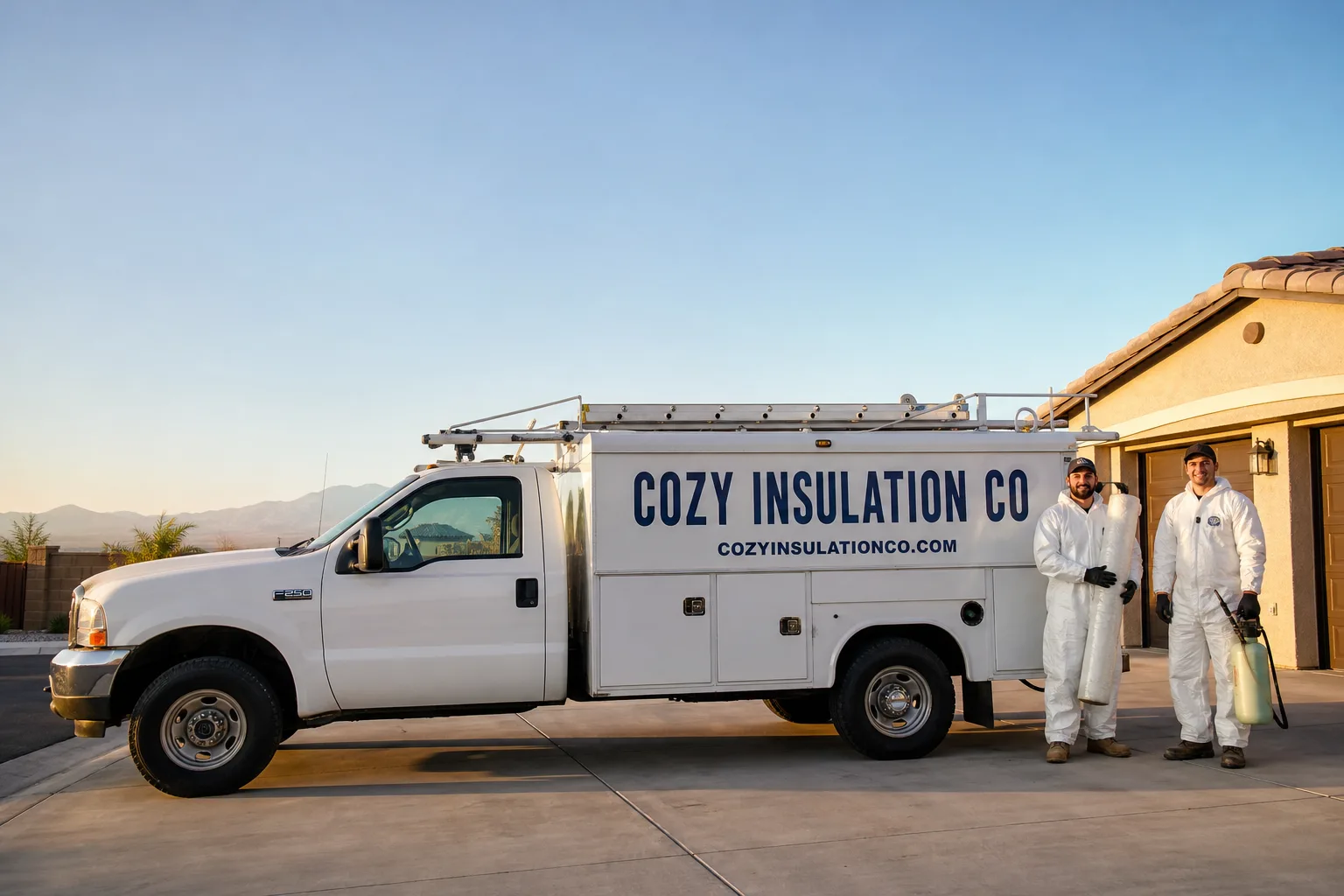
Fast, Reliable Spray Foam Insulation Across Crestline
If your Crestline cabin fights you every winter and bakes you every summer, the culprit is usually what’s hiding in the walls and attic: decades-old insulation, or none at all. Spray foam insulation in Crestline is the fastest way to fix drafty rooms, ice-cold mornings, and energy bills that climb every time the temperature drops below freezing. Our crews know Lake Gregory Drive, the cabins along Crest Forest Drive, and the winding side streets of the 92325 zip code. We’ll get to your home fast, assess what’s going on, and give you a straight answer on whether spray foam is the right fix. Call us at (855) 382-3925 and we’ll set up a time to walk your property.
Key Takeaways:
- Crestline’s 1920s-1970s cabins often have zero insulation and knob-and-tube wiring that must be inspected before foam goes in.
- Spray foam handles both Crestline extremes: sub-freezing snowy winters and 90°F summer afternoons at 4,500 feet.
- We install Icynene and Demilec open- and closed-cell systems, not just commodity fiberglass.
- Free estimates, straight pricing, and a crew that actually knows mountain homes.
Why Cozy Insulation Co Is Crestline’s Preferred Spray Foam Insulation Company
Crestline calls are our regular work. This isn’t a far-flung service add-on for us. We’ve insulated cabins off Lake Gregory Drive, retrofitted mid-century ranch-style homes near Lake Gregory itself, and crawled through crawlspaces under the narrow lots that hug the ridge. Homeowners here tend to ask the same question: “My house was built in 1947 and I can feel the wind through the walls. What can you actually do?” We answer with specifics, not a sales pitch.
Mike Callahan built Cozy Insulation Co around one idea: match the house to the right material, not the easiest install. That means we’re just as comfortable recommending spray foam for a drafty 1960s cabin as we are suggesting Rockwool or GreenFiber cellulose when that’s the smarter play. You get options. Eight trusted brands, one company. When you see how our crews handle the odd framing and piecemeal additions common in Crestline, you’ll understand why we keep getting called back.
Spray Foam Insulation is a core part of what we do, and Crestline is a core part of where we do it. We know the mountain roads, the seasonal timing, and the building quirks. That means we show up prepared.
Spray Foam Attic Insulation in Crestline
Spray Foam Attic Insulation in Crestline is the single best move for most older cabins, because attics here are the main leak point for heat loss in winter and heat gain in summer. We see attics with irregular framing from decades of piecemeal additions, gaps at the eaves, and original 2×4 construction that never held insulation well. Applying closed-cell spray foam directly to the underside of the roof deck seals those gaps and creates an air barrier that keeps snowmelt moisture out and conditioned air in. In Crestline, a typical attic spray foam job runs $3,200 to $6,800 depending on square footage, roof pitch, and how much prep work the old framing needs.
Sealing Irregular Attic Framing
Older Crestline cabins rarely have clean, uniform framing. Attics often have odd angles, dormers added in a 1970s remodel, and gaps where the original roof meets an addition. Spray foam expands to fill those irregular cavities in a way no batt ever could. If your attic has daylight visible at the eaves, foam is probably the right call.
Moisture and Snowmelt Protection
At 4,500 feet, Crestline sees real snowfall, and snowmelt finds its way into attics through unsealed gaps and poorly vented roofs. Closed-cell foam acts as a secondary moisture barrier, reducing the odds of damp insulation and the rot that follows. We never skip a moisture check before spraying.
Spray Foam Wall Insulation in Crestline
Spray Foam Wall Insulation in Crestline is where mountain homes reveal their biggest weakness. Many of these cabins were built with 2×4 walls and zero insulation, which means summer heat and winter cold pass straight through. Open-cell foam works well for interior wall cavities where sound control matters too, while closed-cell delivers higher R-value per inch for exterior walls, rim joists, and anywhere moisture is a concern. Wall retrofit jobs in Crestline typically run $2,800 to $5,500 for a single-story cabin, and up from there for larger or multi-level homes.
The Knob-and-Tube Reality Check
Before any foam touches a Crestline wall, we check for knob-and-tube wiring. Homes built before the 1950s often still have it, and spraying foam over live knob-and-tube creates a genuine fire hazard and fails inspection. If we find it, the wiring gets replaced first, then we foam. That step is easy to skip in flatland homes, but it’s the first thing we look for up here.
Reinsulating Walls Without Gutting Your Cabin
You don’t always need to strip walls to studs. We can drill and inject spray foam into closed wall cavities from the exterior or interior, minimizing disruption to your finished space. For a vintage Crestline cabin with original paneling you want to keep, this is often the most practical route.
Trusted Brands We Service in Crestline
We’re authorized to install spray foam systems from Icynene and Demilec, two of the most performance-tested names in the professional spray foam industry. That matters in Crestline, where a homeowner’s priorities run toward fire resistance, moisture performance, and long-term durability. Beyond foam, our roster includes CertainTeed, Owens Corning, Johns Manville, Knauf, Rockwool, and GreenFiber, so you get a genuine recommendation across categories, not a default pitch. We keep common materials and accessories stocked for fast turnaround on Crestline jobs, including retrofit scenarios where old framing needs prep before the foam goes in. For homes where fire-resistant options are a priority due to Crestline’s wildfire exposure, Rockwool mineral wool is a strong alternative to pair with or choose instead of foam.
Common Spray Foam Insulation Problems We See in Crestline Homes
- Foam over live knob-and-tube wiring. Original wiring from the 1920s-1940s is still common in Crestline cabins, and spraying foam directly over live K&T is a fire hazard that will fail inspection. We recommend a licensed electrical check before any foam retrofit.
- Foam against unsealed, moisture-heavy wood. At 4,500 feet with snowmelt and heavy rain seasons, siding and framing can hold more moisture than expected. Spraying closed-cell foam over damp wood traps that moisture and accelerates rot.
- Attic work that ignores piecemeal additions. Older cabins got added onto over the decades, and those addition seams are where air leaks concentrate. If foam is applied without sealing those transition gaps first, condensation forms and performance drops.
- Ignoring Pier-and-beam foundation leaks. Many Crestline homes sit on pier-and-beam foundations rather than slabs. Cold air rises through uninsulated floors, so if we only foam the attic and walls, the living space still feels drafty. Rim joist spray foam closes that gap.
Pricing for Spray Foam Insulation in Crestline, CA
You deserve real numbers, not “pricing varies.” For Crestline homes, here’s what we see:
- Spray foam attic insulation: $3,200 to $6,800
- Spray foam wall insulation (single-story cabin): $2,800 to $5,500
- Rim joist spray foam: $900 to $2,200
- Garage ceiling spray foam: $1,500 to $3,400
- Spray foam roof deck: $4,000 to $8,500 depending on pitch and deck condition
What moves the number: whether we find knob-and-tube wiring that needs replacement first, how much irregular framing prep the job requires, and whether the attic is finished or raw. Estimates are free, and we give you a written quote before any work starts. Call (855) 382-3925 to schedule a walkthrough.
We Also Serve Cities Near Crestline
Our crews regularly work up and down the 18 and through the mountain communities. Beyond Crestline, we serve Lake Arrowhead, Muscoy, San Bernardino, and Highland. If you’re in any of those areas and dealing with a drafty mountain home or an under-insulated attic, Spray Foam Insulation in Crestline is the kind of work we do every week, and we’ll bring the same approach to your door.
Serving Crestline, CA — Our Local Coverage Area
We’re based in the Crestline area and know this community well. Use the map below to see our service coverage — if you’re nearby, we can almost certainly help.
FAQs About Spray Foam Insulation in Crestline
If your cabin still has original knob-and-tube wiring, yes, it needs to be replaced before spray foam can be safely applied. Spray foam is not safe to install over live K&T wiring; it creates a fire hazard and will fail inspection. We identify this during our initial walkthrough and coordinate with a licensed electrician so the project moves without costly delays. Call us at (855) 382-3925 and we’ll check for you.
Yes, closed-cell spray foam is designed for climates with real temperature swings, including Crestline’s sub-freezing winters and 90°F summer days. It creates a continuous air barrier that reduces drafts in winter and keeps heat from penetrating in summer. We’ve seen it stabilize cabin temperatures through a full Crestline seasonal cycle.
In wildfire-prone areas, closed-cell spray foam can help reduce air infiltration that pulls embers and smoke into the home. It is not fireproof by itself, but pairing it with fire-resistant Rockwool mineral wool in key areas like attic knee walls and rim joists strengthens the home’s overall fire resistance. For Crestline homeowners, we recommend a material mix tailored to your specific fire exposure.
Expect three steps: first, a full inspection for knob-and-tube wiring, unsealed framing, and moisture; second, any necessary electrical or prep work; third, the foam application itself, typically completed in one or two days. Older cabins often have piecemeal additions that require extra attention at the seams, and we schedule around mountain weather so the job doesn’t drag out.
Yes, closed-cell spray foam works well on the rim joists and underside of floors in pier-and-beam homes. It seals the gaps that let cold mountain air rise into the living space, and it’s moisture-resistant, which is important in a foundation type that stays damp. For Crestline cabins on piers, this is often the fastest way to fix cold floors.
Written by Mike Callahan, Owner at Cozy Insulation Co, serving Crestline and the San Bernardino mountains.