
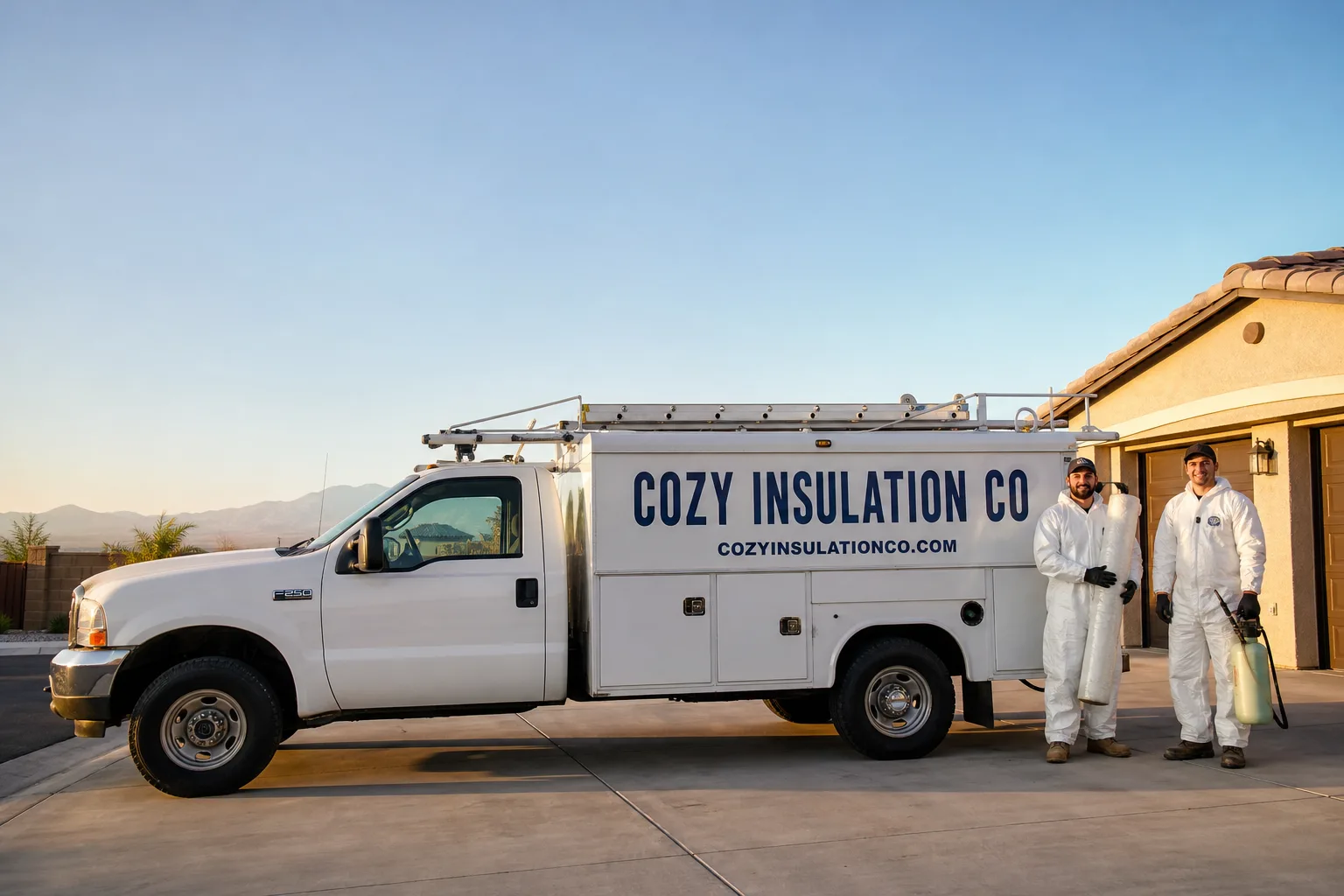
Fast, Reliable Spray Foam Insulation Across Banning
Spray foam insulation in Banning runs $2.10 to $4.80 per board foot installed, with a typical garage ceiling project landing between $1,900 and $3,400 and a full rim joist treatment around $1,100 to $2,600. We get to Banning homes fast – usually within a day or two for standard calls, and our crews know the 92220 zip code well enough to spot wind-related insulation damage before we even climb into the attic. If you’re tired of rooms that bake in August and chill in January, call us at (855) 382-3925 and we’ll tell you exactly what your home needs.
Why Cozy Insulation Co Is Banning’s Preferred Spray Foam Insulation Company
Banning sits in a wind corridor unlike almost anywhere else in Southern California. The San Gorgonio Pass funnels air through town at speeds that shred fiberglass batts and push dust through every unsealed crack. Most insulation companies treat Banning like any other Inland Empire city. We don’t. Every Spray Foam Insulation job we run in Banning starts with air-sealing, because adding foam over a leaky attic is like caulking a screen door.
Our crews know the difference between the mid-century tract homes near downtown, the manufactured homes on the valley floor, and the hillside custom builds off Sunset Avenue. Each needs a different approach. A 1970s wood-frame house with original vents behaves nothing like a newer hillside build that flexes under wind load. That’s why Mike Callahan trains every tech to assess the structure first, then recommend the right Icynene or Demilec system for the job. We don’t sell one product. We solve one problem: a home that won’t hold its temperature.
Banning homeowners call us because neighbors recommended us. Word travels fast in a town this size, and when a garage stays cool through July or a heating bill finally drops, people notice. We’ve built our reputation in Banning one attic at a time, and we answer the phone when you call (855) 382-3925.
Garage Spray Foam Insulation in Banning
Garage Spray Foam Insulation in Banning costs $1,900 to $3,400 for a standard two-car garage ceiling, and it’s one of the highest-impact upgrades we do in this city. Garages here face a double assault: direct sun on the door slab all summer, and wind-driven air exchange through the ceiling and rim joists year-round. An uninsulated garage can push 15 to 20 degrees of heat into the rooms above it, especially in the single-story tract homes common near the 10 freeway.
The job starts with air-sealing the garage ceiling penetrations – light boxes, conduit, plumbing stack vents. Then we apply open-cell foam to the ceiling cavity and closed-cell to the rim joists where the garage wall meets the house. The result is a garage that stops acting like an oven and starts acting like a buffer zone.
Air-Sealing Before Foam
In Banning, skip this step and you’ll pay twice. Wind through the pass pressurizes the garage, and any gap in the ceiling leaks air into the home. We seal first, foam second, every time.
When the Attic Above the Garage Is the Problem
If the ceiling drywall is already in place, we spray foam to the underside of it. If the attic above is accessible and open, we treat the roof deck directly. Two different approaches, same goal: a thermal boundary that holds.
Closed Cell Spray Foam Insulation in Banning
Closed Cell Spray Foam Insulation in Banning typically runs $2.80 to $4.80 per board foot, and it’s the right tool for homes facing the pass winds. Closed-cell foam adds structural rigidity – something mid-century wood-frame homes in Banning genuinely need when the spring winds hit 50 to 60 mph through the San Gorgonio Pass. It also acts as a vapor barrier and a dust barrier, which matters more here than in almost any city we serve.
Our crews use Demilec closed-cell systems on rim joists, roof decks, and knee walls in Banning because the foam’s compressive strength helps the assembly resist flexing under repeated wind load. We’ve also seen how closed-cell foam bridges gaps in older sheathing that would otherwise leak air and dust. For hillside homes west of Sunset Avenue, this is often the single biggest thermal upgrade available.
Rim Joists and the Wind Load Problem
Rim joists in Banning homes flex more than homeowners realize. Every gust pushes and pulls the structure, and an unsealed rim joist is a direct duct for outside air. Closed-cell foam locks those joists in place and seals the band at the same time.
Roof Deck Application for Banning Attics
When an attic is vented, the vents become dust pumps under pass winds. Applying closed-cell foam to the underside of the roof deck – converting the attic to a sealed, unvented assembly – stops that cycle completely. It also keeps the attic 30 to 40 degrees cooler in summer.
Trusted Brands We Service in Banning
We’re authorized to install Icynene and Demilec spray foam systems, and we stock local inventory for Banning’s most common specifications, so we’re not waiting on a warehouse in Riverside when your job is scheduled. Homeowners who want a greener option sometimes ask about GreenFiber blown-in cellulose, and we do that too, though for wind-driven dust conditions in Banning, closed-cell spray foam outperforms nearly everything else. The point is this: we recommend from eight different brands across fiberglass, spray foam, mineral wool, and cellulose. You get the material that fits your home, not the one we happen to sell cheapest.
Common Spray Foam Insulation Problems We See in Banning Homes
- Wind-shredded fiberglass in attic cavities. The San Gorgonio Pass winds push through attic vents and physically displace fiberglass batts. By spring, we routinely find batts shoved against the far wall of the attic, leaving the thermal boundary completely broken.
- Dust-packed vent screens. Banning’s wind-driven dust doesn’t just coat surfaces – it plugs vent screens until they stop passing air. That traps heat in summer and moisture in winter, degrading the entire attic assembly.
- Delaminated spray foam on structural seams. When closed-cell foam is applied over sheathing that flexes under wind load, it can crack or pull away at the seams. The fix is always the same: seal the structure first, then apply foam to a stable surface.
- Garage ceilings that radiate heat into living space. In Banning’s older tract homes, the garage ceiling is frequently the single biggest thermal leak in the house. We see uninsulated garages over 120 degrees in July, pushing heat straight into bedrooms above.
Pricing for Spray Foam Insulation in Banning, CA
Spray foam insulation in Banning costs $2.10 to $4.80 per board foot, depending on foam type and application area. Here’s what that looks like in real numbers for the 92220 area:
- Garage ceiling spray foam: $1,900 to $3,400 for a standard two-car garage.
- Rim joist spray foam: $1,100 to $2,600 for a typical single-story home.
- Roof deck spray foam (sealed attic conversion): $5,000 to $9,500 depending on square footage.
- Whole-attic air-sealing plus spray foam: $3,200 to $7,800 for most Banning homes.
Your total depends on square footage, access difficulty, and whether we need to remove damaged existing insulation first. Estimates are free. Call (855) 382-3925 and we’ll give you an exact number for your home.
We Also Serve Cities Near Banning
Our crews regularly work in Cabazon, Calimesa, Yucaipa, and Valle Vista, so if you’re just outside the Banning city limits, we’re already in your area. Banning is our anchor for the pass region, but the wind problems we solve here show up in every neighboring community. Call (855) 382-3925 to schedule a free estimate anywhere in the 92220 corridor or nearby.
Serving Banning, CA — Our Local Coverage Area
We’re based in the Banning area and know this community well. Use the map below to see our service coverage — if you’re nearby, we can almost certainly help.
FAQs About Spray Foam Insulation in Banning
Air-sealing comes first because the San Gorgonio Pass wind turns every attic vent, electrical penetration, and plumbing chase into a dust pump – adding foam over those leaks just traps the problem inside your thermal boundary. We seal the structure, then apply foam. Call (855) 382-3925 if you’re unsure whether your attic was sealed before a previous insulation job.
Yes. Closed-cell spray foam applied to the attic floor, rim joists, and vent penetrations physically blocks the pathways dust uses to enter your living space, which is why so many Banning homeowners notice less dust indoors within weeks of a proper spray foam job. In homes off Sunset Avenue where we’ve sealed attic floors and roof decks, the indoor dust reduction is usually noticeable before the next wind event.
Closed-cell spray foam is the better choice for most Banning homes because it handles both extreme heat gain in summer and cold nights in winter, and it adds structural stiffness that helps the assembly resist wind flexing through the pass. Open-cell is lighter and cheaper per board foot, but it’s less effective as a dust barrier and adds no structural value. Call (855) 382-3925 and we’ll walk you through which one fits your home and budget.
Most Banning garages don’t need structural reinforcement before spraying foam, but we do inspect the door tracks, panel seams, and ceiling framing before we start, because wind pressure can loosen fasteners over time and we want the foam applied to a stable assembly. If we find a problem, we’ll tell you before we spray, not after.
Closed-cell spray foam holds up well to Banning’s winds when it’s applied to a properly sealed and stable structure – the foam itself is rigid and adheres tightly to sheathing, so flexing is the main risk, and we mitigate that by sealing structural gaps before application. That’s the step generic insulation contractors skip, and it’s why we lead every Banning job with air-sealing. Call (855) 382-3925 for a free inspection and estimate.
Written by Mike Callahan, Owner at Cozy Insulation Co, serving Banning and the San Gorgonio Pass area with spray foam, attic, and blown-in insulation services.