
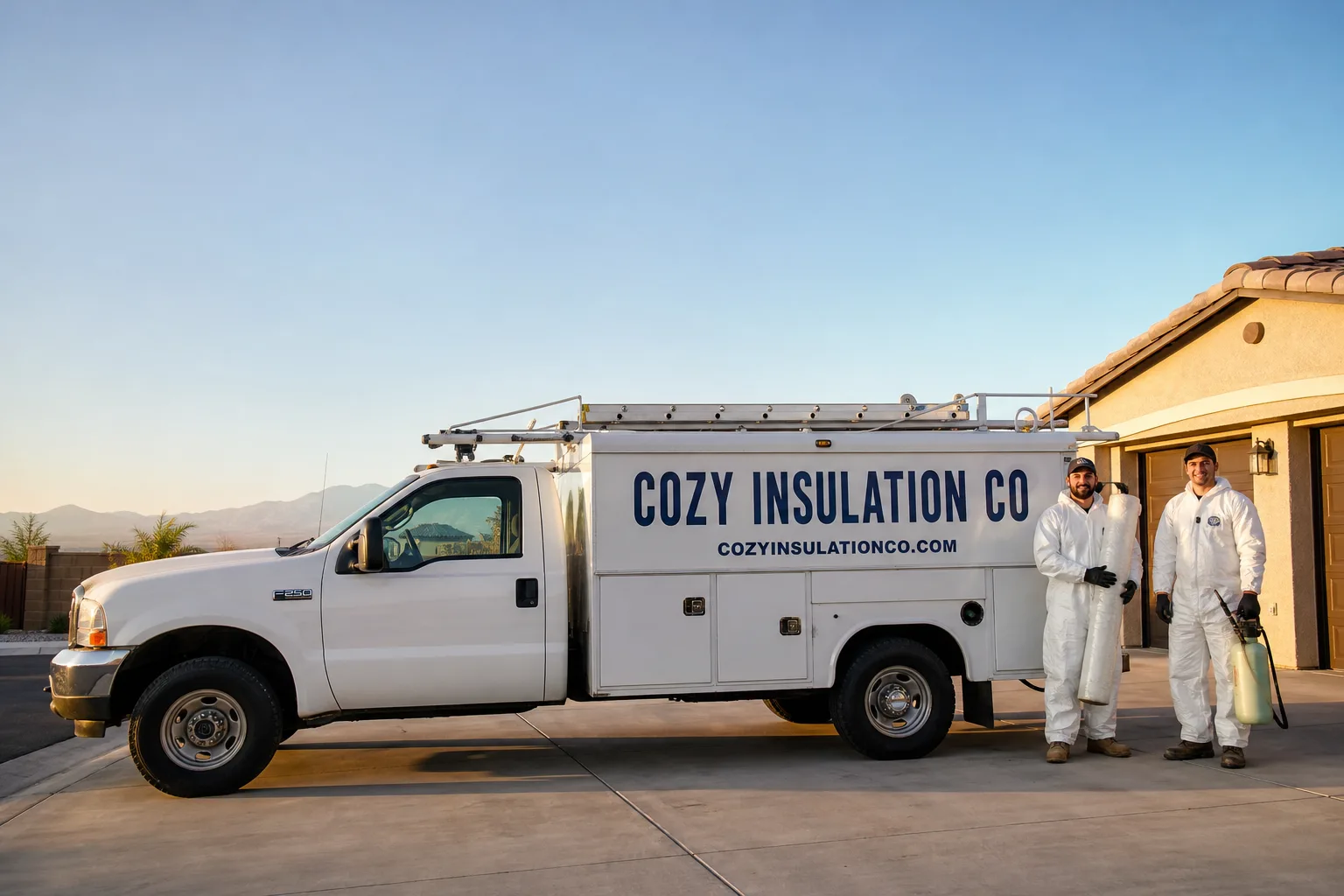
Fast, Reliable Attic Insulation Across Whittier
Attic insulation in Whittier usually costs between $1,800 and $4,900 for a full retrofit, depending on whether we’re topping up existing material, removing old cellulose, or combining new batts with air-sealing and ventilation work. Most Whittier homeowners call us because rooms upstairs run 10 to 15 degrees warmer than the rest of the house, especially in the Uptown and East Whittier flats where 1920s and 1930s bungalows predate modern insulation entirely. We know these houses well. Our crews are in Whittier weekly, and we can typically reach any home in the 90601, 90609, 90610, or 90612 zip codes within a day or two of your call. If your attic feels like an oven by 3 p.m., call (855) 382-3925 and we’ll give you a straight answer about what’s actually going on up there.
What we find in Whittier’s older attics is rarely just “not enough insulation.” It’s a ventilation problem, or blocked eave vents, or knob-and-tube wiring that needs careful handling before anything gets installed. Cozy Insulation Co specializes in attic insulation, spray foam, and blown-in methods, and we match the material to the house, not the other way around. Eight trusted brands, one company. No one-size pitch. Just the right insulation for your home, not just the easiest install.
Why Cozy Insulation Co Is Whittier’s Preferred Attic Insulation Company
Whittier homeowners call us because we take the time to understand how these older homes actually behave. A 1948 Spanish Colonial Revival in Uptown doesn’t perform like a 1960s tract house in East Whittier, and it definitely doesn’t perform like a new build in Santa Fe Springs. The difference matters. When you work with us, you’re getting a company that has walked through enough Whittier attics to know what problems show up before we even climb the ladder. Mike Callahan, our owner, has built Cozy Insulation Co around the idea that the right material and the right prep work matter more than just hitting an R-value number. That’s why we carry fiberglass from Owens Corning and Johns Manville, open- and closed-cell spray foam from Icynene and Demilec, mineral wool from Rockwool, and cellulose from GreenFiber. We’re the Attic Insulation team that gives you options grounded in what your specific house needs.
Response time is a real concern in Whittier, especially when a heat wave hits in August and the attic is making the whole house miserable. We schedule most Whittier estimates within 48 hours, and installation typically follows within a week or two depending on scope. We don’t subcontract any of this work. The same crew that inspects your attic is the crew that installs the material.
Being local to the region means we understand Whittier’s building stock in a way an out-of-area contractor won’t. Plaster walls, balloon-frame construction, unvented attics, original wiring still active in some homes. We’ve seen it all. And we plan for it, instead of being surprised by it halfway through a job. You can read more about how we approach homes across Whittier and the surrounding communities on our local page.
Attic Ventilation in Whittier
Attic Ventilation in Whittier is the single most overlooked part of keeping an older home comfortable, because so many of the attics here were built with eave vents that have spent decades collecting dust, old cellulose, and debris. In a 1920s bungalow in Uptown, the original eave vents are often completely blocked. No airflow means the attic traps heat all afternoon, and that heat radiates down into living spaces long after the sun drops. Proper ventilation, paired with new insulation, is what actually fixes the upstairs rooms that never cool down. We clear the vents, install new baffles where needed, and make sure air moves the way it should before any material goes in.
Clearing blocked eave vents
In homes along Painter Avenue and around the Uptown corridor, the eave vents are frequently packed with decades of accumulated debris. We clear them by hand, then install baffles so future insulation can’t drift over and re-block the airflow. This is a $300 – $700 job on its own, depending on attic size and how many vents need attention.
Adding baffles and ridge airflow
Homes in East Whittier, particularly the single-story tract homes built in the 1950s and 1960s, often have ridge vents but no baffles at the eave line. Without baffles, insulation gets pushed right up against the roof deck and closes off the air channel. We install baffles in each rafter bay and verify the air path from eave to ridge. Expect $400 – $900 total for a full baffle retrofit, including vent clearing.
Radiant Barrier in Whittier
Radiant Barrier in Whittier is one of the highest-impact upgrades you can make for a home that bakes in the inland summer sun. Whittier sits at the base of the Puente Hills with hot, dry summers that routinely hit 95 – 100°F, and the day-night temperature swing means attics absorb enormous heat by afternoon. A radiant barrier stapled to the underside of the roof rafters reflects a large portion of that radiant heat before it ever reaches the attic floor. For an older Whittier home, this works with insulation, not instead of it. The combination of a radiant barrier plus proper attic floor insulation is what finally stabilizes those upstairs bedrooms.
Roof-deck radiant barrier installation
We install reinforced foil radiant barrier directly to the roof rafters, leaving an air gap that’s essential for it to work. In a typical 1,200 – 1,500 square foot Whittier attic, roof-deck radiant barrier runs $1,200 – $2,200. The payback comes in the form of a noticeably cooler attic, which reduces the load on your AC during the hottest July and August weeks.
Radiant barrier with new batts
For many of the older homes in Whittier we see, the best result comes from pairing a radiant barrier with fresh fiberglass batts or spray foam at the attic floor. This addresses both radiant heat from above and conducted heat from the ceiling below. Combined projects in Whittier typically run $3,200 – $5,600, and that includes the air-sealing and vent work we know these houses need.
Trusted Brands We Service in Whittier
We install products from Owens Corning, Icynene, Demilec, and GreenFiber, among others, and we stock common materials locally so your Whittier project doesn’t stall waiting on a warehouse shipment. Owens Corning fiberglass batts are a dependable workhorse for the attic floor, while Icynene and Demilec spray foam systems represent the performance ceiling when you want maximum air-sealing and thermal control. For homeowners who want a recycled-content option, GreenFiber cellulose blown-in is available and performs well in the odd-shaped attics these older homes often have. From blown-in cellulose to closed-cell spray foam, the material matching matters. If a brand isn’t the right fit for your house, we’ll tell you honestly and suggest the one that is.
Common Attic Insulation Problems We See in Whittier Homes
- Blocked eave vents in pre-1950 attics: Most bungalows in Uptown and East Whittier have original eave vents now packed with old cellulose and dust. No venting traps heat and moisture, which degrades insulation performance and can lead to mold along the roofline in Whittier’s cooler, damper canyon evenings.
- Knob-and-tube wiring buried under insulation: Homes built before about 1950 often still have original knob-and-tube circuits in the attic. Blowing insulation over active knob-and-tube is a fire hazard, so we always inspect first, and if needed we’ll recommend an electrician to address the wiring before we proceed with insulation.
- Missing air-sealing at the ceiling plane: Older Whittier homes have dozens of small gaps around ceiling fixtures, interior walls, and plumbing chases that let hot attic air pour into living spaces. Even high-R-value insulation underperforms if the ceiling isn’t sealed first. We seal these gaps as part of every retrofit.
- Original attic insulation that has settled and flattened: Homes from the 1940s and 1950s often have a thin layer of original fiberglass or mineral product that has compacted to a fraction of its original thickness. What’s left provides almost no thermal resistance. A top-up or full removal and replacement is usually the fix.
Pricing for Attic Insulation in Whittier, CA
Here are the ranges we quote most often in Whittier. A blow-in cellulose top-up over existing insulation in a 1,200 square foot home runs $900 – $1,600. Full removal of old, compacted insulation plus new blown-in fiberglass or cellulose typically lands at $2,200 – $4,800. Installing fiberglass batt insulation to R-38 in an empty attic, with vent clearing and air-sealing included, runs $2,800 – $4,900. Spray foam for the roofline or attic floor, using Icynene or Demilec systems, starts around $3,800 and goes up to $8,000+ for full roof-deck encapsulation. Radiant barrier alone typically adds $1,200 – $2,200. Every estimate is free, and we quote a firm price before any work begins. Call (855) 382-3925 to schedule yours.
We Also Serve Cities Near Whittier
Cozy Insulation Co regularly works in South Whittier, West Whittier-Los Nietos, East La Mirada, and Santa Fe Springs. Our crews are based nearby, so scheduling in these communities is usually just as quick as in Whittier proper. If you’re just outside the 90601 or 90609 zip codes, give us a call and we’ll confirm coverage for your street.
Serving Whittier, CA — Our Local Coverage Area
We’re based in the Whittier area and know this community well. Use the map below to see our service coverage — if you’re nearby, we can almost certainly help.
FAQs About Attic Insulation in Whittier
Yes, but not until the wiring is addressed. We never blow insulation over active knob-and-tube circuits, because covering the wiring traps heat and creates a real fire hazard. In most cases we recommend having an electrician evaluate the circuits first, either to disconnect and replace them or to confirm they’re safe to work around. Once the wiring is handled, we can proceed with air-sealing and insulation as normal. Call (855) 382-3925 and we’ll walk you through what to expect.
Because the original vents were never protected with baffles, so blown-in insulation, dust, and debris migrate into them over time. In East Whittier’s 1950s tract homes, this is one of the most common problems we find. We clear the vents, install baffles in every rafter bay, and verify the airflow is actually moving again. It’s a one-time fix that keeps your attic ventilating properly for years.
Yes, and in Whittier specifically it tends to pay off faster than in coastal areas, because our summers are hot and dry with intense afternoon sun. The radiant barrier reflects heat before it gets absorbed into the attic, which keeps the whole house cooler. Paired with proper insulation at the attic floor, it’s one of the most effective upgrades for older Whittier homes.
If your upstairs rooms are consistently 8 – 12 degrees warmer than downstairs in the summer, or if your heating bills spike every January, the insulation is probably underperforming. Visible signs include compacted or flattened material, gaps around ceiling fixtures, and cold spots near walls. We can inspect your attic and tell you definitively what’s going on, usually within 48 hours of your call.
For most Whittier homes, we recommend R-38 to R-49 in the attic floor, depending on the ceiling structure and how much depth you have to work with. The older bungalows with shallow rafter bays can be trickier, which is where spray foam or mineral wool sometimes makes more sense than fiberglass. We’ll look at what your attic can actually accommodate and recommend based on that, not on a generic chart. Call (855) 382-3925 for a free assessment.
We recently worked on a 1948 Spanish Colonial Revival home in Uptown Whittier where the attic had original knob-and-tube wiring and eave vents completely blocked with old cellulose and debris. After carefully air-sealing around the wiring and clearing the vents, we installed Owens Corning R-38 fiberglass batts and added a radiant barrier to combat the intense afternoon heat gain. The homeowner immediately noticed the upstairs rooms stayed cooler during the 95°F summer days.
That’s the kind of result we aim for on every job. A cozy home isn’t luck. It’s the right insulation, installed correctly. If your Whittier attic needs real attention from a company that understands these older houses, call us at (855) 382-3925 for a free, no-pressure estimate. We’ll show you exactly what’s happening up there and what it takes to fix it.
Written by Mike Callahan, Owner at Cozy Insulation Co, serving Whittier and the surrounding communities.