
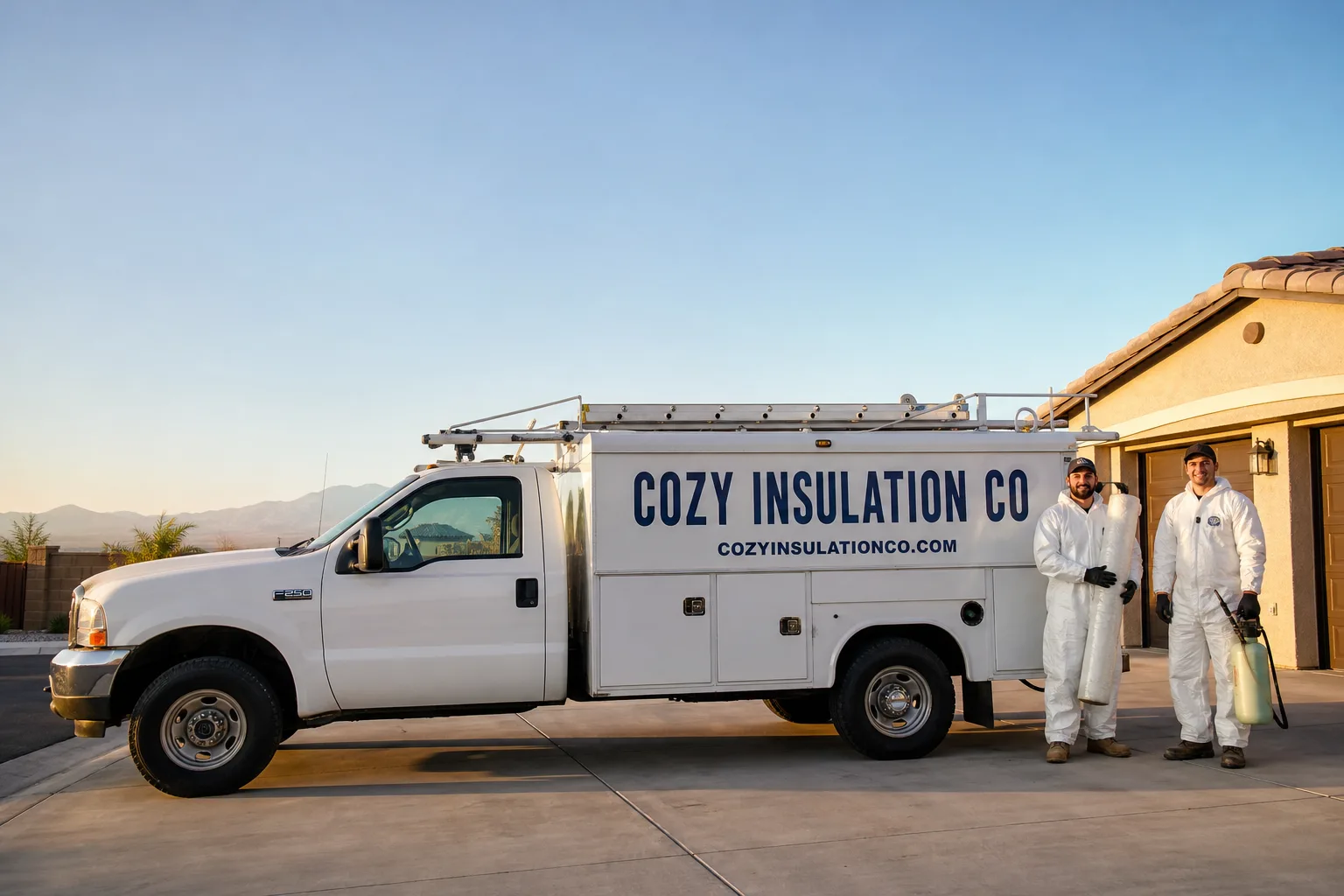
Fast, Reliable Attic Insulation Across Pico Rivera
Attic insulation in Pico Rivera costs between $1,800 and $6,500 for a full attic upgrade, with most mid-century tract homes falling in the $2,200 to $3,800 range depending on square footage and material choice. That’s the honest spread for homes in the 90660, 90661, and 90662 zip codes, where 1950s and 1960s construction dominates and original insulation is often compacted to nothing. We run crews through Pico Rivera daily from our Corona base, and we know these stucco tract homes better than most because we’ve opened hundreds of their attic hatches. Call (855) 382-3925 for a free estimate, and we’ll tell you exactly what’s in your attic before we touch anything.
Most Pico Rivera homeowners call us because rooms are hot in summer, the AC never shuts off, or their ceiling feels warm to the touch at night. Those are the telltale signs of a mid-century attic doing what mid-century attics do in the Los Angeles Basin: soaking up 150°F heat and pushing it down into your living space. We’re the attic insulation team that reads your specific house before recommending a fix, not the other way around.
Why Cozy Insulation Co Is Pico Rivera’s Preferred Attic Insulation Company
We’re not a franchise sending whoever’s available. Mike Callahan built Cozy Insulation Co around one principle: match the house to the right material, not the easiest install. That matters in Pico Rivera, where homes on Burgess Avenue, Gretna Avenue, and down near Smith Park all carry the same mid-century bones but often need very different solutions. Some need blown-in cellulose over old fiberglass. Some need a full radiant barrier and ventilation overhaul. Some have wall cavities with zero insulation and hairline cracks from the Whittier Narrows earthquake letting attic air bleed into bedrooms. We find the source before we touch the material.
Pico Rivera homeowners tell us the same thing: other companies quoted them a single product and pushed to schedule. That’s not how we work. We stock fiberglass from Owens Corning and CertainTeed, spray foam systems from Icynene, mineral wool from Rockwool, and GreenFiber cellulose. Eight trusted brands, one company, and we’ll tell you why one makes sense for your house instead of handing you a brochure with a price tag.
Response time to Pico Rivera is usually next-day for estimates, and same-day or next-day for insulation work depending on scope. We know the permit patterns and the wiring quirks of these 1950s and 1960s tract homes. When we show up, we already know what we’re likely to find before the ladder goes up.
Attic Ventilation in Pico Rivera
Attic Ventilation in Pico Rivera isn’t a bolt-on extra; it’s often the reason your AC bill is so high in the first place. A 1950s or 1960s stucco tract home with a hot attic pushes heat down through the ceiling all summer long, and if the attic can’t breathe, no amount of insulation fully solves the problem. In July and August, attic temperatures here routinely exceed 150°F. Proper ventilation, balanced intake at the eaves and exhaust at the ridge or gable, lets that heat escape instead of cooking your ceiling. Most Pico Rivera homes we inspect were built with either minimal venting or none at all.
A typical attic ventilation upgrade in Pico Rivera runs $850 to $2,200, depending on whether we’re adding soffit vents, a powered attic fan, or a full ridge vent system. The job usually takes one day, and we handle the venting before insulation goes in so you don’t trap heat under a fresh layer of material.
Matching Ventilation to Your Pico Rivera House
A gable-roof tract home near Rivera Park often only needs soffit vents plus a ridge vent to get air moving. A low-slope roof off Telegraph Road may call for a powered vent because passive airflow alone won’t clear a 150°F attic in August. We inspect what’s already there, model the airflow, and add only what the house needs.
Attic Baffles and Intake Vents
Insulation that blocks the eaves can choke ventilation entirely. In Pico Rivera, where many attics were topped up over the years without any thought to airflow, we commonly find batts shoved into the soffit area. We install Attic Baffles during insulation work to keep intake vents clear so your new insulation actually works with the airflow, not against it.
Radiant Barrier in Pico Rivera
A Radiant Barrier in Pico Rivera pushes back against the one thing insulation alone can’t stop: direct radiant heat from a 150°F attic. Standard insulation slows heat transfer through the ceiling. A radiant barrier reflects heat before it ever reaches your living space, which is why it’s the single most effective addition for Pico Rivera’s hot summer months. A radiant barrier typically runs $1,200 to $3,100 installed on a standard mid-century tract home here, depending on attic size and access.
For homes along the 605 corridor, where afternoon sun beats down on unshaded stucco exteriors, the attic becomes a heat battery. A radiant barrier under the roof deck cuts ceiling temperatures noticeably in summer and reduces the strain on your AC. It’s the difference between an attic that radiates heat into your bedrooms at 10 p.m. and one that cools down after sundown.
Radiant Barrier + Insulation: A Pico Rivera Pairing
Radiant barrier doesn’t replace insulation; it works alongside it. We often recommend a radiant barrier plus a fresh layer of blown-in GreenFiber or Rockwool for Pico Rivera homes with original 1960s fiberglass that’s compacted to under an inch. The barrier handles the radiant load, and the insulation handles the conductive load. Together they change how a house holds temperature.
Icynene Spray Foam as a Radiant Alternative
Some Pico Rivera homeowners ask about spray foam instead of a traditional radiant barrier. Closed-cell Icynene spray foam applied to the roof deck acts as an air seal and insulation in one, and it’s especially useful in attics with complex geometry or HVAC equipment in the attic space. It costs more, typically $4,500 to $9,000 for a full roof-deck application in a Pico Rivera tract home, but it creates a conditioned attic that stays nearly at the same temperature as the house.
Trusted Brands We Service in Pico Rivera
We’re authorized to install materials from eight nationally recognized manufacturers, and for Pico Rivera homeowners that means your attic gets the right system rather than whatever happens to be in stock that week. For blown-in work in Pico Rivera, we use GreenFiber cellulose in most retrofit applications because it fills the odd framing cavities these older homes carry and it carries strong recycled-content credentials. For spray foam performance, we run Icynene open- and closed-cell systems on both new and existing attics. And CertainTeed fiberglass remains the workhorse for straightforward batt and roll applications where the framing is standard and ventilation is already correct.
Having multiple brands available means we match material to your home’s construction, not the other way around. When parts or additional materials are needed mid-job, we’re close enough to Pico Rivera that turnaround is hours, not days.
Common Attic Insulation Problems We See in Pico Rivera Homes
- Compacted original attic insulation from 1950s – 1960s tract homes. These houses were built when insulation was an afterthought, and what little was installed has settled to under an inch. The result is a ceiling that radiates heat into your living space on Pico Rivera summer nights.
- Live or abandoned knob-and-tube wiring buried in the attic. Before any new insulation goes in, this wiring must be identified and de-energized by a licensed electrician. Adding insulation on top of active knob-and-tube is a fire hazard, and we flat-out won’t do it.
- Hairline wall cracks from the 1987 Whittier Narrows earthquake. Many Pico Rivera homes developed invisible-to-the-eye cracks in interior walls near the ceiling line. These act as channels that pull hot attic air into rooms even after insulation is installed. Sealing them is part of doing the job right.
- Uninsulated wall cavities. Many of these 1950s stucco homes have zero insulation in the walls, not just the attic. Blown-in wall insulation is frequently the missing piece that makes a house finally hold temperature.
Pricing for Attic Insulation in Pico Rivera, CA
Here’s what you can expect to pay for attic work in Pico Rivera, based on standard mid-century home footprints in the 90660 – 90662 zip codes.
- Attic Insulation Top-Up: $900 – $1,800 for adding blown-in cellulose or fiberglass over existing material.
- Attic Insulation Replacement: $1,800 – $3,800 for removal of old insulation and full re-insulation, depending on attic access and square footage.
- Attic Batt Insulation: $1,500 – $3,200 for new or replacement batt installation in a standard Pico Rivera tract home.
- Radiant Barrier: $1,200 – $3,100 installed under the roof deck.
- Attic Ventilation Upgrade: $850 – $2,200 depending on vent type and roof configuration.
- Spray Foam Roof-Deck Application: $4,500 – $9,000 for full Icynene closed-cell coverage.
These are honest ranges for Pico Rivera’s housing stock. Attic size, access difficulty, the presence of knob-and-tube wiring, and whether we need to pull out old compressed material all move the number. What doesn’t change: we give you the quote before any work starts and we don’t surprise you with add-ons. Call (855) 382-3925 for a free estimate on your Pico Rivera attic.
We Also Serve Cities Near Pico Rivera
Our crews cover Pico Rivera along with the surrounding communities: West Whittier-Los Nietos, Montebello, Santa Fe Springs, and Bell Gardens. If you’re in any of these areas and dealing with the same mid-century attic problems, we’ll bring the same material-matching approach and the same free estimate to your door.
Serving Pico Rivera, CA — Our Local Coverage Area
We’re based in the Pico Rivera area and know this community well. Use the map below to see our service coverage — if you’re nearby, we can almost certainly help.
FAQs About Attic Insulation in Pico Rivera
No, not until the wiring is addressed. Knob-and-tube wiring must be de-energized and signed off by a licensed electrician before any insulation material goes down; adding insulation over active or abandoned knob-and-tube creates a fire hazard. We identify the wiring during our attic inspection, and if we find it, the project pauses until an electrician clears the circuits.
Because your attic is transferring heat into your living space faster than your AC can remove it. Pico Rivera attics regularly exceed 150°F in summer, and when original insulation is compacted to under an inch, that heat radiates straight through the ceiling. Add hairline cracks from the Whittier Narrows earthquake and you get a house that never quite cools down. Fix the attic, and the AC load drops. Call (855) 382-3925 and we’ll show you exactly what’s happening above your ceiling.
A radiant barrier is a reflective layer installed under the roof deck that bounces radiant heat back toward the roof instead of letting it radiate into your attic. In Pico Rivera’s hot, sunny Los Angeles Basin climate, a radiant barrier can significantly reduce ceiling temperatures in summer months, especially on homes with direct sun exposure. It’s most effective when paired with proper ventilation and fresh insulation.
Yes. During an attic insulation job on Pico Rivera homes, we inspect the zone near the ceiling line where those hairline cracks form and seal them so attic air stops pulling into your rooms. On more involved wall-insulation projects, we may also blow insulation into the wall cavities themselves, which addresses the air channel problem at the source.
Most Pico Rivera homes built in the 1950s and 1960s have empty wall cavities, meaning heat enters through walls as much as through the ceiling. If your attic is already insulated and you’re still hot, the walls are likely the reason. We offer blown-in wall insulation for existing stucco tract homes, and in many cases we can do the attic and walls in a single project. Call (855) 382-3925 for a free assessment of both.
On a stucco tract home off Mines Avenue, our crew found the original ceiling insulation compacted to under an inch and attic temps pushing past 150°F. The homeowner didn’t know a run of knob-and-tube wiring was still live up there. We had it de-energized and confirmed clear by a licensed electrician, then blew in GreenFiber and sealed the hairline wall cracks from Whittier Narrows so attic air stopped seeping into the bedrooms. The house now holds its cooled air instead of losing it through the ceiling and the cracks. That’s the job done right: find the source, fix it, and let the materials do their work.
If you’re in Pico Rivera and your attic hasn’t been looked at in a decade, or you’ve never known what’s actually up there, call us at (855) 382-3925 for a free estimate. We’ll show you the condition of your existing insulation, check for wiring issues, and tell you the honest cost to make your house hold temperature. No pressure, no one-size-fits-all pitch. Just a real answer for your Pico Rivera home.
Written by Mike Callahan, Owner at Cozy Insulation Co, serving Pico Rivera with the right attic insulation since day one.