
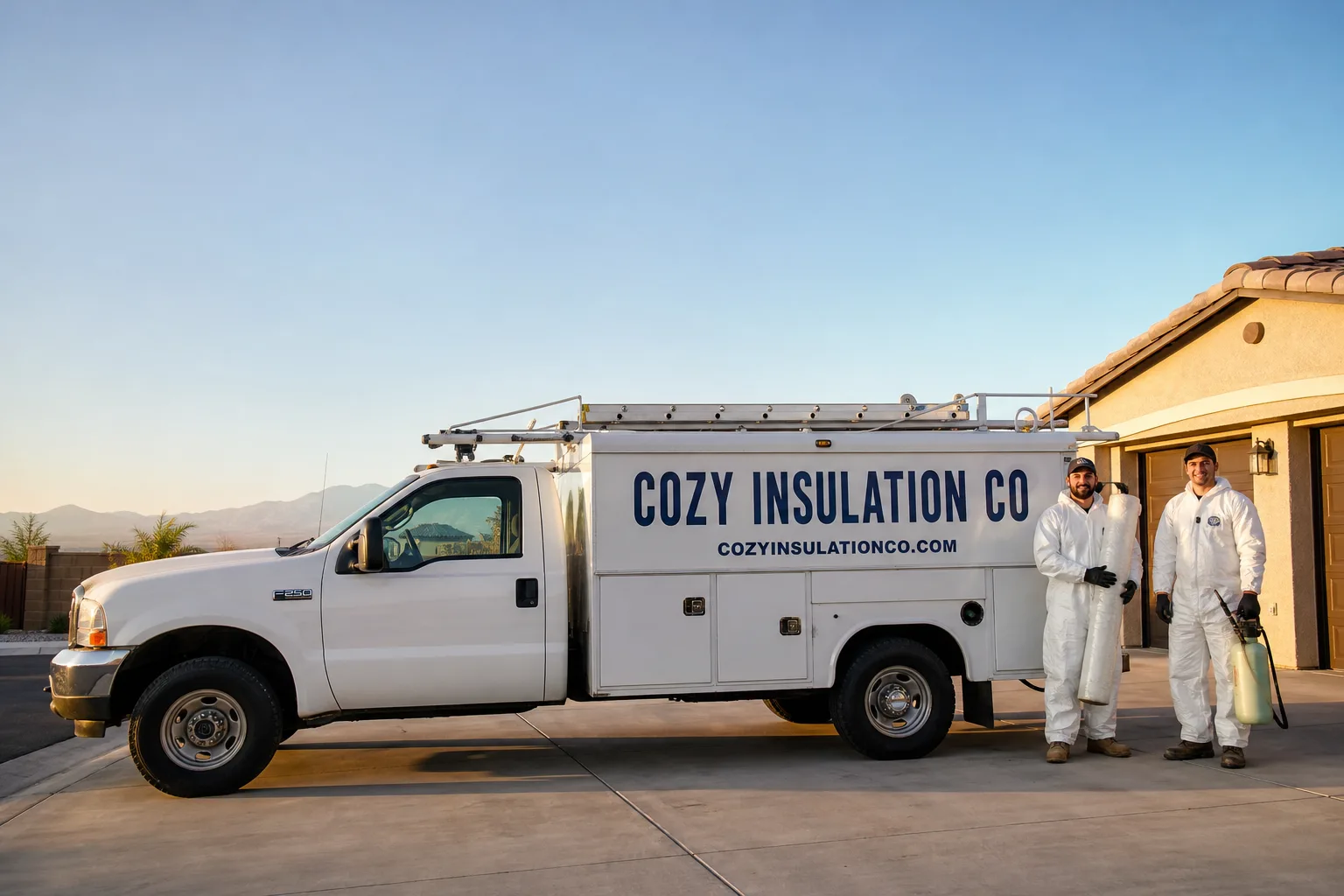
Fast, Reliable Attic Insulation Across Paramount
Attic insulation in Paramount, CA typically runs $1.20 to $2.80 per square foot for batt installation and $1.75 to $3.50 per square foot for spray foam, depending on the material you choose. Our crew knows Paramount’s housing stock well enough to tell you exactly what you’re working with before we quote: settled rock wool from the 1950s, paper-faced batts that have turned to dust, or bare rafters that never saw insulation in the first place. We serve all of Paramount, including the 90723 zip code, and we can usually get a crew out within 48 hours of your call. Call (855) 382-3925 for a free attic assessment.
Key Takeaways
- Paramount’s 1950s-era ranch homes often have compacted rock wool or cellulose that’s lost more than half its original R-value.
- Uninsulated knee walls are common in east-side Paramount homes and act as direct thermal bridges.
- We install fiberglass, spray foam, and blown-in cellulose from Owens Corning, Icynene, Demilec, and GreenFiber.
- Title 24 compliance is strict in Paramount, and we handle all permitting for insulation upgrades.
- Free estimates, same-week scheduling, and manufacturer-backed warranties on select products.
Why Cozy Insulation Co Is Paramount’s Preferred Attic Insulation Company
Homeowners in Paramount call us because we actually understand what’s sitting in their attics. This isn’t a city of new construction. It’s post-war tract homes, most of them built between 1948 and 1962. The insulation those homes got on day one was thin by modern standards, and sixty to seventy years of settling and humidity have made it worse. When we walk through a Paramount house near Garfield Avenue or along the stretch of Alondra Boulevard, we already know what we’re likely to find before we pull the attic ladder down.
Mike Callahan leads every assessment personally. He’s spent years working in South Bay attics and knows the failure patterns specific to this area: compacted rock wool in older east-side homes, moisture-laden batts where the marine layer has soaked through poor ventilation, and knee walls that builders never bothered to insulate at all. Paramount homeowners tell us they appreciate that we don’t show up with a one-material sales pitch. Instead, we match the attic’s condition to the right product: open-cell spray foam from Icynene for tight, irregular cavities, blown-in GreenFiber cellulose for an eco-conscious top-up, or Owens Corning fiberglass batts where budget matters more than peak performance.
We’re not a national chain with a call center in another state. When you call, you reach someone who knows the difference between a home near Paramount High School and one out by the 710 freeway corridor. That matters when you need a fast, accurate quote and a crew that shows up ready to work in tight, low-clearance attics.
Insulation Contractors in Paramount
Insulation contractors in Paramount do more than blow fiberglass into an attic and hand over a bill. The job starts with identifying what’s already up there, because in this city the existing material is usually the problem. A proper contractor crew will assess settled depth, check for moisture intrusion at soffit vents, seal air gaps around plumbing stacks and electrical runs, and then install or top up material to code. Paramount homes need a contractor who understands the dual challenge of marine-layer humidity off the South Bay and summer heat that pushes attic temperatures past 130 degrees. That means insulation is only half the job; ventilation and air sealing matter just as much.
Sub-service focus: Blown-In Attic Insulation
Blown-in fiberglass and cellulose work well in Paramount’s 1950s ranch homes because the attic cavities are often irregular, with low-pitch roofs and tight corners that make batts awkward to install correctly. We use Owens Corning blown-in fiberglass and GreenFiber cellulose depending on your priorities. Blown-in material settles evenly, fills voids around framing, and gives you a consistent R-value across the whole attic floor.
Sub-service focus: Attic Insulation Top-Up
If your Paramount home was built before 1965, your attic likely has R-11 to R-19 worth of coverage, and much of that has compacted to less than half its intended depth. A top-up involves laying new material over the existing insulation to bring it up to R-38 or R-49, depending on your budget and roof configuration. We inspect first to make sure the old material is dry and mold-free before we add anything on top. Adding new insulation over damp, degraded material traps moisture and eventually rots the sheathing. No honest contractor should do that.
Attic Ventilation in Paramount
Attic ventilation in Paramount is not optional. The marine layer rolls in most mornings from the South Bay and drives humidity into any unsealed cavity it can find. Then the afternoon sun burns through and heats the attic like an oven. Without enough airflow through soffit vents, ridge vents, or gable vents, that humidity condenses on insulation and roof framing. The result is reduced R-value, mold growth, and wood rot. An attic ventilation upgrade typically runs $350 to $900 for most Paramount homes, depending on the number and type of vents needed, and it’s usually done alongside insulation work because the two systems have to work together.
Sub-service focus: Attic Baffles & Ventilation Prep
Before any new insulation goes in, we check that every soffit vent has a baffle in place to keep airflow moving from the eaves up to the ridge. Older Paramount homes often have soffit vents that were never baffled, which means insulation gets pushed right up against the vent and blocks the airflow entirely. We install rigid foam or plastic baffles as needed and then blow in insulation to the correct depth without covering the airflow path. This is the part of the job that separates a careful contractor from a crew that just wants to get in and out fast.
On a recent job near the intersection of Paramount Boulevard and 64th Street, our crew opened an attic in a 1953 ranch home to find original rock wool compacted to barely 3 inches and knee walls with no insulation at all. We removed the degraded material, sealed air gaps, and blew in Owens Corning fiberglass to R-38, then installed a radiant barrier to combat the summer heat. The homeowner noted an immediate drop in attic temperature and a quieter second floor.
Trusted Brands We Service in Paramount
We install products from eight nationally recognized manufacturers, and we keep local stock for the brands Paramount homeowners request most. Owens Corning fiberglass and blown-in material are daily staples for us. GreenFiber cellulose gets called up when a customer wants a recycled-content product with good thermal density. And when a Paramount home needs the performance ceiling, we turn to Icynene’s open-cell and closed-cell spray foam systems, which seal air gaps that batts simply can’t touch. Demilec closed-cell foam is another option we offer for attics with moisture sensitivity or space constraints. Eight trusted brands, one company, and we’ll match the material to your home’s actual construction, not whatever is easiest to install.
Common Attic Insulation Problems We See in Paramount Homes
- Settled rock wool and cellulose. Original insulation from the 1950s and 1960s compacts over decades. In east-side Paramount homes, we regularly find rock wool that was once 6 inches deep now sitting at 3 inches or less, leaving large uninsulated zones that let heat escape in winter and pour in during summer.
- Uninsulated knee walls. Many Paramount ranches have knee walls along the roofline that were never insulated when the house was built. These walls create a direct thermal bridge between conditioned space and the attic, causing condensation and moisture buildup that degrades new insulation if left unaddressed.
- Moisture intrusion from the marine layer. Morning cloud cover off the South Bay pushes humidity into wall and attic cavities. Without proper ventilation, insulation absorbs that moisture, loses R-value, and becomes a breeding ground for mold. We see this most often in homes with poor soffit-to-ridge airflow.
- Paper-faced batts that have turned to dust. The original fiberglass batts in Paramount’s post-war tract houses are now sixty to seventy years old. The paper facing crumbles, the fiberglass settles, and the result is an attic that looks insulated but performs like it isn’t. A visual inspection alone doesn’t always catch this; you need to measure depth and check for gaps.
Pricing for Attic Insulation in Paramount, CA
A full attic insulation replacement in Paramount runs $1,800 to $4,200 for a typical 1,000 to 1,500 square foot ranch home. Blown-in fiberglass top-ups cost $900 to $2,100 depending on depth needed and access. Spray foam insulation runs higher, typically $3,200 to $7,500 for an open-cell application across a standard attic, because the material cost and prep work are both greater. Knee wall insulation is a smaller job, usually $450 to $1,100 per knee wall depending on size and accessibility. The biggest variables are the condition of the existing material, whether demolition and removal are needed, and whether ventilation upgrades must be done at the same time. We give free, no-pressure estimates with exact line-item pricing before any work begins. Call (855) 382-3925 and we’ll come out, inspect the attic, and give you a written quote that day.
We Also Serve Cities Near Paramount
Our Attic Insulation team works throughout the South Bay and southeast LA County. In addition to Paramount, we regularly send crews to Bellflower, Lynwood, East Rancho Dominguez, and Downey. If you live in any of these neighboring cities, the scheduling works the same: call us, we inspect, you get a written quote. We cover all these areas without surcharges or extended lead times.
Serving Paramount, CA — Our Local Coverage Area
We’re based in the Paramount area and know this community well. Use the map below to see our service coverage — if you’re nearby, we can almost certainly help.
FAQs About Attic Insulation in Paramount
Sometimes, yes, but only after we check the condition of what’s there. If the existing rock wool is dry and free of mold or rodent contamination, we can blow fiberglass or cellulose over it to bring the attic up to R-38 or R-49. If the old material is damp from marine-layer humidity, compacted to the point of blocking airflow, or contaminated, it has to come out first. Adding new insulation over degraded material traps moisture and shortens the life of everything. Call (855) 382-3925 and we’ll inspect it for free.
The marine layer raises morning humidity levels significantly, especially in homes closer to the South Bay and the LA River corridor. That humidity enters the attic through soffit vents and any unsealed gaps, and if the attic lacks proper ventilation, it condenses on insulation fibers. Wet insulation loses a substantial portion of its R-value and can support mold growth. The fix is twofold: improve attic ventilation and install insulation that tolerates moisture, such as closed-cell spray foam or properly vented batt systems. Our Attic Insulation specialists address both issues together.
For Paramount’s climate, we recommend R-38 minimum for most attics, and R-49 when the roof pitch allows it. That level of coverage handles both the winter cool-down and the 90-plus degree summer days when attic temperatures spike. If you have a low-pitch 1950s roof with limited attic space, we may recommend spray foam from Icynene, which delivers high R-value in a thinner profile than batts or blown-in material can. The right answer depends on your roof geometry and existing ventilation.
Yes, uninsulated knee walls are extremely common in Paramount’s east-side ranch homes, especially those built between 1950 and 1965. These walls create a direct thermal connection between your conditioned living space and the attic’s temperature extremes. If you insulate the attic floor but leave the knee walls bare, heat still transfers through the wall into the house. We insulate knee walls with batts or spray foam depending on the cavity depth and accessibility. It’s a critical detail that generic insulation contractors often skip.
Yes. Paramount enforces California Title 24 energy standards strictly, and attic insulation work must meet current building code requirements for R-value and ventilation. We pull permits when required, schedule the inspection, and handle all the paperwork. Our crews know exactly what the Paramount building department looks for, so the inspection passes the first time. Call (855) 382-3925 for a free estimate and we’ll walk you through the process.
Written by Mike Callahan, Owner at Cozy Insulation Co, serving Paramount and the South Bay area. Mike personally inspects a majority of the attics his crew works in and has spent years specializing in the insulation challenges specific to post-war tract housing in this part of Los Angeles County.