
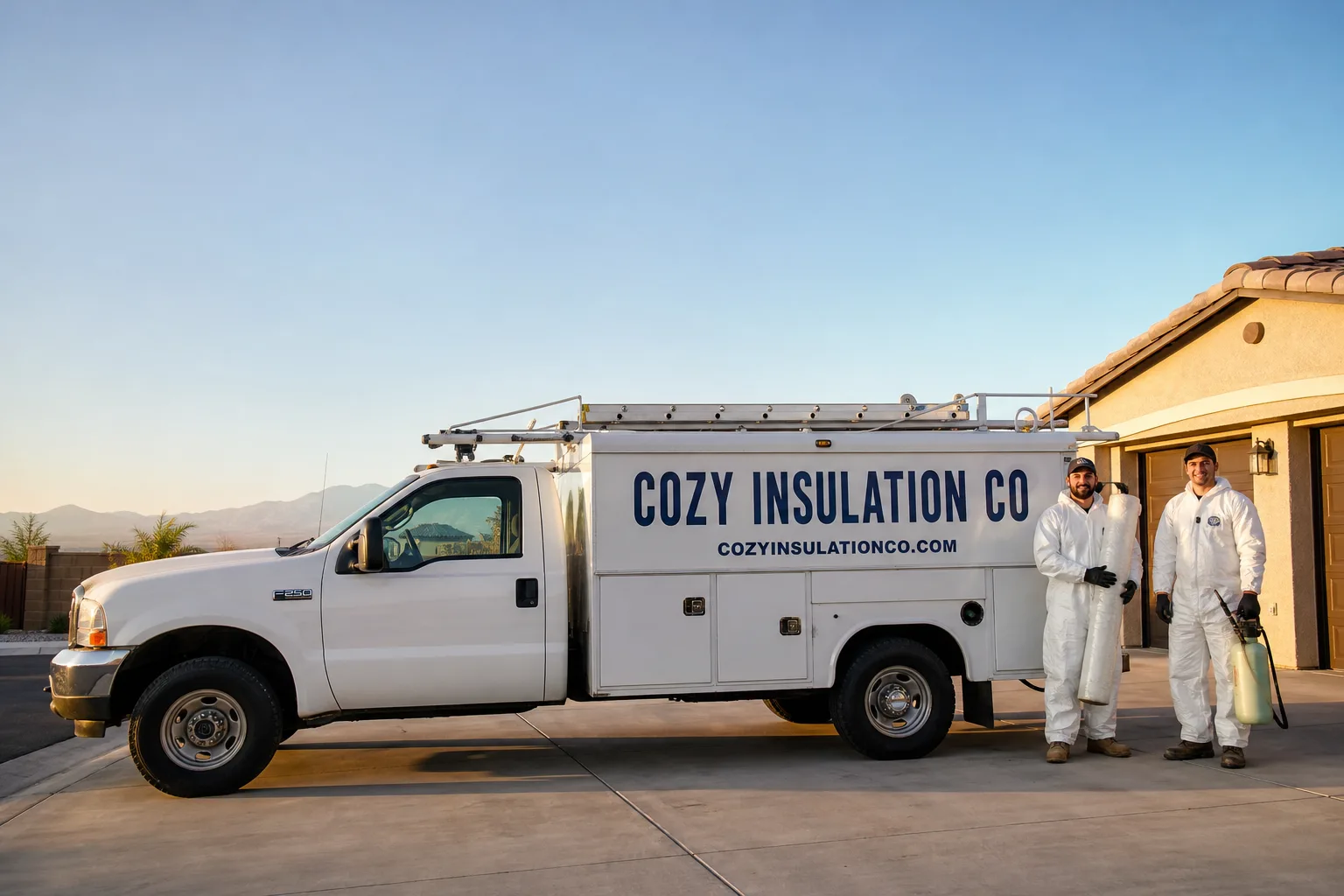
Fast, Reliable Attic Insulation Across Mead Valley
Attic insulation in Mead Valley isn’t a winter project. It’s a summer survival upgrade. When your roof hits 140°F in July and your AC runs nonstop while the hallway still feels warm, the problem is almost always what’s sitting – or sagging – above your ceiling. Cozy Insulation Co serves homeowners throughout the 92570 zip code with full attic insulation removal, air sealing, re-blow, and radiant barrier installation. We know the houses here. We know the heat here. Call (855) 382-3925 and we’ll come take a look, usually within a day or two.
Why Cozy Insulation Co Is Mead Valley’s Preferred Attic Insulation Company
We’ve worked on enough Mead Valley properties to know the patterns. Homes off Cajalco Road, along Clark Street, and up through the rural lots near the 215 corridor all share the same story: built decades ago, insulated to the minimum standard of their era, and never touched since. Homeowners here don’t need a sales pitch. They need someone who understands why a 1970s ranch house off Ethanac Road still bakes in summer despite having “some insulation” up there.
Mike Callahan started Cozy Insulation Co with a simple promise: match the material to the house, not to whatever’s easiest to install. That’s why we carry eight brands spanning fiberglass, cellulose, mineral wool, and spray foam. It’s why we’ll tell you when a top-up is enough – and when it’s not. For Mead Valley homeowners, that honesty matters more than a logo on a truck.
Our crews are in Mead Valley regularly. Same-week scheduling is typical. When we say we’ll show up, we show up.
Attic Ventilation in Mead Valley
Attic Ventilation in Mead Valley is what stops your insulation from becoming an oven liner. Most older homes here have static vents or a single whirlybird, which simply can’t move enough air when the attic hits 130°F to 140°F in August. The fix involves calculating the vent ratio for your attic’s square footage, then balancing intake at the eaves with exhaust at or near the ridge. In Mead Valley’s ranch-style and manufactured homes, we often find soffit vents painted over or blocked by old blown-in, which chokes airflow entirely.
Intake and Exhaust Balance
An attic needs roughly 1 square foot of vent area per 150 square feet of attic floor. If the intake at your eaves is blocked, ridge vents and powered exhaust units pull air from inside your living space instead. For Mead Valley homes on large rural lots, we frequently add continuous soffit vents and a solar-powered exhaust fan to keep the air moving without adding to your electric bill.
Attic Baffles and Airflow Prep
Before we blow in new insulation, we install baffles along the roof deck to keep the eave vents open. Without them, insulation drifts into the soffits and suffocates the system. We do this on every Mead Valley re-blow, because a fresh R-38 isn’t much help if the attic can’t breathe.
Attic ventilation work around Mead Valley typically runs $350 to $900 depending on attic size and whether you need passive vents, a solar fan, or both. It’s often the missing piece behind a hot upstairs and sky-high cooling bills.
Radiant Barrier in Mead Valley
Radiant Barrier in Mead Valley is the single most effective upgrade for blocking the brutal afternoon sun that bakes every roof in the Inland Empire. A radiant barrier is a reflective foil material stapled to the underside of the roof rafters. It works by reflecting radiant heat back out of the attic before it ever reaches your insulation. In Mead Valley, where cooling loads dominate and sun exposure is relentless from May through October, this makes an immediate measurable difference.
How It Complements Insulation
Insulation slows heat transfer. A radiant barrier stops it at the source. When the sun hammers your roof deck, the top surface gets hot enough to fry an egg. Without a barrier, that heat radiates down into the attic. With one, most of it bounces back. We recommend pairing a radiant barrier with fresh blown-in insulation for maximum effect in Mead Valley’s older homes.
Installation on Older and Manufactured Homes
Ranch and manufactured homes in Mead Valley often have low-slope roofs and tight attic access, which makes installation trickier but no less important. Our crews staple the foil directly to the rafters running north-south, leaving the recommended air gap below the roof deck. The result: an attic that’s 20 to 30 degrees cooler on the hottest days.
Radiant barrier installation in Mead Valley typically costs $1.50 to $2.50 per square foot, meaning a 1,200-square-foot attic runs roughly $1,800 to $3,000. It pays for itself in reduced cooling strain faster than most people expect in this climate.
Trusted Brands We Service in Mead Valley
We install GreenFiber cellulose for most Mead Valley re-blows because it packs tightly, resists rodent nesting, and fills weird cavities in manufactured homes better than batts. For homeowners who prefer fiberglass, we stock CertainTeed batts in a range of R-values. And for attics that need an air-sealing performance upgrade, Icynene open-cell spray foam is unmatched in our lineup. We keep our trucks stocked with these materials for Mead Valley jobs, which means no waiting on a supplier when you’re ready to schedule.
Common Attic Insulation Problems We See in Mead Valley Homes
- Rodent-tunneled batts: Older manufactured and ranch homes here have original fiberglass that mice, rats, and squirrels have used as highways. The compression and tunneling create dead zones where heat pours through your ceiling, even though the insulation “looks” thick.
- Sun-degraded ductwork: Flexible ducts in a 140°F attic crack and separate over time. We routinely find leaks pushing cooled air into the attic instead of your bedrooms, which is why insulation alone sometimes doesn’t fix a hot home.
- Original thin insulation: Homes built in the 1970s and 1980s around Mead Valley often have R-11 or R-19 at best. Modern code in this climate zone calls for R-38 to R-49. That gap is why ceilings feel warm to the touch in August.
- Slumped and compressed layers: Even without rodents, decades of heat and attic traffic flatten old batts. A 12-inch batt compressed to 4 inches performs like a quarter of its rating. We see this constantly in Mead Valley’s older single-family stock.
Pricing for Attic Insulation in Mead Valley, CA
A full attic insulation removal and re-blow in Mead Valley typically runs $1,800 to $3,500 for a 1,200 to 1,500-square-foot attic, depending on depth and access. A simple top-up over existing, healthy insulation runs $800 to $1,400. Attic ventilation work adds $350 to $900. Radiant barrier runs $1.50 to $2.50 per square foot. Rodent damage removal costs $400 to $800 extra because we have to clean, sanitize, and prep before blowing. Call (855) 382-3925 for a free estimate – we’ll inspect your attic and give you exact numbers before any work begins.
We Also Serve Cities Near Mead Valley
Cozy Insulation Co handles Attic Insulation throughout western Riverside County. In addition to Mead Valley, our crews regularly work in Perris, Good Hope, Canyon Lake, and Meadowbrook. If you’re in Mead Valley or any neighboring community, give us a call and we’ll get you on the schedule.
Serving Mead Valley, CA — Our Local Coverage Area
We’re based in the Mead Valley area and know this community well. Use the map below to see our service coverage — if you’re nearby, we can almost certainly help.
FAQs About Attic Insulation in Mead Valley
In most cases, no. In Mead Valley, the combination of 100°F+ summers and aging manufactured or ranch-style homes means original batts are usually not just thin, but tunneled through and compressed by rodents. Adding new insulation on top of damaged material leaves R-value gaps that radiant heat finds immediately. That’s why we frequently recommend full removal and re-blow rather than a quick add-on. Call (855) 382-3925 and we’ll inspect what’s actually up there before recommending anything.
Because Mead Valley’s climate is dominated by long, intense summers where attics routinely reach 130°F to 140°F. Winter here is mild and short, so heating loads are minimal compared to the months your AC runs. Proper attic insulation blocks that radiant heat from baking through your ceiling, keeping your cooled air inside. In this climate, insulation is primarily a cooling measure. That’s why we emphasize radiant barriers and ventilation alongside deep insulation for Mead Valley homes.
Blown-in insulation slows conductive heat transfer through your ceiling. A radiant barrier reflects radiant heat before it enters the attic. They do different jobs and work best together. In Mead Valley’s extreme heat, pairing both typically delivers the biggest comfort improvement and the largest cooling savings. We recommend blown-in cellulose or fiberglass for the floor of the attic, plus a foil radiant barrier on the rafters.
Signs include visible droppings in the attic, a strong ammonia smell near the access hatch, uneven ceiling temperatures, unexplained spikes in your cooling bill, and compressed or displaced batts. In Mead Valley’s manufactured homes, rodents love the fiberglass batts because they nest down into them. If you see any of these warning signs, a thorough inspection is warranted. Mike Callahan and our team can assess the damage and tell you whether removal is necessary or if a targeted repair will do.
It helps, but it won’t fix leaking ducts. If your ducts are cracked or separated in a 140°F attic, you’re cooling the attic, not the house. We always recommend checking duct integrity when we insulate. Air sealing the attic floor, replacing damaged duct sections, and then adding fresh insulation gives you a complete system. For Mead Valley homeowners with 20-plus-year-old flexible ducts, we often find the leaks are the bigger issue than the insulation itself. Call (855) 382-3925 and we’ll check both.
On a 1970s ranch-style home off Ethanac Road, our crew found the original fiberglass batts slumped and rodent-tunneled, with attic temps hitting 140°F. We removed the old insulation, air-sealed the top plates, and blew in GreenFiber cellulose to R-49, then added a radiant barrier to cut heat gain. The homeowner reported a 30% drop in summer cooling costs. That’s the kind of result we aim for on every attic in Mead Valley.
Written by Mike Callahan, Owner at Cozy Insulation Co, serving Mead Valley and the Inland Empire since day one.