
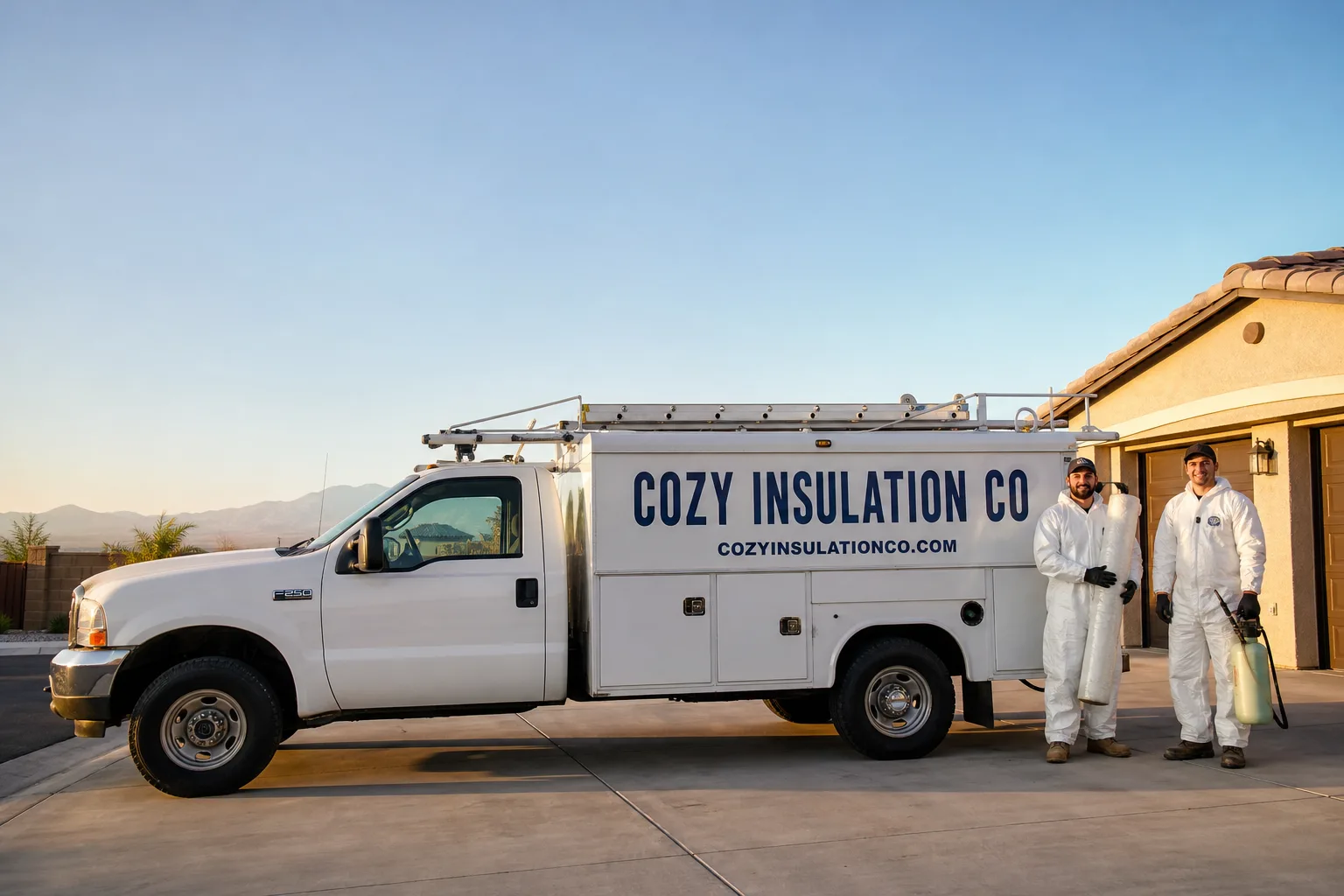
Fast, Reliable Attic Insulation Across Encino
If your Encino home has rooms that never quite cool down in August or an upstairs bedroom that turns into an oven during a heat wave, the problem usually isn’t your HVAC system. It’s the attic. Attic insulation in Encino typically runs $1,800 – $4,200 for a full replacement in a mid-century ranch, and most jobs are completed in one day. When you call Cozy Insulation Co at (855) 382-3925, you reach a team that knows exactly what’s happening above the ceilings of Encino’s ranches and hillside homes because we work on them every week.
We’re not a call center. We’re the crew that shows up with Owens Corning, Icynene, and GreenFiber materials on the truck, ready to look at what’s actually in your attic before recommending anything. That matters in a city like Encino where two houses on the same street can need completely different solutions simply because one sits on the flats and the other climbs into the Encino Hills.
Why Cozy Insulation Co Is Encino’s Preferred Attic Insulation Company
Encino homeowners call us because we treat their attic as a system, not a square footage calculation. Our approach starts with one question: what’s the point of insulation if the roof can’t breathe? That’s why our work in Encino regularly pairs Attic Insulation with proper ventilation and radiant barrier installation, especially in the ZIPs that sit south of the 101 and bake all summer. We’re authorized installers for eight nationally recognized insulation brands, which means we can match your home to the right material instead of selling you whatever’s stacked in the warehouse. Icynene and Demilec spray foam for tight seal work, Owens Corning blown-in fiberglass for open attics, GreenFiber cellulose for slopes and sound dampening.
Mike Callahan leads every project from estimate to final walkthrough. He’s the one who’ll climb the ladder, not just someone on the phone. Homeowners across Encino have told us the same thing: our crews show up on time, protect the hallway with drop cloths before dragging a hose through, and leave the attic label-readable. That doesn’t sound like much until you’ve had three other companies no-show or quote without even opening the hatch.
Attic Ventilation in Encino
Attic Ventilation matters more in Encino than in almost any coastal neighborhood, because a poorly vented attic here doesn’t just feel stuffy, it turns into a 150°F heat trap that cooks both the insulation and your air-conditioned ceiling below. In Encino’s summer months, we regularly measure attic temperatures 40 to 50 degrees hotter than the outside air. That heat radiates through whatever insulation exists, making the top floor work against itself. A properly vented attic moves that superheated air out through ridge or gable vents while pulling cooler air in through soffit intakes. It extends the life of your shingles, reduces the strain on your AC, and keeps blown-in or batt insulation performing as designed.
Vent Retrofit for Mid-Century Ranches
Many of the 1950s and ’60s ranches in 91416 and 91316 were built before ridge venting was standard practice. They might have a couple of weak whirlybirds or a single gable vent, but nowhere near enough airflow for a San Fernando Valley summer. We evaluate your existing venting, calculate the net free area needed, and retrofit the right intake-to-exhaust ratio without tearing up your roof structure.
Combining Ventilation With Insulation Top-Up
Here’s the thing most homeowners don’t realize: adding more insulation without fixing ventilation actually makes the problem worse. More material holds more heat. In Encino, the right approach is usually ventilation first, insulation second. We prep the baffles and soffit channels before the new material goes in, so the attic can actually do its job.
Expect to pay $400 – $900 for a full ventilation assessment and retrofit on an average Encino ranch, depending on how much correction the roof needs. That’s separate from the insulation work itself, but skimping on it is how attics get re-foamed two years later.
Radiant Barrier in Encino
Radiant Barrier is the difference-maker in Encino specifically because it attacks the real enemy here: radiant heat from a 100°F-plus roof deck, not just conductive heat moving through the insulation. On a typical August afternoon, an Encino attic without radiant barrier can hit 150°F even with good insulation below it. A radiant barrier, installed on the underside of the roof rafters, reflects that heat back out before it ever reaches your insulation. This is why homes in the Encino Hills off Mulholland and Sepulveda get dramatically different results from radiant barrier than coastal homes would. It’s not coastally needed. In Encino, it’s a legitimate comfort upgrade.
Hillside Homes With Direct Sun Exposure
If your home sits on the south or west slopes of the Encino Hills, your roof takes direct afternoon sun with no shade relief. We see attics up there that stay above 130°F well into October. Radiant barrier, paired with a good blown-in product above the ceiling line, returns the attic to something resembling ambient. Top-floor rooms stop feeling like saunas by evening.
When to Skip Radiant Barrier
Radiant barrier isn’t for every Encino house. If your attic already has HVAC ducting lying directly on the floor and open access, sealing and insulating the ductwork may be a higher priority. We’ll tell you honestly where your dollars do more work. Sometimes that’s radiant barrier, sometimes it’s a ventilation fix, sometimes it’s just removing the old compressed batts and starting clean.
For a typical 1,600 – 2,200-square-foot Encino ranch, radiant barrier installation runs $900 – $1,700. Hillside homes with complex rafter geometry land on the upper end of that range.
Trusted Brands We Service in Encino
We stock and install products from Owens Corning, Icynene, Demilec, and GreenFiber, among others, and we keep common materials ready for quick deployment to Encino jobs. When a homeowner calls us on Tuesday after a weekend that topped 105°F, we don’t want to tell them the product arrives in two weeks. Our Encino projects typically get scheduled within 3 – 5 business days of the estimate. Icynene and Demilec spray foam systems are what we recommend for hillside homes where sloped ceilings make traditional batts a liability. GreenFiber cellulose, with its high recycled content, answers for the homeowner who wants something between batt comfort and foam cost. That breadth of material choice is the whole point. The right insulation for your home, not just the easiest install.
Common Attic Insulation Problems We See in Encino Homes
- Original fiberglass batts settled to 2 – 3 inches. In mid-century ranches across 91416 and 91316, the original batts, installed when the homes were built, have lost most of their loft and R-value. What’s left is a mat that barely insulates anything and often shows signs of rodent or moisture exposure. This isn’t fixable by adding on top; it needs removal first.
- Blown-in insulation settled toward the low side of sloped ceilings. In hillside homes off Mulholland Drive and Sepulveda Boulevard, the vaulted or sloped ceiling cavities hold blown-in product poorly. Gravity does the work over a decade or two, leaving the ridge line bare and the top-floor rooms noticeably hotter. A callback after the first 100°F week is common, and always for the same reason.
- Decades of HVAC and electrical retrofits disturbed the insulation. Almost every Encino home from the 1960s or earlier has had a new furnace, AC unit, or rewiring at some point. Every one of those projects meant someone crawled into the attic and moved the insulation aside, then rarely put it back. The result is uneven coverage and thermal bridging exactly where occupants feel it most: above hallways and bedrooms.
- Attic ventilation built for a different era. Homes south of Ventura Blvd that have never had ridge venting retrofitted are essentially cooking themselves. Poor airflow in an Encino summer makes the insulation, whatever condition it’s in, hold heat instead of shedding it. This is the classic “we added insulation and the house got hotter” scenario, and it’s shockingly common here.
Pricing for Attic Insulation in Encino, CA
Encino pricing reflects both the age of the housing stock and the range of home types, from single-story ranches on the flats to multi-level hillside builds. A standard attic top-up with blown-in fiberglass or cellulose runs $1,200 – $2,500 depending on the square footage and desired R-value. Full removal of failed original batts plus air sealing and new blown-in insulation runs $2,800 – $4,600 for most Encino ranches. Adding radiant barrier typically adds $900 – $1,700, and a ventilation retrofit runs $400 – $900. Hillside homes with sloped ceiling cavities and difficult access land at the higher end of each range. Call (855) 382-3925 for a free estimate and we’ll give you a real number based on what’s in your attic today, not a formula from a spreadsheet.
We Also Serve Cities Near Encino
Our crews work throughout the San Fernando Valley, and we regularly handle Attic Insulation in Encino and the surrounding communities. We’re in Sherman Oaks, Van Nuys, Valley Glen, and Northridge every week. If you’re in one of those neighborhoods or anywhere else in the Valley, call us and we’ll find a route that gets your attic done within days, not weeks.
Serving Encino, CA — Our Local Coverage Area
We’re based in the Encino area and know this community well. Use the map below to see our service coverage — if you’re nearby, we can almost certainly help.
FAQs About Attic Insulation in Encino
No. Adding material on top of settled blown-in insulation in sloped ceilings does not fix the problem, because the heat still penetrates the uninsulated ridge area. The correct fix is to remove the settled material, install baffles in the sloped cavities, and re-blow with a product that resists settling, often a cellulose or a denser fiberglass. Call (855) 382-3925 and we’ll inspect the slope and tell you exactly what’s happening.
Look for three signs: the batts are visibly compressed or stained, the attic has been entered multiple times for HVAC or electrical work, or the insulation measures less than 6 inches thick. Most original batts in Encino’s mid-century ranches are 2 – 3 inches now. Topping off on top of degraded material leaves the air sealing problem untouched, so replacement is usually the right call.
Ventilation moves hot air out of the attic. A radiant barrier reflects heat before it can enter the attic in the first place. In Encino’s summer climate, most homes benefit from both: ventilation reduces the heat buildup, and radiant barrier cuts the radiant load that causes temperatures to spike to 150°F or more. They work together and should be specified as a pair on most San Fernando Valley attics.
Yes, the clearest sign is that rooms directly under the ridge line are consistently 8 – 12°F hotter than rooms under the lower side of the slope. Another tell: your AC runs in the late afternoon even when the thermostat is set low, but the upper rooms never feel as cool as the rest of the house. Call (855) 382-3925 for a thermal check and we’ll identify the pattern within the first visit.
In Encino’s climate, both matter, but radiant barrier often has the bigger immediate impact on comfort. That’s because our summer heat is primarily radiant, not conductive. Radiant barrier stops that heat at the roof deck before it reaches the insulation. Additional insulation helps with conductive heat transfer and winter retention, but on its own it won’t fix rooms that turn into ovens by 4 p.m. in August.
Ready to fix your Encino attic? Call Mike Callahan and the team at Cozy Insulation Co at (855) 382-3925 for a free estimate. We’ll inspect the attic, identify the exact failure mode, and recommend the material that matches your home’s construction and your budget. No scripts, no upsells, just an honest answer about what’s above your ceiling.
Written by Mike Callahan, Owner at Cozy Insulation Co, serving Encino and the San Fernando Valley with attic insulation, spray foam, and blown-in installation since the company opened its doors.