
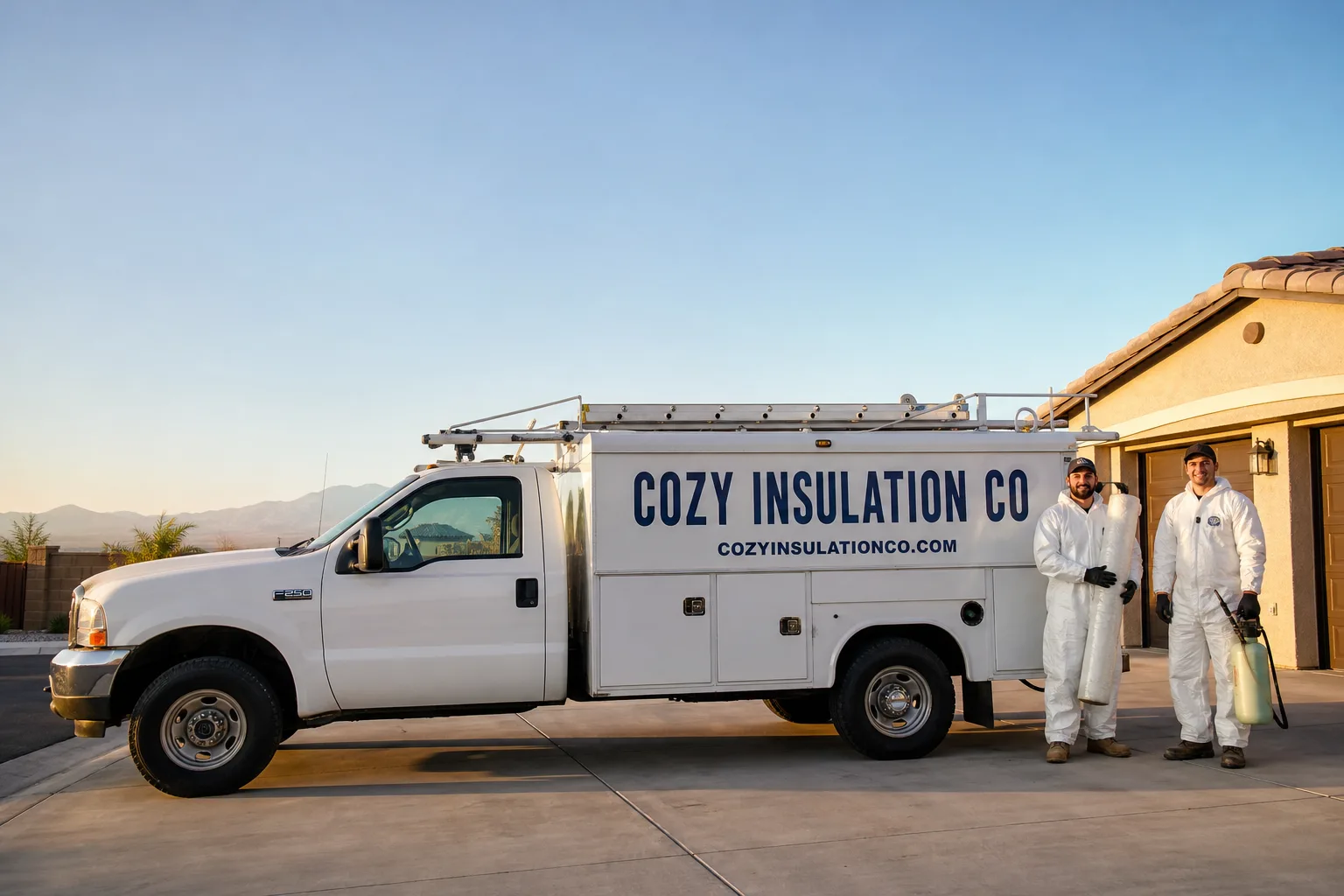
Fast, Reliable Attic Insulation Across Covina
Attic insulation in Covina is usually a full retrofit job, not a simple top-up. Most homes here were built between the late 1940s and the 1970s, and their original insulation has either settled to nearly nothing or was never adequate for a San Gabriel Valley summer. We work throughout the 91722, 91723, and 91724 ZIP codes, and we know exactly what these tract homes and ranches need. Call (855) 382-3925 and we’ll schedule a look at your attic, usually within a couple of days.
Our team serves Covina from our Corona base, which puts us close enough to respond fast but familiar enough with this specific housing stock to know what we’ll find before we open the attic hatch. The low-pitch roofs, the tight eave vents, the stucco walls. We’ve seen it hundreds of times.
Key Takeaways
- Covina attics regularly top 140°F in summer; thin or missing insulation turns that heat into a comfort problem downstairs.
- Most Covina homes need full Attic Insulation retrofit work with baffling, not just a blown-in top-up.
- We install fiberglass, spray foam, and cellulose from eight trusted brands, matched to your home’s actual construction.
- Attic ventilation and radiant barrier are routine add-ons here because of Covina’s low-pitch roofs and heat-driven cooling loads.
- Free estimates. Call (855) 382-3925 to get a specific number for your house.
Why Cozy Insulation Co Is Covina’s Preferred Attic Insulation Company
Mike Callahan started Cozy Insulation Co with a simple idea: match the insulation to the house, not to whatever’s cheapest on the truck that day. That approach matters enormously in Covina, where a 1953 stucco ranch in the 91723 ZIP and a 1970s two-story near the 91724 side have completely different attic problems. We carry fiberglass batts, spray foam, and blown-in cellulose, which means we’re not trying to force one material into every attic we enter.
Our Covina customers tell us the same things over and over: upstairs rooms that won’t cool down, AC units running constantly from June through October, and energy bills that spike every summer. Those aren’t mysteries. They’re symptoms of attics that never had proper insulation in the first place, or had it but lost it to decades of heat and settling. We diagnose the actual problem, then fix it.
The eight-brand portfolio is a real advantage here. CertainTeed and Owens Corning offer manufacturer-backed warranties that extend beyond our installation. For Covina homeowners who want the performance ceiling, we install Icynene and Demilec spray foam systems, closed-cell and open-cell. For those prioritizing recycled content, GreenFiber cellulose does the job. You get options, not a pitch.
Why Covina’s Older Tract Homes Need More Than a Top-Up
The defining feature of Covina’s insulation market is the age of the housing. Walk the blocks around Citrus Avenue, past the downtown core, and you’ll see 1940s and 1950s single-story stucco tract homes with low-pitch roofs and original wood-framed construction. These houses were built when energy was cheap and insulation was an afterthought. Many have one inch of rock-wool or a thin layer of original fiberglass batts that have been baking under San Gabriel Valley sun for sixty or seventy years. One inch of settled fiberglass delivers almost no meaningful R-value. Functionally, these attics are uninsulated.
That’s the core difference between Covina and newer developments elsewhere in the valley. A newer home might need a top-up: add six inches of blown-in, call it done. A 1955 Covina ranch needs the old material removed or bypassed, air sealing addressed, baffling installed at the eave vents, and then new insulation matched to the roof’s geometry. On a 1950s stucco ranch off Citrus Avenue, our crew opened a low-slope attic to find the original fiberglass batts compressed to roughly an inch with no baffling at the tight eave vents. We installed Owens Corning blown-in over air-sealed framing, added proper rafter baffles to keep the eave vents clear, and sealed the top plates before finishing. Attic temps that had been climbing well past 140°F on summer afternoons dropped noticeably, and the homeowner’s second-floor rooms stopped baking by mid-morning.
That’s not a one-off story. It’s the standard condition for Covina’s older housing stock. The San Gabriel Valley’s summer heat pushes attic temperatures high enough that any insulation gap becomes a comfort emergency. And because these homes were built with low-slope roofs and minimal eave ventilation, the heat has nowhere to go. It sits up there, radiating down through the ceiling, working against your AC every hour of the day.
Attic Ventilation in Covina
Attic Ventilation in Covina is not an optional add-on; it’s a required part of nearly every insulation job we do in the 91722 and 91723 ZIP codes. The low-pitch roofs and tight eave vents common to the older tract homes trap hot air inside the attic cavity. That hot air cooks the insulation, degrades it faster, and forces heat down into your living space. Proper ventilation gives that heat a path out.
Most Covina homes we inspect have insufficient eave venting, and many have had blown insulation added at some point without baffles. The insulation covers the vents, blocks the airflow, and makes the problem worse. Our approach is to install rafter baffles first, verify intake and exhaust balance, and only then add insulation. Ventilation work on a typical Covina ranch adds roughly $300 to $600 to a project, depending on the number of baffles and whether ridge or roof vents need to be added.
Baffle Installation and Airflow Correction
Baffles are simple channels that hold insulation back from the eave vents so air can move from the soffit up to the roof exhaust. In Covina’s older homes, we almost always find them missing. Installing them is quick, inexpensive, and makes every other insulation dollar work harder.
Sealing the Thermal Boundary
Ventilation only works if the attic is separated from the living space. Top plates, can light housings, and framing gaps all leak. We air-seal these before adding insulation, which keeps the 140°F attic air from sneaking into your bedrooms and living room.
Radiant Barrier in Covina
Radiant Barrier in Covina makes a measurable difference in homes where summer cooling is the dominant energy cost, which describes almost every house in the 91724 ZIP and across the older tracts. A radiant barrier is a reflective material—similar to what you’d find with Reflectix repair in Covina—installed on the underside of the roof decking. It reflects radiant heat back toward the roof instead of letting it soak into the attic, which can lower peak attic temperatures significantly.
Covina’s hot, dry summers are the ideal condition for radiant barrier performance. Radiant barriers work best in hot climates with long cooling seasons, and that’s exactly what we have here. The dry air also means the reflective surface stays effective year-round without the moisture degradation you’d see in coastal areas. Adding radiant barrier to a typical Covina attic runs $1,200 to $2,800 depending on attic square footage and how much prep work is needed to access the roof deck.
Pairing Radiant Barrier with New Insulation
We usually recommend doing both together. The radiant barrier handles the heat before it enters the attic, and the insulation handles the conductive transfer through the ceiling. Together they cut the cooling load far more than either one alone.
When Radiant Barrier Is the Right Call
If you have a dark-shingled roof and a south-facing orientation, common in Covina’s central tracts, radiant barrier pays back fastest. We’ll look at your roof exposure and tell you honestly whether the numbers justify it.
Trusted Brands We Service in Covina
We install products from eight vetted manufacturers, which means we can match material to your budget, your roof geometry, and your priorities. For Covina attics we frequently reach for CertainTeed fiberglass, Icynene and Demilec spray foam for the performance-focused jobs, and GreenFiber cellulose when a homeowner wants recycled content and great coverage in tight spaces. We stock a full range of accessories locally, so when a Covina job needs a specific baffle profile or a particular R-value, we’re not waiting on a parts run. The right material matters more than brand loyalty, and we carry enough range to make the honest call every time.
Common Attic Insulation Problems We See in Covina Homes
- Compressed original batts. In 1940s and 1950s tract homes, the original rock-wool or fiberglass batts have often settled to an inch or less, leaving the attic effectively uninsulated.
- Missing eave baffling. Covina’s low-slope roofs and tight eave vents get clogged by old insulation, trapping heat in the attic and baking the ceiling below.
- Air leaks through top plates and can lights. Even after a past top-up, gaps in the framing and light fixtures let superheated attic air push straight into living spaces, especially upstairs.
- No separation between attic and home. The heat radiating from a 140°F attic defeats the AC, drives bills up, and makes upper-floor rooms unusable by late afternoon in August.
Pricing for Attic Insulation in Covina, CA
For a typical 1,200 to 1,800 square foot Covina ranch, full attic insulation replacement with air sealing and baffling runs $2,800 to $5,500 depending on the material. Blown-in cellulose or fiberglass sits at the lower end; spray foam runs higher, with closed-cell at a premium. A basic top-up without baffling or sealing might run $1,500 to $2,000, but we usually don’t recommend it for Covina’s older homes because it skips the ventilation fixes that make insulation actually work. Attic ventilation adds $300 to $600, and radiant barrier adds $1,200 to $2,800. Call (855) 382-3925 for a free estimate specific to your house.
We Also Serve Cities Near Covina
Our service area around Covina stretches west to West Covina, north to Azusa and Irwindale, and south to Citrus. If you live just outside the city line, give us a call. We likely cover your neighborhood too, and the insulation problems in these surrounding areas are often identical to what we see in Covina’s older tracts.
Serving Covina, CA — Our Local Coverage Area
We’re based in the Covina area and know this community well. Use the map below to see our service coverage — if you’re nearby, we can almost certainly help.
FAQs About Attic Insulation in Covina
The most common cause is an attic that has little or no effective insulation left, combined with missing ventilation baffles that trap 140°F air against your ceiling. Your AC is fighting the heat radiating down from the attic all day. The fix is a full attic retrofit with air sealing, baffle installation, and new insulation matched to your roof. Call (855) 382-3925 and we’ll inspect it for free.
Mostly correct. Covina’s dry, inland San Gabriel Valley climate means moisture-driven insulation failure is far less of a concern than it is in coastal Los Angeles. Your primary enemy is heat. That said, we do check for any roof leaks or bathroom fan venting issues before adding insulation, and we fix what we find. But for most Covina homes, the problem is radiative heat, not condensation.
Low-pitch roofs have less vertical space for hot air to stratify, which means the heat stays close to your ceiling. Without proper eave baffles and exhaust venting, that heat has no escape path and transfers directly into your living space. Ventilation is the difference between an attic that sheds heat and an attic that stores it.
We install CertainTeed, Owens Corning, Johns Manville, Knauf, and Rockwool fiberglass and mineral wool products, Icynene and Demilec spray foam systems, and GreenFiber cellulose. For Covina’s older homes, GreenFiber blown-in is a popular choice because it fills the irregular cavities in old framing, and Icynene closed-cell foam delivers the highest R-value per inch for tight attic spaces.
Yes, in most cases. Radiant barrier and insulation do different jobs: the barrier reflects heat before it enters the attic, and the insulation slows the transfer through your ceiling. Doing both at once saves on labor and gives you the biggest reduction in cooling load. We’ll give you a clear recommendation based on your roof orientation and attic size. Call (855) 382-3925 for a free estimate.
Ready to Fix Your Covina Attic?
You don’t have to live with upstairs rooms that bake in the summer and energy bills that climb every year. The problem is usually the attic, and the fix is usually more straightforward than you think. We inspect, we explain what we found in plain language, and we give you a written estimate on the spot. Call (855) 382-3925 today and we’ll schedule a time that works for you. Attic Insulation in Covina is what we do.
Written by Mike Callahan, Owner at Cozy Insulation Co, serving Covina and the San Gabriel Valley.