
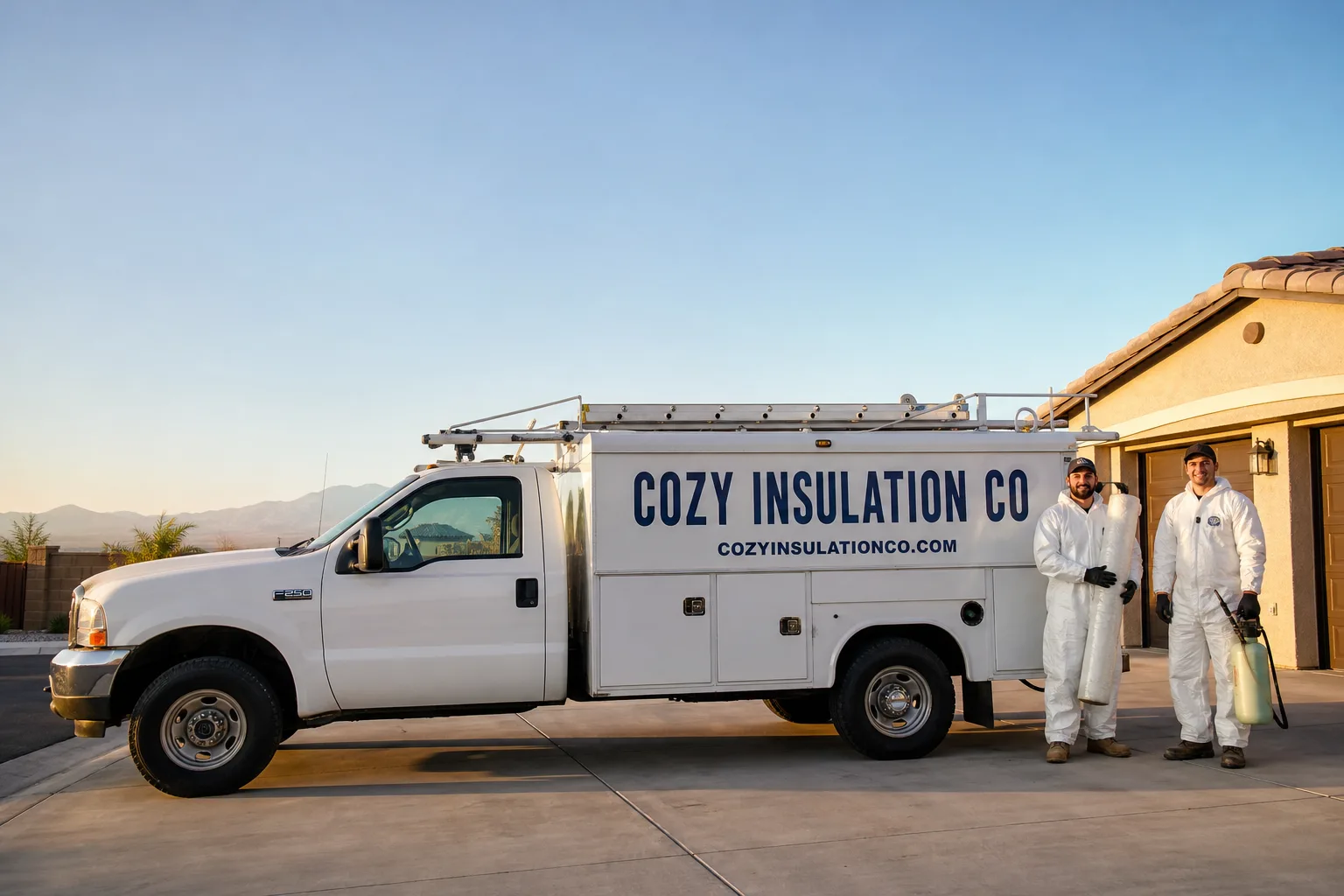
Fast, Reliable Spray Foam Insulation Across Stanton
If you live in Stanton’s 90680 ZIP, you’ve probably noticed how fast your AC kicks on once the afternoon sun hits your roof. That’s not your imagination. Most homes here were built between the 1950s and 1970s, and the original insulation in those tract attics was thin the day it went in. Decades later, it’s compressed, displaced, or just plain gone in spots. Our crews route to Stanton regularly from our Corona shop, and we answer the phone at (855) 382-3925. When you call, we’ll talk about your attic, your rim joist, and which foam system actually fits your home, not just what’s quickest to spray.
Why Cozy Insulation Co Is Stanton’s Preferred Spray Foam Insulation Company
Stanton’s housing stock is mostly single-story tract homes on compact lots. Neighbors are close. Attic clearances are tight. That changes how spray foam should be applied, and we’ve spent enough time in these attics to know what works and what doesn’t. Homeowners off Cerritos Avenue, Beach Blvd, and around Stanton Park call us because we don’t push a one-size-fits-all job. We match the foam to the space. Sometimes that’s open-cell on the roof deck. Sometimes it’s closed-cell at the rim joist plus blown-in fiberglass to level out old batts. Saying that upfront is what keeps our Stanton customers from paying for foam they don’t need.
Response time to Stanton is usually same-week, often faster. Mike Callahan runs the company and still reviews the material plan for tight-access attics like the ones we see near the 22 freeway. We’re not a subcontracting middleman. The crew that quotes your Stanton job is the crew that shows up to spray it.
Open Cell Spray Foam in Stanton
Open cell spray foam is the workhorse for Stanton attics where clearance is limited and the goal is air sealing plus a solid thermal barrier without adding excess weight or trapping moisture. For a typical 1,000 to 1,200 square foot Stanton ranch, open-cell foam on the attic floor or roofline costs $1,800 to $3,200 depending on depth and how much prep work is needed first. The foam expands into gaps that fiberglass can’t fill, which matters in homes where decades of HVAC and cable installs have shifted the original batts around.
Roof deck and shared wall applications
On Stanton lots where roofs sit just a few feet from the neighbor’s, open-cell foam applied to the roof deck helps cut the radiant heat that builds in the attic by late afternoon. It also dampens some of the freeway drone, because the foam fills the cracks where sound leaks through. We don’t oversell the acoustic benefit, but homeowners near Beach Blvd and the 22 consistently notice the difference in back bedrooms.
Attic floor versus roof deck
Most Stanton homes with existing ductwork do better with the attic floor sealed and the ducts covered, not the whole roof deck encapsulated. It’s cheaper, uses less foam, and lets the attic breathe the way these 1960s and 1970s frames were designed to. We’ll look at your access hatch, your duct runs, and your rafter spacing before recommending anything.
Spray Foam Insulation Contractors in Stanton
Spray foam insulation contractors in Stanton are not all the same, and the main difference comes down to whether they’ll remove bad existing insulation before they spray. We will. Spraying foam over compressed 1970s fiberglass batts doesn’t fix the problem. The old material still traps heat and the foam can’t form a proper air seal. A typical Stanton retrofit, including removal of failed batts in key areas and closed-cell foam at the rim joist and duct chases, runs $2,500 to $5,500. Smaller jobs, like just a rim joist seal on a single-story home, can run $900 to $1,800.
Rim joist and duct chase sealing
In Stanton’s slab-on-grade tract homes, the rim joist is where the biggest air leaks hide. Warm outside air pushes into the floor cavity in summer, and your AC fights it all day. Closed-cell foam at the rim joist stops that. The same foam works around displaced duct chases, where the original ceiling insulation was pushed aside during an old HVAC re-route.
Shared roofline and bulkhead gaps
Stanton lots are tight. When your roofline is only a few feet from your neighbor’s, heat from their attic still radiates into your shared wall cavity. We address the accessible side with foam at the bulkhead gaps, which is often the single biggest improvement on a west-facing facade. It’s a detail most contractors skip because it’s hard to reach, but it’s exactly the kind of retrofit this city’s housing stock calls for.
Trusted Brands We Service in Stanton
We’re authorized to install spray foam systems from Icynene and Demilec, and we also carry Owens Corning and Johns Manville fiberglass for hybrid retrofits. That matters in Stanton because most homes here don’t need a full foam encapsulation. They need closed-cell at the rim joist, open-cell at the roof deck, and blown-in fiberglass to level out the rest. We keep the common materials stocked for this area’s housing stock, so we don’t have to order in and reschedule your job. If your existing GreenFiber cellulose is still in good shape, we’ll tell you that too. We’d rather sell you the right mix than the maximum square footage.
Common Spray Foam Insulation Problems We See in Stanton Homes
- Foam over failed batts. We regularly find closed-cell sprayed directly over original fiberglass in Stanton attics by previous contractors. The old batts stay hot, the air seal fails, and the homeowner paid for foam that’s doing half its job. The old material has to come out first.
- Full encapsulation in low-clearance attics. Some companies sell a full attic foam job on a 4-foot-clearance 1960s tract attic without addressing ignition barriers or ventilation. In Stanton’s post-war framing, that can trap moisture and create code problems. Not every attic should be encapsulated.
- Ignoring the shared roof gap. When your neighbor’s roof line sits inches away, their attic heat still raises your cooling load even after you foam your side. The bulkhead gap has to be addressed, not just the accessible surface.
- Displaced duct-chase insulation. On original 1960s and 1970s ranch homes off Beach Blvd and Katella, old HVAC installs pushed the batts aside and never put them back. The hallway ceiling goes bare, and the hallway gets hot. Foam at the chase plus new blown-in coverage fixes it.
Pricing for Spray Foam Insulation in Stanton, CA
For a typical Stanton single-story home built in the 1950s through 1970s, here’s what you can expect. Open-cell spray foam on a low-clearance attic floor with existing ductwork runs $1,800 to $3,200. Closed-cell at the rim joist for a slab-on-grade ranch runs $900 to $1,800. A full hybrid retrofit combining rim joist foam, duct chase sealing, and blown-in fiberglass runs $2,500 to $5,500. The biggest cost driver is prep work: removing failed batts, accessing tight corners, and addressing any old wiring that needs to be moved. We give you a written quote before any work starts. Call (855) 382-3925 and we’ll come measure your attic. The estimate is free.
We Also Serve Cities Near Stanton
In addition to our work in Stanton, our crews cover Garden Grove, Cypress, Westminster, and Midway City. If you’re in a neighboring tract home with the same post-war attic clearance issues, give us a call. Our Spray Foam Insulation team handles hybrid retrofits across northern Orange County.
Serving Stanton, CA — Our Local Coverage Area
We’re based in the Stanton area and know this community well. Use the map below to see our service coverage — if you’re nearby, we can almost certainly help.
FAQs About Spray Foam Insulation in Stanton
Yes, and that’s actually the typical Stanton setup. In a 4-foot-clearance attic with original batts, we almost always recommend closed-cell foam at the rim joist and duct chases plus blown-in fiberglass to level out the rest, rather than a full attic encapsulation. The old batts get removed from the critical areas first. Call (855) 382-3925 for a specific plan for your attic.
Spray foam reduces noise by sealing the air gaps that let sound travel into your living space, but it’s not a full acoustic insulation. In homes we’ve done near Beach Blvd and the 22, homeowners typically report a noticeable drop in traffic hum in back bedrooms, especially when we foam the rim joist and shared wall gaps. For stronger sound control, we pair the foam with blown-in fiberglass.
Spray foam alone is rarely the right fix for that problem. The displaced batts need to be pulled back or replaced in the affected areas, and then closed-cell foam at the duct chase seals the gap permanently. On a 1968 ranch off Beach Blvd, our crew found original batts shoved aside by a 1990s HVAC re-route. We foamed the chase, then blew Owens Corning loose fill to an even R-38. The homeowner’s back bedroom got quieter and the AC cycled less within the first week.
Spray foam works well in Stanton because the main cooling load is radiant attic heat from the afternoon sun and air leaks around the rim joist, not extreme humidity. Open-cell foam on the attic floor or roof deck blocks that radiant heat transfer into your living space, and closed-cell at the rim joist stops the warm outside air from pushing in. The cool nights mean your home recovers quickly once the attic stops radiating, which is why sealing the air gaps matters more than adding R-value alone.
We use Icynene and Demilec spray foam systems, and we carry Owens Corning and Johns Manville fiberglass for the blown-in portion of a hybrid retrofit. For the shared roof gaps common on Stanton’s lot-to-lot tracts, we address the accessible bulkhead side with foam and then level out the rest with blown-in coverage. Radiant heat from your neighbor’s attic still matters, so sealing those gaps is part of the job, not an add-on.
Get a Free Estimate for Spray Foam Insulation in Stanton
If your Stanton home has a hot hallway, a drafty floor, or an attic full of displaced fiberglass, we’ll come out and tell you what actually needs to happen. No pressure, no upsell. Call (855) 382-3925 today to schedule your free estimate. Mike and our crew know these 1950s to 1970s tract homes well, and we’ll give you a straight answer on foam, fiberglass, or a combination of both.
Written by Mike Callahan, Owner at Cozy Insulation Co, serving Stanton and northern Orange County.