
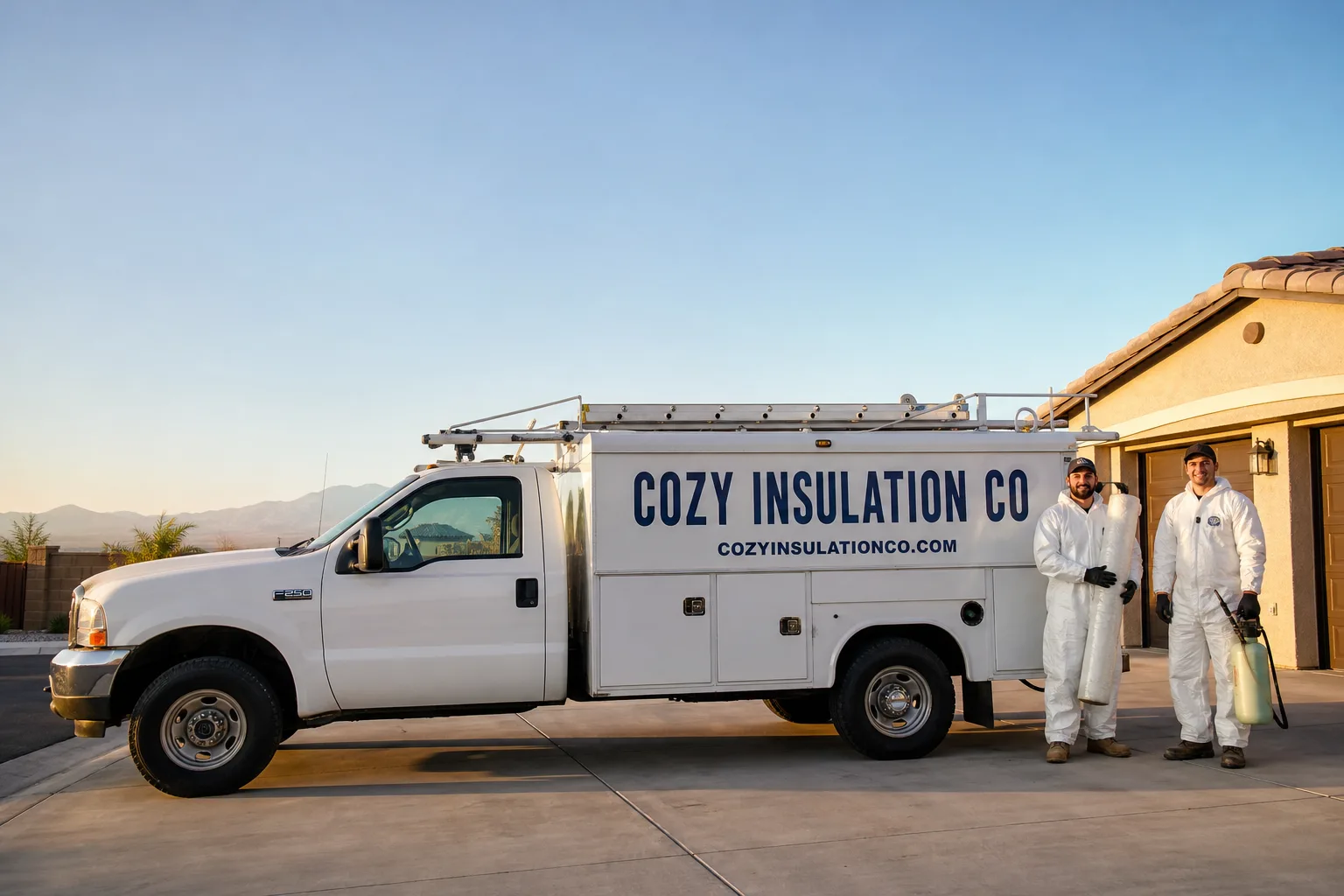
Fast, Reliable Spray Foam Insulation Across Spring Valley Lake
Spray foam insulation in Spring Valley Lake typically costs $3.50 to $7.00 per square foot for open-cell and $5.50 to $9.50 per square foot for closed-cell, depending on depth, access, and whether your home sits near the water. Most jobs in the 92395 ZIP are completed in one to two days. We run crews out to Spring Valley Lake weekly from our Corona shop, and because we know the stucco homes and slab foundations here well, we can usually quote accurately over the phone. Call (855) 382-3925 and Mike Callahan will talk you through what your specific house needs.
Why Cozy Insulation Co Is Spring Valley Lake’s Preferred Spray Foam Insulation Company
Spring Valley Lake isn’t like the rest of the high desert. The man-made lake changes how attics and walls behave, and we’ve spent enough time in homes off Bear Valley Road and around the lake loop to know what that means for insulation. When a 1980s stucco house near the water starts showing condensation on attic sheathing, that’s not normal Mojave behavior. That’s lake-effect humidity. Our crew has pulled failed R-11 batts out of dozens of these homes and seen the same pattern: sagging, gaps, and moisture where the original install just gave up.
We’re the team that shows up to Spring Valley Lake with a plan for your specific house, not a sales pitch for whatever roll of fiberglass is in the truck. Mike Callahan founded Cozy Insulation Co around one idea: match the material to the home. That means open-cell or closed-cell Spray Foam Insulation, fiberglass batts from Owens Corning, or GreenFiber cellulose where it makes sense. We always tell you why one beats the others for your walls, your attic, your garage. Not because one is easier for us to install. Because one is right.
Spring Valley Lake homeowners call us because we respond fast, we quote honestly, and we don’t subcontract. The same crew that starts your job finishes it. If you’re off Hesperia Road or up near the golf course, expect us at your door when we say we’ll be there. Estimates are free. Call (855) 382-3925.
Garage Spray Foam Insulation in Spring Valley Lake
Garage Spray Foam Insulation in Spring Valley Lake is one of the highest-impact upgrades you can make on an attached garage, because when that shared wall and the garage ceiling aren’t sealed, 100°F summer air bleeds into your house and 20°F winter air creeps through every seam. A typical garage ceiling spray foam job here runs $1,800 to $3,200, and a shared-wall application runs $1,200 to $2,500. Most Spring Valley Lake garages were never insulated as part of the original 1970s through 1990s build, which is why the room above the garage is always the hottest or coldest in the house.
Why attached garages in Spring Valley Lake get so hot
The home’s original R-11 wall batts don’t stop radiant heat from soaking through a west-facing garage wall. Add the fact that most garages here sit on slab with no thermal break, and that slab radiates heat up into the garage all night long. Closed-cell spray foam on the garage ceiling and shared wall cuts that heat transfer at the source.
When spray foam beats fiberglass in a garage
If you use the garage as a workshop, home gym, or even just parking with a fridge out there, the air-sealing property of spray foam is what you’re after. Fiberglass filters air; it doesn’t stop it. Spray foam seals the rim joist, the ceiling penetrations, and the wall cavities so the garage stops acting like an oven attached to your house. We also offer Spring Valley Lake homeowners rim joist spray foam for homes where the biggest losses happen along the foundation line.
Closed Cell Spray Foam Insulation in Spring Valley Lake
Closed Cell Spray Foam Insulation in Spring Valley Lake is the right call when you need structural rigidity, a built-in vapor retarder, and serious R-value in a single pass, especially for roof decks and lake-adjacent homes where the man-made lake raises the moisture stakes. Closed-cell foam here runs $5.50 to $9.50 per square foot installed, and because it acts as its own vapor barrier at two inches thick, it’s often the correct material when condensation is already a problem. That’s a common story near the water.
Lake-adjacent attics need more than just foam
Homes that sit within a few hundred feet of the lake, especially the older stucco singles off the main lake loop, deal with humidity that the rest of the desert never sees. When you trap that humidity against the underside of a roof deck, you get rot. So before we spray a lake-adjacent attic, we look at ventilation. Sometimes the fix is foam plus added ridge vents. Sometimes the foam goes on the roof deck and the attic gets converted to conditioned space. Every house is different, and that’s why Mike sends an experienced tech to look before quoting.
Closed-cell foam and the 40-degree temperature swing
Spring Valley Lake regularly swings 40 degrees between the afternoon high and the pre-dawn low. Closed-cell foam at two inches in a roof deck dramatically slows heat gain during the day and stops the rapid cooldown at night, which means your HVAC doesn’t have to fight the envelope. For older homes with original R-11 or R-13 in the walls, we often recommend a hybrid approach: closed-cell foam at the rim joist and roof deck, and either dense-packed cellulose or fiberglass in the wall cavities where it makes financial sense.
Trusted Brands We Service in Spring Valley Lake
We install spray foam systems from Icynene and Demilec, two of the most performance-tested names in professional insulation. For homeowners who prefer a fiberglass or cellulose path, we work with Owens Corning and GreenFiber. Being authorized across eight nationally recognized brands means we stock the right materials for Spring Valley Lake jobs and we don’t have to push one product into a house that needs another. The Demilec closed-cell systems we spray are what we specify for most lake-adjacent attics because of their vapor-retarding performance and consistent cell structure.
Common Spray Foam Insulation Problems We See in Spring Valley Lake Homes
- Condensation on attic sheathing near the lake. The man-made lake raises local humidity enough that crawlspaces and attics in lake-adjacent homes sweat. The original vented attics were never designed for that moisture load, and spray foam has to be paired with a vapor retarder and ventilation work or you’ll trap water where it does damage.
- Collapsed R-11 batts in 2×4 wall cavities. Homes built between the 1970s and 1990s around Spring Valley Lake used R-11 or R-13 batts that have since compressed and sagged. That leaves uninsulated gaps at the top of every stud bay, which is why your walls feel sun-baked by late afternoon in July.
- No radiant barrier and no attic ventilation upgrade. Most original Spring Valley Lake homes went up before radiant barriers were common. When you add closed-cell foam to a roof deck without addressing ventilation, the attic gets hotter in summer and holds moisture in winter, which is exactly what you don’t want.
- Air infiltration through the rim joist and top plates. Stucco exteriors look solid, but the framing behind them has gaps at every rim joist and top plate. In a house built in 1985, those gaps collectively equal a window left open year-round. Closed-cell spray foam on the rim joist is one of the cheapest-per-square-foot fixes in the whole house.
Pricing for Spray Foam Insulation in Spring Valley Lake, CA
You should expect to spend $3.50 to $7.00 per square foot for open-cell spray foam and $5.50 to $9.50 per square foot for closed-cell in Spring Valley Lake. A full attic roof deck on a 1,500-square-foot home typically lands between $5,000 and $9,500. Garage ceiling and shared-wall jobs run $1,800 to $3,200. Rim joist sealing for a typical two-story house is $900 to $2,200. The price shifts based on access, whether the old batts need removal, and whether we’re adding ventilation or vapor retarders as part of the job. We give you a written, line-item quote before any work starts. Call (855) 382-3925 and we’ll come out and measure.
We Also Serve Cities Near Spring Valley Lake
If you’re just outside the Spring Valley Lake boundary, we cover Mountain View Acres, Victorville, Apple Valley, and Hesperia with the same crews and the same response times. A lot of our Spring Valley Lake customers find us through neighbors in Victorville and Apple Valley, and honestly, most Midway Hills and Spring Valley Lake jobs get scheduled together since they’re minutes apart. Call (855) 382-3925 to confirm we’re in your area.
Serving Spring Valley Lake, CA — Our Local Coverage Area
We’re based in the Spring Valley Lake area and know this community well. Use the map below to see our service coverage — if you’re nearby, we can almost certainly help.
FAQs About Spray Foam Insulation in Spring Valley Lake
Because the lake changes everything. Spring Valley Lake’s man-made lake creates a microclimate where humidity near the water is far higher than the surrounding Mojave, so attic sheathing and wall cavities in lake-adjacent homes can condense moisture even when Victorville, three miles away, stays bone dry. When we’re spraying closed-cell foam at two inches, the foam itself acts as a vapor retarder, but in vented attics near the lake, we add a separate retarder and check ventilation so the home’s moisture has a path out instead of rotting the sheathing. If your home is within a few hundred feet of the water, call (855) 382-3925 and ask Mike whether your attic needs this added step.
Yes. Closed-cell spray foam is the best material we install for fighting a 40-degree daily swing because its air-sealing and high R-value-per-inch work together to slow heat gain during the 100°F afternoons and slow heat loss after the temperature drops into the 20s at night. For older Spring Valley Lake homes, we typically recommend closed-cell foam on the roof deck and rim joist as the highest-impact areas, with a different material in the walls where it makes more sense for your budget.
Usually yes, but the answer depends on whether your home sits close to the lake. The original R-11 batts in 2×4 walls have almost certainly compressed and sagged, leaving gaps that let heat pour through. Dense-packed cellulose or spray foam both fix that, but if you’re near the water, spray foam’s air-sealing matters more because it also blocks the moisture driving through the stucco. We’ll open a wall cavity and look before recommending anything. Estimates are free.
Yes. Homes near the lake draw in more moisture than typical desert houses, and spray foam without a ventilation plan can trap that moisture against the sheathing. Before spraying any lake-adjacent attic, we assess whether you need additional ridge or soffit vents, or whether the roof deck should be converted to a conditioned, unvented assembly. The wrong call here causes rot that costs ten times what the foam did.
Yes, and it’s one of the most noticeable upgrades you can make in a Spring Valley Lake home. Attached garages here were rarely insulated in the original build, so the room above the garage is always the least comfortable space in the house. Closed-cell spray foam on the garage ceiling and the shared living-space wall cuts that heat transfer and also seals out the dust that the desert wind pushes through garage door gaps. A typical Spring Valley Lake garage ceiling job runs $1,800 to $3,200. Call (855) 382-3925 for an exact quote.
Get a Free Spray Foam Insulation Estimate in Spring Valley Lake
If your stucco home was built in the 1970s, 80s, or 90s, and you’re tired of rooms that never hold temperature, call Cozy Insulation Co at (855) 382-3925. We’ll send Mike Callahan out to Spring Valley Lake to look at your attic, your walls, and your garage, and we’ll give you a straight answer about what’s actually going on. Free estimates, honest material recommendations, and a crew that treats your house like it’s in our neighborhood. Because it is.
Written by Mike Callahan, Owner at Cozy Insulation Co, serving Spring Valley Lake and the high desert.