
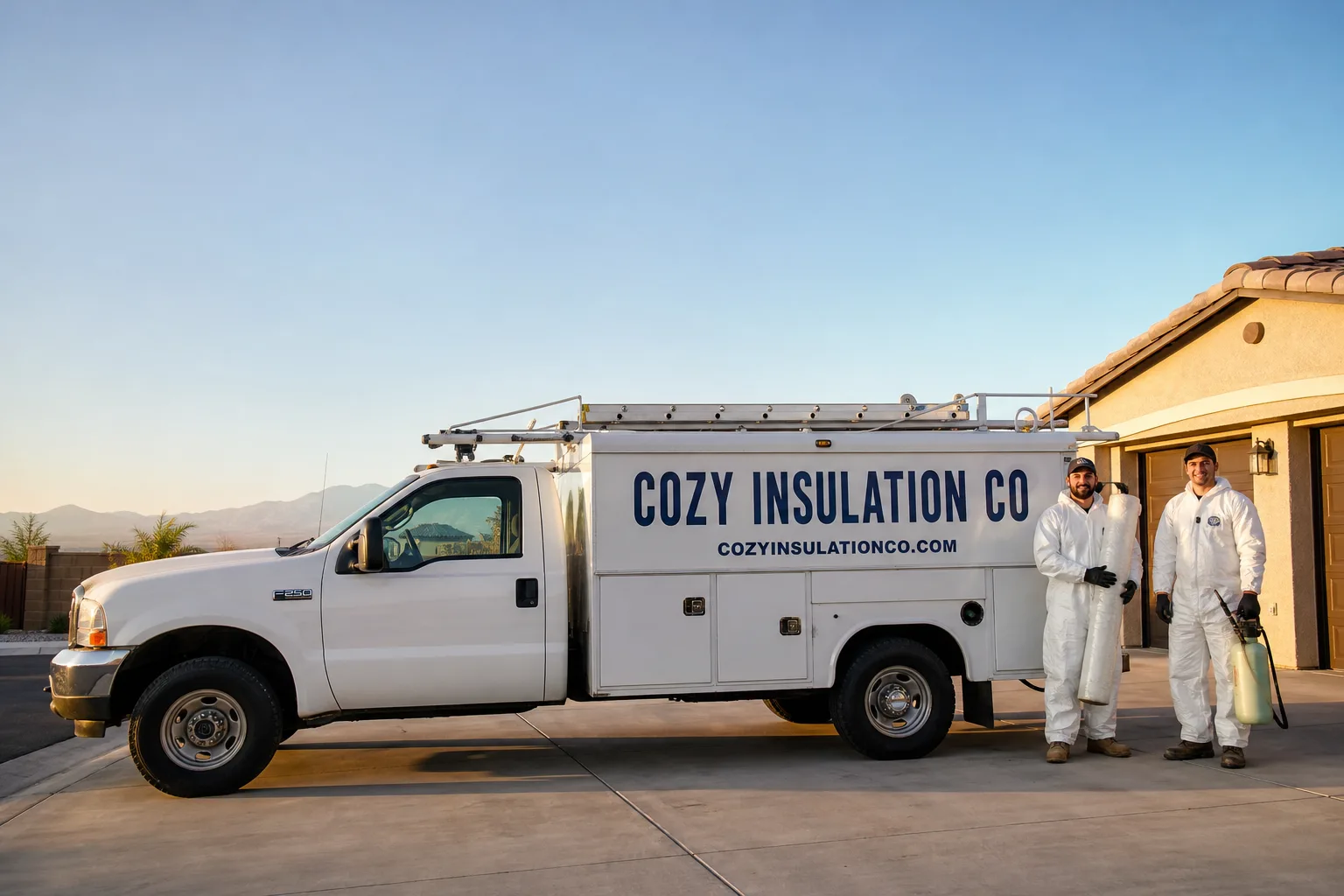
Fast, Reliable Spray Foam Insulation Across Orange
Spray foam insulation in Orange, CA typically costs $2,800 – $7,500 for a full attic application and between $900 – $2,400 for a garage ceiling or crawl space, with closed-cell running roughly 40% more than open-cell. Most Orange jobs wrap in one to two days, and we schedule within the same week for neighborhoods from Old Towne to the eastside tracts off Chapman. Call (855) 382-3925 and we’ll give you a straight answer on what your house actually needs, whether it’s a 1923 Craftsman near the Plaza or a 1960s stucco ranch east of the 55.
Mike Callahan has been running crews through Orange’s attics and crawl spaces long enough to know that this city doesn’t have one housing stock. It has two, sometimes on the same block. That matters more than most insulation companies admit, because the foam that works in a mid-century tract home is the wrong play in a knob-and-tube bungalow unless the prep work is done right. We get that. And we plan for it before we ever park the truck.
Why Cozy Insulation Co Is Orange’s Preferred Spray Foam Insulation Company
Orange homeowners call us because we show up knowing the difference between a 1920s lath-and-plaster attic off Glassell and a 1965 stucco box near the 55. That matters when you’re deciding between open-cell and closed-cell foam. Our crews work in Old Towne, the Chapman University corridor, and the tracts along Katella every week, so we don’t need a GPS to find your street and we already know what your attic probably looks like before we climb the ladder.
We’re the company that stocks both Icynene and Demilec spray foam systems, and our technicians have years of hands-on time with each. That’s not a brochure line. When a Santa Ana event pushes your attic past 130°F and the foam has to cure against hot roof sheathing, the applicator’s experience with off-ratio mixing is the difference between a clean seal and a bubbling mess. Our Orange customers see that difference in the finished result, and they say so on review sites where you can read their words, not ours.
Response time matters too. We can usually get a crew to an Orange address within 48 to 72 hours for a quote and schedule installation inside a week, unless you’re in the middle of a summer heat wave, when everyone in the 92865 and 92867 ZIP codes suddenly remembers their attic exists.
Crawl Space Spray Foam Insulation in Orange
Crawl Space Spray Foam Insulation in Orange handles the damp, under-ventilated spaces beneath the raised-floor bungalows and older ranchers that make up much of this city’s housing stock. In Orange, many of the original 1920s and 1930s homes sit on post-and-beam foundations with crawl spaces that were never insulated at all. You feel it as cold floors in winter and a musty smell that creeps up through the floorboards. We spray closed-cell foam directly to the underside of the subfloor and along the rim joists, creating an air and moisture barrier that changes how the whole house feels.
A typical crawl space spray foam job in Orange runs $1,800 – $3,400 depending on square footage and access. Tight crawls under low-pitch Craftsman bungalows take longer and cost more than open, taller spaces under mid-century homes. But the result is the same: floors that aren’t freezing in January and humidity that doesn’t climb into the living space every time the marine layer hangs around past ten in the morning.
Rim Joist Sealing for Raised Foundations
The rim joist is the single biggest air leak in most raised-floor Orange homes. We’ve watched thermal cameras show 15-degree temperature swings right at that band around the house perimeter. Closed-cell foam seals it, stops the drafts, and also blocks the rodent entry points that older Orange crawl spaces are famous for.
Moisture Control Before Foam Application
Dry rot is common in Orange crawl spaces, especially in the older parts of town where redwood and Douglas fir have been sitting on damp soil for a century. We don’t spray over rot. We identify it, mark it, and let you know what needs repair before foam goes on. Foam over rotted wood just hides the problem and makes the repair more expensive later.
Garage Spray Foam Insulation in Orange
Garage Spray Foam Insulation in Orange solves a very specific local problem: garages here become ovens by mid-afternoon. Old Towne garages are often detached, uninsulated, and topped with low-pitch roofs that bake in direct sun. Eastside attached garages from the 1960s and 70s share a wall with the house, so every degree of heat in the garage pushes into your laundry room or kitchen. We spray open-cell foam on garage ceilings and the shared wall in attached garages, and closed-cell on the roof deck of detached structures.
Garage ceiling spray foam in Orange usually falls between $900 – $2,400 for a standard two-car garage. Detached garages with exposed roof decking run on the higher end because you’re spraying a larger, more complex surface. The change is immediate: a garage that no longer radiates heat into the house at 4 p.m. and a car that doesn’t feel like a convection oven when you open the door.
Shared Wall Insulation for Attached Garages
In the 1950s-70s stucco tracts east of the 55, the garage shares a full wall with the living space and that wall often has nothing but air in the cavity. Spraying closed-cell foam into that wall cavity cuts the heat transfer dramatically. It’s one of the fastest, highest-impact fixes we do for Orange homeowners who say their laundry room or hallway is always the hottest room in the house.
Detached Garage Roof Decks in Old Towne
Old Towne garages are a different animal. Built in the 1920s alongside the houses, they have shallow roof pitches and original wood roof sheathing that’s seen a century of sun. We inspect every inch before foaming. If the wood is sound, we spray. If it’s dry-rotted or rodent-damaged, that gets addressed first. Foam over bad wood is wasted money.
Trusted Brands We Service in Orange
We are authorized installers for the spray foam systems Orange homeowners actually ask about: Icynene and Demilec. These are the two most performance-tested names in professional spray foam, and our techs are trained on both open-cell and closed-cell formulations from each manufacturer. We also carry GreenFiber cellulose and Owens Corning batt products for the homes where spray foam isn’t the right fit. Because we stock these locally for our Orange routes, we don’t run into the “we’ll order that for you” delays that plague single-brand contractors.
For a home in Old Towne with original redwood sheathing, the material choice matters less than the preparation. But when the prep is done right, Icynene open-cell and Demilec closed-cell are the two best-performing products in our trailer, and we stand behind both.
Common Spray Foam Insulation Problems We See in Orange Homes
- Foam sprayed over active rodent runs in Old Towne attics. The original redwood roof sheathing in 1920s bungalows has tunnels chewed through it by generations of rats and squirrels. Spray foam over those tunnels doesn’t stop the pests; it just hides them until they chew through the foam and you’re back to square one. We air-seal, remediate, and pest-proof first.
- Foam applied over slumped R-7 fiberglass batts in eastside tract homes. The 1950s-70s stucco homes east of the 55 were built with thin fiberglass that has long since collapsed in the attic. Spraying foam directly over it creates uneven curing and voids. The old batts come out before the foam goes in.
- Off-ratio foam bubbling during Santa Ana heat events. When attic temps exceed 130°F, spray foam applied to overheated roof sheathing can bubble, crack, or cure with uneven density. This is an applicator-skill problem, and it’s the biggest reason to hire a crew that knows Orange’s inland heat patterns, not a crew coming from the coast.
- Foam in contact with knob-and-tube wiring in historic homes. Old Towne and the surrounding early-1900s streets still have active knob-and-tube circuits. Spraying foam over energized K&T wiring is a code violation and a fire hazard. The wiring gets evaluated before any foam goes near it.
Pricing for Spray Foam Insulation in Orange, CA
Here’s what Orange homeowners should expect to pay. Attic spray foam (open-cell) on a standard 1,200-square-foot attic runs $2,800 – $4,200. Closed-cell adds about 40%, bringing the range to $3,900 – $5,900 for the same space. Crawl space work lands at $1,800 – $3,400. Garage ceilings and shared walls come in at $900 – $2,400. The variables are access (Old Towne attics with low pitch and original sheathing take more prep), existing insulation removal, and whether pest remediation or dry-rot repair is needed before foam is applied. We give free estimates, and the price we quote is the price you pay. Call (855) 382-3925 for an exact number on your house.
We Also Serve Cities Near Orange
Our crews handle Spray Foam Insulation in Orange every week, and we run the same trucks to Villa Park, North Tustin, Tustin, and Anaheim. If you’re in one of those neighboring cities and want a crew that already knows the local housing stock across this whole stretch of Orange County, call us. You’ll get the same prep-first approach whether your street is in Orange proper or just over the city line.
Serving Orange, CA — Our Local Coverage Area
We’re based in the Orange area and know this community well. Use the map below to see our service coverage — if you’re nearby, we can almost certainly help.
FAQs About Spray Foam Insulation in Orange
In almost every case, yes. Old fiberglass batts in Orange attics have been cooking under Santa Ana heat for decades; they’re compressed, dusty, and doing nothing for you. More importantly, foam sprayed over them won’t adhere properly to the roof deck or cavity surfaces. In the eastside stucco tracts where original R-7 batts have slumped into the truss bays, we remove everything before foam goes in. The only exception is blown-in fiberglass that’s still dry and relatively fresh, which we can sometimes leave in place depending on the foam type and substrate. Call us at (855) 382-3925 and we’ll tell you what applies to your attic.
We treat the pest problem before a single ounce of foam leaves the rig. In Old Towne attics, that typically means removing rodent-damaged redwood sheathing sections, sealing entry points with pest-resistant mesh and caulk, and treating the runs. Only then do we spray. Foam over active rodent runs fails fast: the animals chew new holes, the foam gets shredded, and you pay twice. Call us for an assessment.
No. Spray foam must not be applied directly over active knob-and-tube wiring, and this is non-negotiable in Orange’s historic districts where K&T circuits are still common. The foam can insulate the conductors and cause them to overheat. No reputable contractor will do it. The wiring needs to be evaluated, deactivated, or replaced before insulation touches those cavities. We flag this on almost every Old Towne project we quote.
For Orange attics, we recommend R-38 to R-49 for open-cell on the attic floor or roof deck, and R-21 to R-28 for closed-cell in wall cavities and rim joists. The Santa Ana heat here pushes attic temperatures above 130°F for days at a time, so the attic insulation has to be thick enough and correctly installed to keep that heat out of your living space. The R-value only tells half the story; spray foam’s air-sealing is what stops the convection that batt insulation can’t. Call (855) 382-3925 and we’ll walk you through what your specific attic needs.
In Orange’s inland climate, garages and crawl spaces need different foam than what coastal cities use. Our dry, hot afternoons mean garage ceilings need open-cell with enough depth to stop radiant heat transfer, while crawl spaces need closed-cell to block the ground moisture that feeds dry rot in our older raised foundations. The marine layer’s morning dampness also matters: in crawl spaces it creeps in and condenses on wood, so an air and vapor barrier you get from closed-cell foam is a bigger win here than it would be three miles west in Santa Ana. We customize each application to that specific microclimate, because Orange doesn’t have one weather pattern; it has an inland pattern with coastal mornings.
Written by Mike Callahan, Owner at Cozy Insulation Co, serving Orange since day one.