
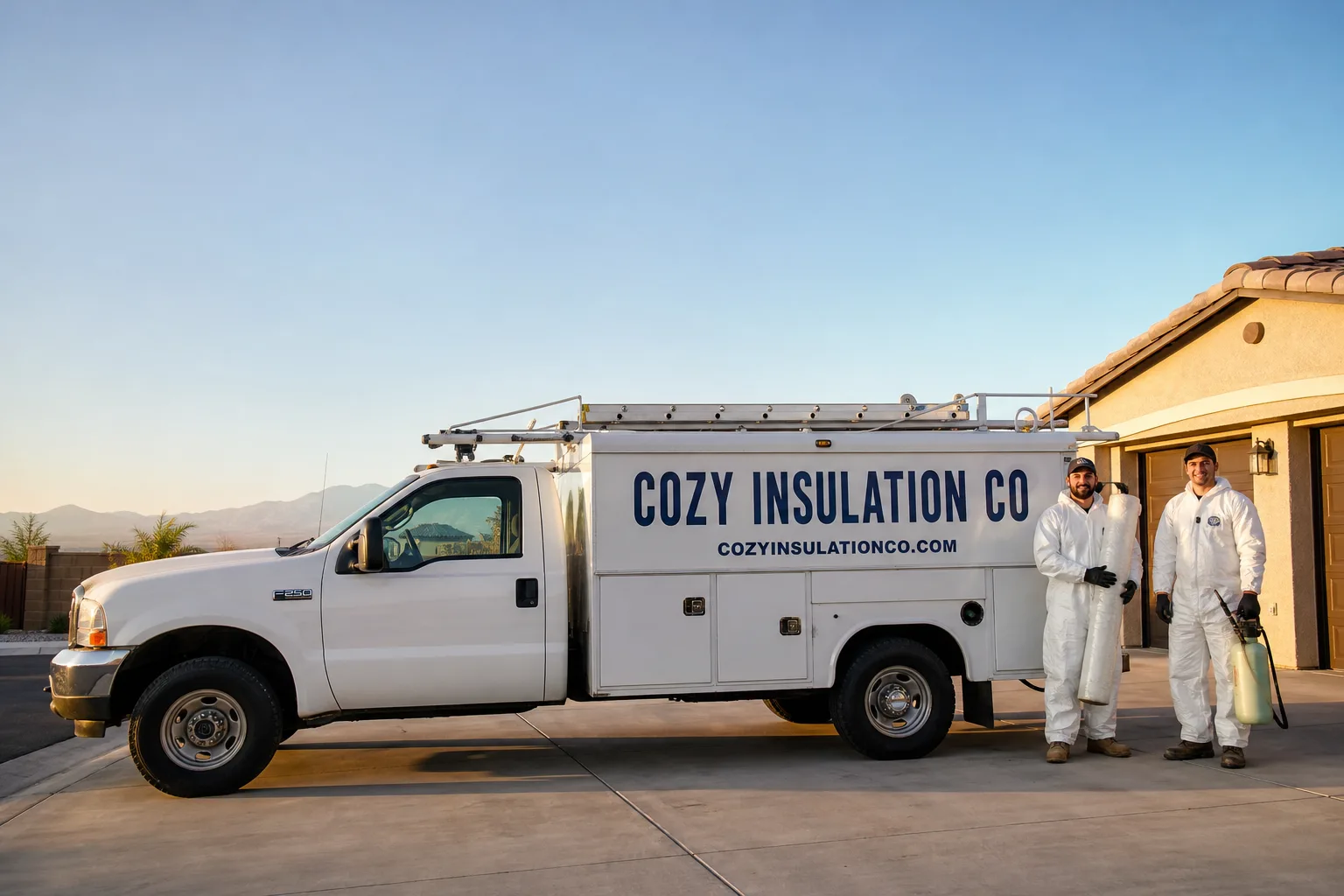
Fast, Reliable Spray Foam Insulation Across Murrieta Hot Springs
Spray foam insulation in Murrieta Hot Springs typically costs $1,800 – $7,200 per project depending on whether you’re sealing a rim joist, a garage ceiling, or a full attic roofline. Most jobs in the 92563 ZIP are done in a single day, and we schedule service calls across Murrieta Hot Springs within two to three business days. If your tile-roof attic is baking your upstairs rooms, call (855) 382-3925 and Mike Callahan will walk you through what’s actually going on up there before we ever send a crew.
This page explains why Murrieta Hot Springs is a uniquely demanding market for spray foam, what it costs here, and how we approach installation so the foam doesn’t just cover a surface but actually changes how your house feels at 4 p.m. on a 100° day.
Why Cozy Insulation Co Is Murrieta Hot Springs’s Preferred Spray Foam Insulation Company
We work all over the 92563 ZIP because we understand the housing stock here. Most homes in Murrieta Hot Springs went up between 1990 and 2015, and nearly all of them shipped with builder-grade fiberglass batts that were fine for code minimums but not for what the Temecula Valley heat asks of them. The tile roofs look great, but they turn vented attics into ovens, and that’s where we spend most of our time diagnosing discomfort.
Our Spray Foam Insulation team has pulled compressed batts out of hundreds of attics across this specific market, from neighborhoods near Murrieta Hot Springs Road to the tract developments off Winchester and Pourroy. We don’t have to guess what’s causing a second-story heat differential here. We’ve measured it, fixed it, and heard back from homeowners who couldn’t believe the difference.
Mike Callahan personally reviews the scope on every Murrieta Hot Springs job before we spray. That means the foam you get is the foam the house needs, not whatever’s easiest to shoot. Two to three business days to get a crew out, free estimates, and no pressure to buy beyond the square footage that makes sense.
Spray Foam Wall Insulation in Murrieta Hot Springs
Spray foam wall insulation in Murrieta Hot Springs is one of the most effective ways to stop afternoon wall-driven heat from the city’s west-facing stucco exposures, and the work usually runs $2,200 – $5,800 depending on whether we’re opening drywall on an existing home or spraying open stud cavities during a remodel. The west-facing walls here don’t just get warm. They hold heat well into the evening, and fiberglass batts in the stud bays can’t stop the thermal bridging through the framing. Closed-cell foam does, because it binds to the sheathing and closes off the air path.
Why Wall Cavities Matter Here
Most Murrieta Hot Springs homes have stucco over wood frame with minimal exterior insulation. That’s fine in a mild coastal climate, but in this inland basin it means wall cavities hit temperatures that make air conditioning run harder. Spray foam in the wall cavity creates both an air seal and an insulation layer in one pass.
We’ve watched owners chase upstairs comfort with bigger AC units when the real issue was in the walls and rim joists. The foam goes in, the thermal envelope closes, and the system doesn’t have to fight the building envelope.
Open-Cell vs Closed-Cell for Walls
In a 92563 tract home with existing drywall, we generally recommend open-cell foam for wall cavities where we can access them from the attic or during a remodel. It expands to fill odd framing gaps and performs well for sound dampening between rooms. Closed-cell makes sense when moisture resistance is a concern or when the wall assembly is exposed to the garage or an unconditioned space.
Rim Joist Spray Foam in Murrieta Hot Springs
Rim joist spray foam in Murrieta Hot Springs is the most overlooked insulation upgrade in this market, and sealing the rim joist in a typical 92563 garage runs $800 – $1,900. The rim joist is the wood band where your floor framing meets the foundation, and in most Murrieta Hot Springs homes it was never air-sealed. That gap lets superheated attic and garage air move into the floor and wall cavities, which is why rooms above garages are chronically uncomfortable.
Why Garage Rim Joists Fail Here
Garages in this area are almost always unconditioned. In summer the garage air itself hits 110°F plus, and that hot air gets drawn into the home through the unsealed rim joist. We see this constantly in the newer tract homes off Murrieta Hot Springs Road, where builders skipped the rim joist seal to save a few dollars in year 2000 and the homeowner pays for it every August.
A two-inch pass of closed-cell foam across the rim joist band stops the air movement entirely. It’s usually a morning job, and the comfort payoff is immediate, especially in rooms directly above the garage.
What a Proper Seal Looks Like
We spray closed-cell foam across the full rim joist band, covering the gap between the sill plate and the subfloor. We also check for penetrations where plumbing and electrical runs pass through the rim, since those are secondary leak paths. In a Murrieta Hot Springs home, this one repair often brings the cantilevered bedroom or bathroom above the garage within a couple degrees of the rest of the house.
Trusted Brands We Service in Murrieta Hot Springs
We spray Icynene open-cell and Demilec closed-cell systems in Murrieta Hot Springs because both have been tested for the sustained high heat this market throws at foam. Icynene’s open-cell formulation handles the interior walls and rooflines well, and Demilec’s closed-cell products hold up under the thermal stress of tile-roof attics that run 160°F plus. We also install GreenFiber cellulose for homeowners who want a recycled-content option in their attic or walls. Our trucks carry material for these installations, so we’re not waiting on a distributor in Temecula to get your job scheduled.
Common Spray Foam Insulation Problems We See in Murrieta Hot Springs Homes
- Foam shrinkage at the roof deck: Attics under tile roofs in Murrieta Hot Springs can hit 160 – 180°F in summer, and foam applied with the wrong formulation or in too-thick a single pass can shrink and pull away from the decking. That opens air gaps exactly where radiant heat is worst. We spec high-temperature-rated closed-cell for roof decks here, not generic open-cell.
- Unsealed rim joists defeating the whole system: We regularly find spray foam installed in the attic while the garage rim joist is left wide open. Hot air migrates through wall cavities and undercuts the R-value of the attic work. You can’t fix the top of the house while the bottom is still leaking.
- Off-gassing and lingering odors: Tile roofs slow attic ventilation, and when low-density open-cell is sprayed too thick in one pass, the chemical smell can linger for weeks in a Murrieta Hot Springs home. We control lift thickness and ventilate properly so the foam cures clean before you’re living with it.
- UV degradation near eaves and garage doors: Exposed foam around garage door frames and eave overhangs breaks down quickly under Riverside County sun, especially with the intensity this valley gets. Any foam we install in exposed areas gets an ignition barrier or covering to prevent UV and fire risk.
One 92563 homeowner near Murrieta Hot Springs Road called us because a west-facing upstairs bedroom was running 10°F hotter than the rest of the house every afternoon. We found builder-grade fiberglass batts compressed to half their intended thickness and a rim joist in the garage left unconditionally open. We sprayed two inches of closed-cell foam on the rim joist and applied open-cell foam to the attic roofline. The room came within 3°F of the downstairs, and the AC stopped running through the evening.
Pricing for Spray Foam Insulation in Murrieta Hot Springs, CA
Here’s what we’re seeing in the Murrieta Hot Springs market right now. A garage ceiling spray foam job runs $1,400 – $3,200. Full attic roofline encapsulation in a typical 2,000-square-foot tracked home runs $4,800 – $7,200. Wall spray foam on an existing home runs $2,200 – $5,800 depending on access. Rim joist work runs $800 – $1,900. Closed-cell foam costs more per board foot than open-cell, but in the 92563 heat, closed-cell at the roof deck and rim joist is often the correct spec. Call (855) 382-3925 for a free estimate, and Mike will give you the exact square footage and thermal performance plan before you commit.
We Also Serve Cities Near Murrieta Hot Springs
Our crews cover the full Temecula Valley, so if you’re in Murrieta Hot Springs or anywhere in the surrounding area, we’re close. We regularly work in Murrieta, Temecula, Wildomar, and Quail Valley, and the same team handles every job so the insulation plan stays consistent across your project.
Serving Murrieta Hot Springs, CA — Our Local Coverage Area
We’re based in the Murrieta Hot Springs area and know this community well. Use the map below to see our service coverage — if you’re nearby, we can almost certainly help.
FAQs About Spray Foam Insulation in Murrieta Hot Springs
Yes, when you use a closed-cell formulation rated for sustained high-temperature exposure. Murrieta Hot Springs attics under tile roofs routinely hit 160 – 180°F on summer afternoons, and open-cell foam applied at the roof deck can soften, shrink, or off-gas in those conditions. We use Demilec closed-cell at the roofline here for that reason. Call (855) 382-3925 for a free attic inspection and we’ll tell you exactly which foam your roof deck needs.
Because in an inland heat basin, your rim joist is a direct air leak between the hot garage or outside air and the inside of your walls. Murrieta Hot Springs tract homes from the 1990s and 2000s almost never had rim joists sealed at construction, so hot air pours into floor and wall cavities all afternoon. A single pass of closed-cell foam across the rim band closes the leak and typically brings adjacent rooms within a few degrees of the rest of the house. This is one of the highest-value insulation fixes you can make here.
It means the foam has to perform in 95 – 105°F daytime highs with attic temperatures that can exceed 170°F, not in mild coastal conditions. That changes which products we recommend and how we apply them. We control lift thickness, use high-temperature-rated closed-cell at the roof deck, and make sure the foam cures correctly in hot, vented attics before we leave. A foam job spec’d for San Diego won’t hold up in the Murrieta Hot Springs heat.
Yes, and it’s usually the fastest fix. In Murrieta Hot Springs homes, the second-floor heat differential is typically driven by a superheated attic, compressed builder-grade batts, and an unsealed rim joist pulling hot air into the upper floor framing. Sealing the rim joist and getting the attic roofline done with the right foam closes both heat paths. We’ve measured these fixes in local homes and regularly see the upstairs come within a few degrees of the downstairs.
We install Icynene open-cell and Demilec closed-cell spray foam, both of which are performance-tested for sustained high-temperature conditions like those in Murrieta Hot Springs attics. We also offer GreenFiber cellulose where a recycled-content blown-in product makes more sense. We’re not tied to one brand, so the recommendation comes from the house’s actual heat profile, not our inventory sheet.
Written by Mike Callahan, Owner at Cozy Insulation Co, serving Murrieta Hot Springs and the Temecula Valley with spray foam, attic, and blown-in insulation.