
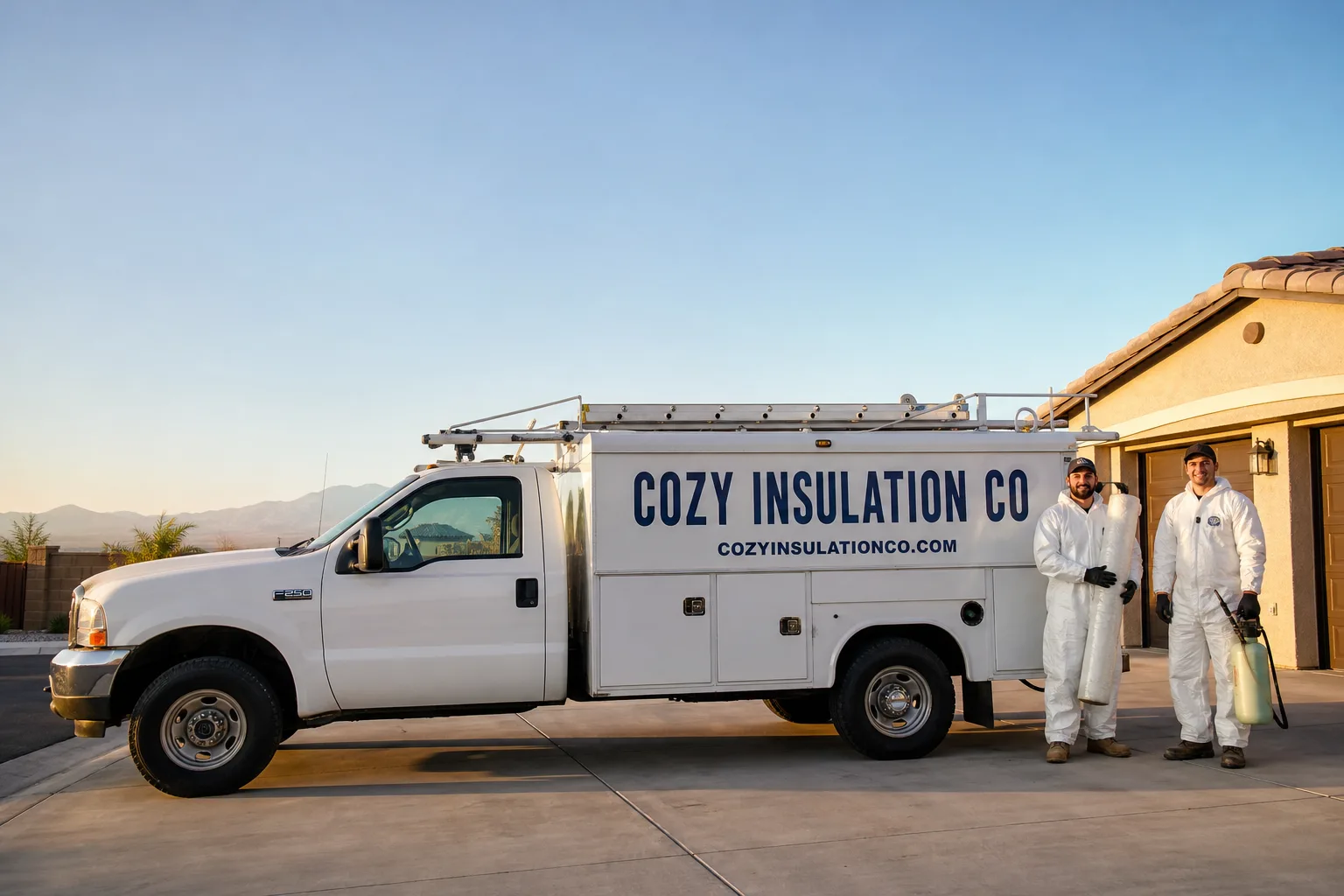
Fast, Reliable Spray Foam Insulation Across Monrovia
Spray foam insulation in Monrovia typically costs $2.50 to $6.80 per board foot installed, with most whole-attic projects landing between $3,200 and $7,400 depending on whether you’re sealing a rim joist or insulating a full roof deck. Our crews roll into Monrovia from Corona in under 40 minutes, and we stock both open-cell and closed-cell Icynene and Demilec systems on every truck, so there’s no second trip for materials. If your north-side tract home bakes in the summer sun or your Old Town bungalow has drafts that move the curtains, call (855) 382-3925 and we’ll give you an honest read on what your walls and attic actually need. Mike Callahan built Cozy Insulation Co around material matching – not selling whatever is easiest to spray – and that matters more in Monrovia than most places.
Why Cozy Insulation Co Is Monrovia’s Preferred Spray Foam Insulation Company
Monrovia isn’t one housing market; it’s three or four stacked on top of each other. The bungalows near Myrtle and Lime Avenue date to the 1920s and 1930s with framing that has moved and settled for a century. The tract homes climbing north of Foothill Boulevard toward the base of the San Gabriels were built fast in the 1960s and 1970s, most with thin original insulation and attic geometry that fights any installer who doesn’t know what they’re walking into. Then you’ve got a handful of newer builds tucked into hillside lots off Canyon Boulevard where the wind exposure changes everything. We’ve sprayed foam in all of them. Homeowners in the 91016 and 91017 zip codes call us because we lead with what the house needs, whether that’s two inches of closed-cell along the roofline or a targeted rim joist application that stops the floor from feeling cold in January. That’s the difference between a crew that drives up from wherever and a company that knows why your attic smells like hot dust every August.
Mike Callahan and our techs have spent enough time on Monrovia’s sloping streets to know the failure patterns before we open the attic hatch. We know that low-pitch attics on the north side hold heat differently than a flat-land rancher in Arcadia. We know that the canyon wind off the San Gabriels finds gaps that a thermal camera misses on a still day. And we know that showing up on time, keeping the job site clean, and explaining what we found before we spray is how you build trust in a city where homeowners have seen too many contractors cut corners. We’re state-licensed and insured, we offer free estimates, and we stand behind the manufacturer warranties on every system we install.
Rim Joist Spray Foam in Monrovia
Rim joist spray foam in Monrovia runs $950 to $2,400 for a typical home, and it’s one of the most overlooked fixes for the cold-floor problem that shows up in so many foothill houses when evening air drains down from the mountains. The rim joist is the band of framing where your floor meets your foundation wall, and in Monrovia’s older homes it’s often totally unsealed – just wood sitting on concrete with nothing between the crawl space air and the living space above. We spray closed-cell foam into every joist bay, which air-seals and insulates in one pass. On a 1960s tract home off Norumbega Drive, this is usually a half-day job; in a pre-war bungalow near Old Town with a rubble foundation, it takes longer because the irregular stone leaves gaps that need careful gun work. A properly sealed rim joist in Monrovia means floors that don’t suck heat out of the room and an attic that stops pulling musty crawl space air upward.
Sloping Sites and Crawl Space Air
Homes on Monrovia’s foothill slopes sit above crawl spaces that exhale cold air every evening. The rim joist is the boundary, and when it leaks, it doesn’t matter how much insulation sits in the attic – the stack effect pulls cold air up through the walls. We treat rim joist work as an air-sealing job first and an insulation job second, which is the order that actually changes how the house feels.
Closed-Cell for Foundation Contact
Where the rim joist meets masonry or stucco, we use closed-cell foam from Demilec almost exclusively. It holds compressive strength, doesn’t absorb the moisture that concrete foundations wick upward, and doubles as a vapor barrier in a zone where open-cell would sit damp. In Monrovia’s older balloon-framed houses, we often find the rim joist is the only barrier between the crawl space and the wall cavity, so getting the material choice right matters more than the R-value math.
Crawl Space Spray Foam Insulation in Monrovia
Crawl space spray foam insulation in Monrovia typically runs $2,800 to $6,500 for a full encapsulation-grade application, and if your house sits on one of the sloping streets above Foothill, it’s worth understanding what that crawl space is doing to the rest of the building. Many Monrovia homes have vented crawl spaces that pull in whatever air the foothills deliver – cool and damp in spring, bone-dry and dusty during Santa Ana season. We spray the crawl space walls and rim joists with closed-cell Icynene, which creates an air and moisture boundary that open, vented floors can’t match. This isn’t a fiberglass batt that sags out of the floor joists in five years; it’s a monolithic seal that stops the stack effect at its source. For homes in the 91017 zip code, especially those near the base of the mountains where drainage and soil moisture vary block by block, a sealed crawl space changes the way the whole house holds temperature.
Why Monrovia Crawl Spaces Need a Different Approach
Canyon-fed evening air cools the crawl space faster than the floor above, and that differential is what drives dampness and cold-floor complaints. A vented crawl space in Monrovia is basically an uninsulated basement with extra steps. We spray the foundation walls and leave the floor joists alone, which keeps the thermal boundary at the perimeter where it belongs instead of trying to insulate against ground air that never stops moving.
Encapsulation Without the Complexity
Full encapsulation sometimes gets overbuilt. In Monrovia, the practical version is spray foam on the walls, a vapor barrier on the dirt floor, and attention to any knee walls or penetrations where plumbing and wiring come through. That’s the setup that stops the cold-floor problem, keeps the subfloor dry, and doesn’t require reengineering the entire vented system from scratch.
Trusted Brands We Service in Monrovia
We install spray foam systems from Icynene and Demilec, which represent the performance ceiling of residential insulation – Spray Foam Insulation done right, with closed-cell and open-cell chemistry backed by decades of field testing. Because we’re authorized installers for both manufacturers, we can match the foam to the problem: Demilec closed-cell where moisture and structural strength matter, Icynene open-cell where air sealing and sound dampening are the priority. That’s two of the eight brands in our full portfolio, which also includes Owens Corning, CertainTeed, Rockwool, and GreenFiber for jobs where spray foam isn’t the answer. Keeping trucks stocked for Monrovia means we don’t have to run back to the shop when a job runs long, and that keeps your project moving.
Common Spray Foam Insulation Problems We See in Monrovia Homes
- Compressed original batts in pre-war bungalows. In the 1920s-era homes near Old Town, original fiberglass or mineral wool batts have typically settled to half their original thickness or less. Spray foam has to be applied after removing or isolating that old material – not sprayed over it, which creates a false seal that traps stale air between layers.
- Uninsulated rim joists in 1960s-70s tract homes. The framing where floor meets foundation was rarely sealed when these houses went up. Cold evening air off the San Gabriels moves through those bays and into the walls, which is why so many north-side homes feel drafty even with attic insulation present.
- Knob-and-tube wiring in Old Town walls and attics. This is the one that separates careful installers from everyone else. Foam sprayed directly over active knob-and-tube creates a heat-adjacent fire risk and a code violation. We isolate and box around the wiring before applying any foam, which takes more time but is the only correct approach.
- Low-pitch attics that hold heat under the roof deck. On Monrovia’s foothill slopes, shallow attic spaces bake in direct sun through the summer. Poorly applied foam at the roofline degrades under the heat cycling, and Santa Ana winds stress every air-sealing point. We inspect for previous amateur foam work and cut out and replace failed sections before spraying new material.
Pricing for Spray Foam Insulation in Monrovia, CA
Rim joist spray foam in Monrovia runs $950 to $2,400. A crawl space application with closed-cell foam on the walls and rim area lands between $2,800 and $6,500 depending on square footage and access. Whole-attic projects – either open-cell under the roof deck or closed-cell along the roofline – range from $3,200 to $7,400 for typical Monrovia homes. Larger hillside properties off Canyon Boulevard or north of Hillcrest with complex roof geometry can push toward the top of that range or slightly beyond. Factors that move the number: how much old insulation has to come out first, whether we’re isolating knob-and-tube wiring, fixture and can light setbacks, and how much prep the roof deck needs before we spray. We give free, itemized estimates so you know what you’re paying for before the truck shows up – call (855) 382-3925 to schedule a walkthrough.
We Also Serve Cities Near Monrovia
If you’re in Mayflower Village, Duarte, Bradbury, or Arcadia, you’re within our normal service area and we run crews there every week. Monrovia is one stop on a route that covers the whole foothill corridor, so scheduling is fast whether you’re off Huntington Drive or up near the base of the mountains.
Serving Monrovia, CA — Our Local Coverage Area
We’re based in the Monrovia area and know this community well. Use the map below to see our service coverage — if you’re nearby, we can almost certainly help.
FAQs About Spray Foam Insulation in Monrovia
Yes – Monrovia’s summer heat is more intense than the basin, and the cold canyon-fed evenings mean the insulation has to work in both directions rather than just keeping heat out. We typically recommend closed-cell foam at 2 to 3 inches on rim joists and crawl space walls in Monrovia, where the moisture and temperature swings are more aggressive than a flat-land home in El Monte or Rosemead. For roof decks and attics, the target is usually R-38 to R-49, and closed-cell hits that with a thinner profile than open-cell – which matters a lot in the low-pitch attics on the north side. If you want a number for your specific roofline, call (855) 382-3925 and we’ll measure it properly.
Yes, but only after we isolate the wiring. Knob-and-tube systems run hot by design, and spraying foam directly over them traps heat in a way that creates a fire risk and a code violation. Our techs box around the wiring with non-conductive barriers before applying Icynene open-cell to the wall cavities, so you get the air-sealing benefit without the hazard. This adds prep time, but in the pre-war bungalows near Myrtle Avenue it’s the difference between a correct retrofit and a dangerous shortcut.
They bake. A shallow attic on a Monrovia hillside gets hit with direct sun for hours during the summer, and the roof deck heats up to the point where poorly applied foam can delaminate or lose adhesion over repeated heat cycles. We check the roof deck temperature and existing vapor conditions before we choose between open-cell and closed-cell, and on low-pitch roofs we often recommend closed-cell at the roofline because it holds its shape and R-value under heat stress better than open-cell.
Yes, and the slope is the reason. Homes built into a hillside have crawl spaces on the downhill side that sit open to whatever air moves through at night, and in Monrovia that’s cold air draining off the San Gabriels. That cold air hits the unsealed rim joist and travels up through the wall cavities, which is why you can have attic insulation and still feel drafts at the floor line. Sealing the rim joist with closed-cell foam stops the stack effect at the source and makes the whole house hold temperature more evenly.
Only if you remove or isolate the old batts first. Spraying foam over compressed fiberglass or mineral wool doesn’t seal anything – it just buries the problem under a layer of plastic that makes it harder to fix later. In the pre-war bungalows near Old Town, we remove the settled batts, assess the framing, and then apply spray foam directly to the wall or floor surface where it can actually air-seal and insulate. Leaving the old material in place under the foam is the kind of shortcut that causes the very drafts and hot rooms you were trying to fix. For a straight answer on your attic, call (855) 382-3925 – we’ll take a look and tell you what’s actually there.
Mike Callahan started Cozy Insulation Co to match every home with the right insulation – not the easiest one to install. Monrovia’s mix of old bungalows, mid-century tract homes, and hillside builds means no two attics are the same, and that’s exactly the work we like. Call (855) 382-3925 for a free estimate, and we’ll walk through what your house needs, what it costs, and why it’ll feel different when it’s done.
Written by Mike Callahan, Owner at Cozy Insulation Co, serving Monrovia and the surrounding foothill communities.