
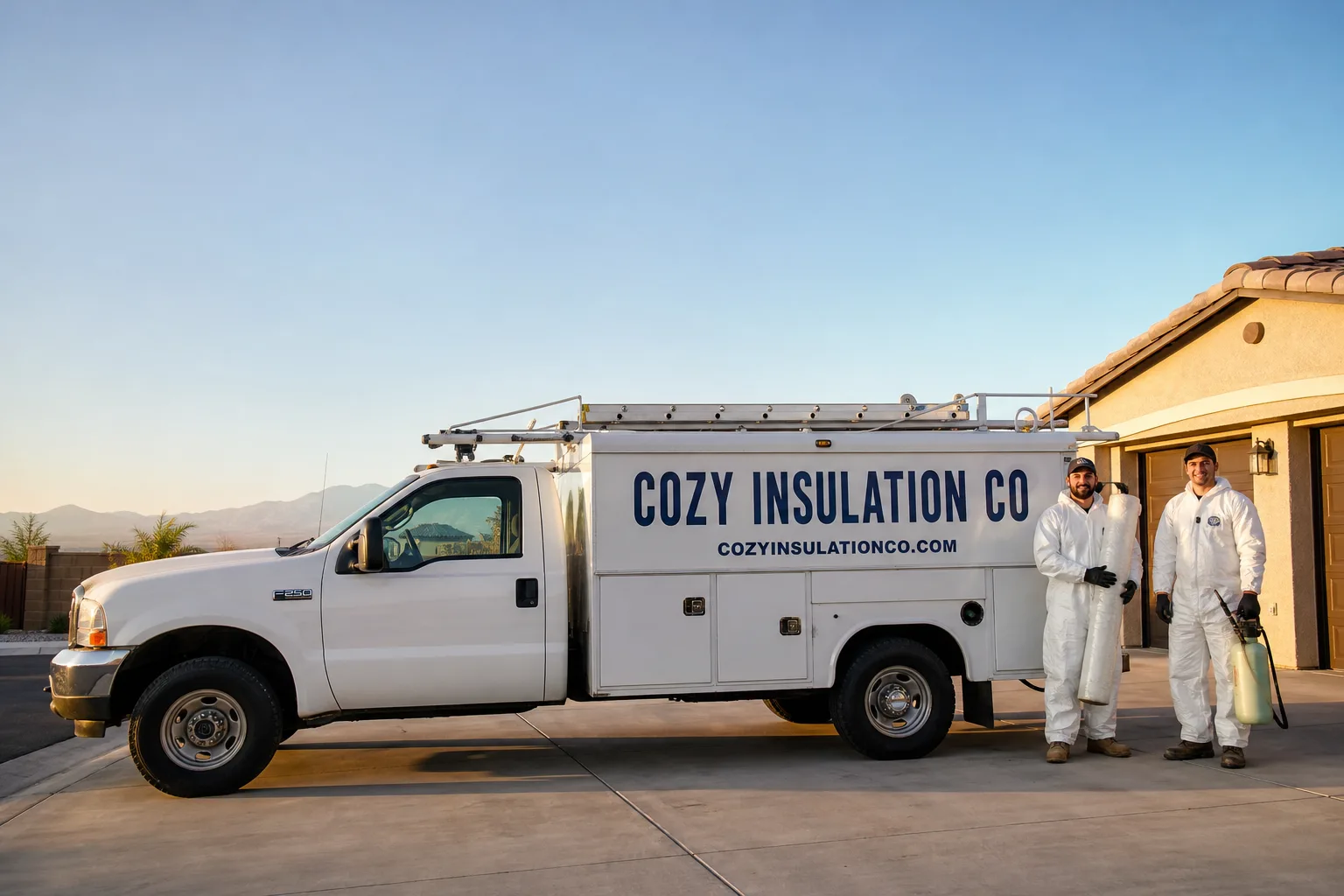
Fast, Reliable Spray Foam Insulation Across Highgrove
If you live in Highgrove and your front rooms bake by noon while the AC runs nonstop, the problem usually isn’t your HVAC – it’s the unsealed rim joist and crawl space under your feet. Older ranch homes here sit close to the ground with low-pitch roofs, and that construction style traps heat in ways newer builds don’t. Our crews know those homes because we’ve foamed dozens of them across the 92313 corridor. We match the right spray foam system to the void that’s actually leaking, not the one that’s easiest to reach. Call (855) 382-3925 for a free inspection and an honest read on what your house needs.
Why Cozy Insulation Co Is Highgrove’s Preferred Spray Foam Insulation Company
Highgrove homeowners keep calling us for one reason: we work the accessible voids on old ranch construction instead of forcing roofline foam where it doesn’t belong. That restraint comes from time spent inside these attics and crawl spaces, not from reading about them online. Mike Callahan leads our crews with a simple rule – if the foam can’t be applied at a consistent thickness in that cavity, we say so and recommend what actually fits. In Highgrove that often means rim joist and crawl space work, with radiant-barrier or blown-in retrofits handling the roofline. You get one company that understands the whole house, not a subcontractor guessing at one part of it.
We’re licensed and insured, and our technicians run spray foam systems from Icynene and Demilec – two of the most performance-tested names in the professional spray foam industry. When a Highgrove homeowner asks about the difference between open-cell and closed-cell for their crawl space, we can answer with real experience from jobs on this side of Riverside, not a sales script. That’s what keeps our phone ringing in Grand Terrace, Colton, and right here in the 92313.
On a mid-century ranch off the 92313 corridor in Highgrove, we found the original rim joist open to the crawl with settled, thin insulation and sun-baked air pushing up through the floor system by mid-morning. Our crew shot closed-cell foam along the rim and band joist and foamed the crawl space walls before dawn, when the low-pitch attic was still workable, then verified the seal against the intense inland heat load. The homeowner noticed the front rooms stopped overheating before noon. That’s the kind of outcome we look for on every Spray Foam Insulation job we take.
Key Takeaways for Highgrove Homeowners
- Low-pitch ranch roofs change the game. In Highgrove, spray foam usually belongs at the rim joist and crawl space, not across a tight attic roofline.
- Pre-dawn starts aren’t a gimmick. They’re how our crews work safely and achieve consistent foam thickness before inland heat makes attics dangerous.
- Closed-cell foam seals and insulates. On old rim joists it blocks hot air intrusion from the crawl while adding structural rigidity.
- You get real options. We install Icynene and Demilec systems alongside fiberglass, mineral wool, and cellulose – so the material fits the home, not our inventory.
Rim Joist Spray Foam in Highgrove
Rim Joist Spray Foam is the single highest-impact insulation upgrade on most older Highgrove ranch homes, because the band joist is where the crawl space meets the outside wall and where heat pours in all summer. The exposed rim joist on a 1960s one-story here is often completely uninsulated – just wood sheathing between the crawl and the sunbaked exterior air. We clean the rim and band joist surface, then shoot closed-cell foam into every bay to create an air seal and thermal break in one pass. For a typical Highgrove home, rim joist foam runs $650 – $1,450 depending on linear footage and access. Most jobs finish in under a day.
When a Highgrove homeowner needs it
You’ll feel the need before you see it. Rooms above the crawl stay hot long after the AC kicks on, and you might notice a faint musty smell when the air runs. Those are signs the band joist is leaking hot, dry crawl air into conditioned space.
How the climate drives the fix
Highgrove’s inland heat isn’t just an attic problem. The sun bakes the exterior walls and the ground, heating the crawl space until it pushes hot air up through every gap at the rim. Foam seals those gaps and stops the stack effect. Once sealed, the crawl stops acting like a heat source under your floor.
Crawl Space Spray Foam Insulation in Highgrove
Crawl Space Spray Foam Insulation in Highgrove is the companion fix to rim joist work – you seal the walls and then you insulate them, so the entire crawl becomes a passive, conditioned buffer under the house. On the older ranch homes here, crawl space walls are often bare concrete or thin fiberglass batts that have sagged and settled for decades. We apply closed-cell foam directly to the crawl space walls to insulate and air-seal them in one step. A full crawl space encapsulation with spray foam on the walls typically runs $2,800 – $6,500 for a Highgrove home, depending on square footage, access height, and whether we’re also foaming the rim joist at the same time.
Sealing before you insulate
Here’s the thing about Highgrove crawl spaces: the hot, dry air trapped against those old walls means foam over the existing mess won’t fix the problem. We remove or reset decades-settled insulation first, address any moisture or pest damage, then shoot foam onto a clean substrate. That order matters as much as the foam itself.
What it means for your floor
Once the crawl space walls and rim joist are sealed, the floor system stops pulling hot air upward into your living space. Front rooms that used to overheat by mid-morning hold their temperature. That’s the difference between adding insulation and actually changing how the house behaves in inland heat.
Trusted Brands We Service in Highgrove
We’re authorized to install spray foam systems from Icynene and Demilec, two manufacturers whose products carry a long testing history in hot, dry climates like ours. When a Highgrove homeowner asks about open-cell versus closed-cell, we can talk through real performance differences between these systems because we’ve shot both. Beyond foam, our eight-brand portfolio includes CertainTeed and GreenFiber for homes where a hybrid approach – foam at the rim, blown-in at the attic – makes more sense. We keep the materials coming from local supply partners, so a Highgrove job doesn’t stall waiting on product to ship from out of state.
Common Spray Foam Insulation Problems We See in Highgrove Homes
- The rim joist was skipped entirely. Original ranch construction often left the band joist open to the crawl, and after decades of inland sun the whole crawl becomes a heat reservoir pushing hot air up through the floor.
- Roofline foam was attempted on a low-pitch deck. When an attic cavity has barely 18 inches of clearance at the eaves, crews trying to shoot across the roofline end up with thin spots and uneven thickness that fail under Highgrove’s sustained heat. The foam belongs at the rim and crawl, not the roofline.
- Settled original insulation behind crawl space walls. Fiberglass from the 1960s and 1970s has compressed to a fraction of its original R-value, but it still traps hot, dry air against the walls. Foam can’t fix that unless the old material is pulled and the cavity is sealed first.
- Open crawl vents undoing the work. Some Highgrove homeowners foam the walls but leave the crawl vents wide open. In our climate, that’s a slow leak of cool air in summer and a pathway for heat to re-enter. Sealing means closing and covering those vents after the foam cures.
Pricing for Spray Foam Insulation in Highgrove, CA
Rim joist spray foam in Highgrove runs $650 – $1,450 on most ranch homes, while a full crawl space wall spray foam job lands between $2,800 – $6,500. Homes that need both typically come in toward the middle of that range. What moves the number: linear footage of band joist, crawl space square footage and ceiling height, whether we’re removing old settled insulation, and which foam system – open-cell or closed-cell – fits the void. Closed-cell costs more per board foot but delivers a higher R-value per inch and acts as a vapor barrier, which matters in a crawl that’s been hot and dry for decades. We give you a written quote before any work starts. Call (855) 382-3925 and we’ll walk the house, take measurements, and hand you a number that won’t change at the end.
We Also Serve Cities Near Highgrove
Our crews run from Highgrove into Highgrove and back most days, so we’re a short drive from Grand Terrace, Colton, Loma Linda, and Rubidoux. Same scheduling, same crews, same foam systems. If you’re on the edge of the 92313 and wondering if we cover your street, call and ask.
Serving Highgrove, CA — Our Local Coverage Area
We’re based in the Highgrove area and know this community well. Use the map below to see our service coverage — if you’re nearby, we can almost certainly help.
FAQs About Spray Foam Insulation in Highgrove
Because the roofline on most Highgrove ranch homes has too little attic clearance for consistent foam thickness, and the real heat intrusion happens at the rim joist and crawl space walls. Foam applied to a low-pitch deck ends up thin and uneven, failing under sustained inland heat. Rim and crawl space foam gets applied at full thickness in accessible voids, sealing the actual leaks. Call (855) 382-3925 for an inspection that tells you which voids on your house are worth foaming.
Yes – open-cell and closed-cell foam both perform well here, but the application points matter more than the material choice. In high heat with dry air, closed-cell foam at the rim and crawl seals hot air out and adds structural rigidity to older framing. The foam itself works; you just have to put it where the heat actually enters. We’ll tell you honestly if a radiant-barrier or blown-in retrofit belongs on the roofline instead.
We install Icynene and Demilec spray foam systems, and we’re authorized to purchase directly through those manufacturers. Our team has shot both open-cell and closed-cell from these brands across Highgrove, Grand Terrace, and Colton. You get a foam system with a real service history, not whatever’s on sale at the supply house that week.
We start before dawn whenever the job is in a hot attic or a crawl space with limited ventilation. That’s standard practice for us in Highgrove from May through October. Starting at 5 a.m. means the low-pitch attic is still workable and the crawl space hasn’t started radiating the day’s heat yet. It’s about safety and consistent foam thickness, not about rushing.
In most cases, yes. Overheating front rooms on old ranches trace back to the rim joist and crawl space, not the attic. Once we foam the band joist and crawl space walls, the hot air stops pressing up through the floor system, and those rooms hold their temperature. It’s the first fix we recommend on a Highgrove ranch before touching the attic.
Written by Mike Callahan, Owner at Cozy Insulation Co, serving Highgrove and the surrounding Inland Empire.