
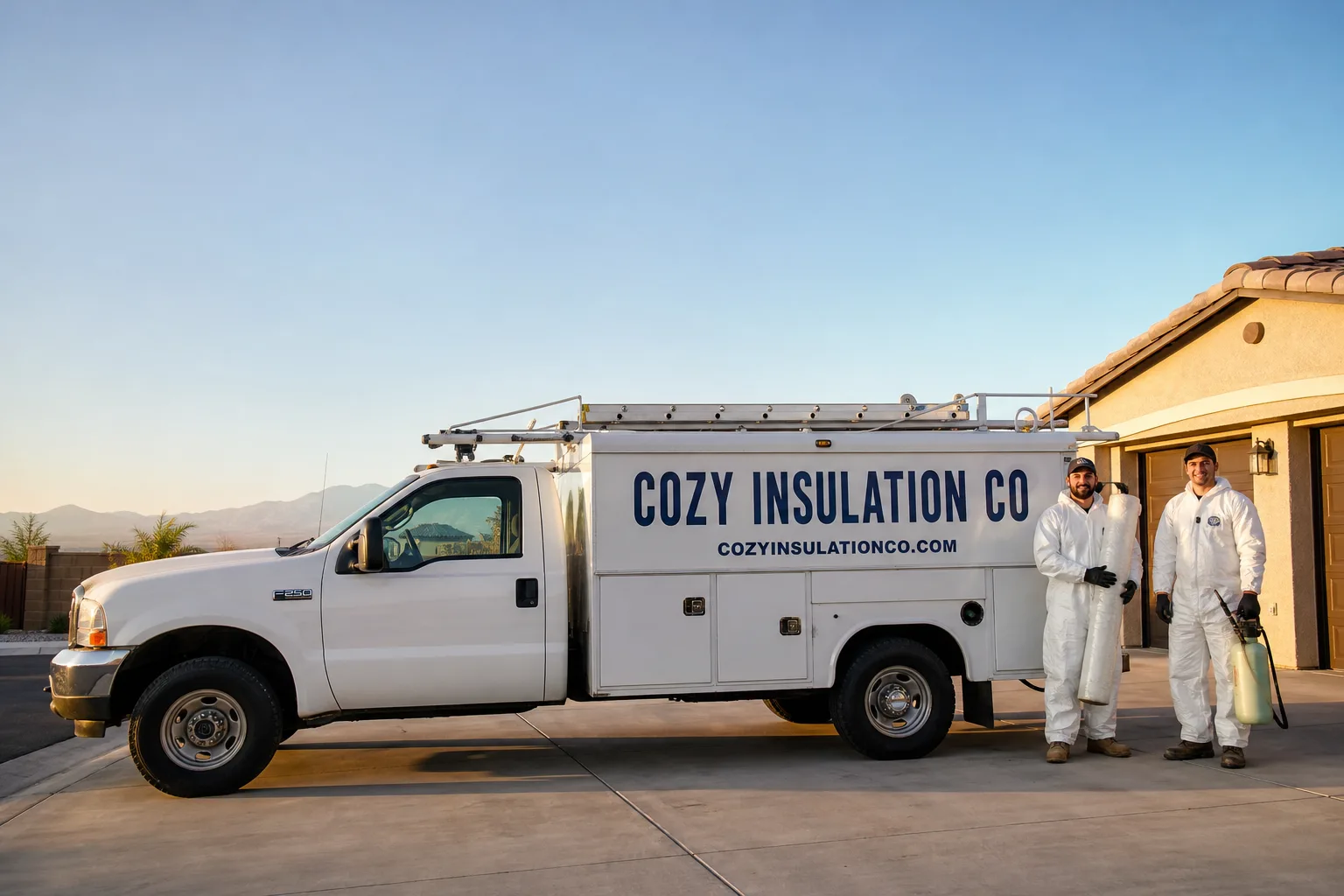
Fast, Reliable Spray Foam Insulation Across Chino
Spray foam insulation in Chino typically costs $2,100 – $6,800 depending on whether you’re treating the attic, walls, or both, and we can usually schedule your install within 7 – 10 days. If you live in the 91708 or 91710 ZIP codes and your upstairs rooms feel like ovens by mid-afternoon, the problem is rarely your AC unit. It’s almost always the attic above you, radiating heat down through builder-grade insulation that was never meant for Chino summers. Call (855) 382-3925 for a free estimate and we’ll tell you exactly what’s going on up there.
Why Cozy Insulation Co Is Chino’s Preferred Spray Foam Insulation Company
Chino homeowners call us because we show up on time, quote honest numbers, and don’t push insulation you don’t need. We’re based in Corona, which means our crews are on Chino roads regularly, and we know the 91708 tract layout well enough to predict where heat gain is worst before we even climb the ladder. Mike Callahan built Cozy Insulation Co around a simple rule: match the material to the house, not the commission check. That’s why we offer open-cell and closed-cell spray foam from Icynene and Demilec, alongside fiberglass and blown-in options when they’re genuinely the better fit.
Our Spray Foam Insulation team has treated homes from the Chino Preserve to the older pockets south of the 60. What we hear most from Chino customers is that other contractors quoted them commodity fiberglass without ever measuring the attic’s actual thermal gaps. We do the opposite. We diagnose first, then recommend the system that fixes the specific problem. That’s why Chino homeowners call us back for the garage ceiling or the rim joists after we’ve already done the attic.
Spray Foam Attic Insulation in Chino
Spray Foam Attic Insulation in Chino is the single most effective fix for the hot-afternoon bedroom problem that plagues so many local homes. In the 91708 master-planned tracts around the Chino Preserve, builders installed R-11 to R-19 batts in vented attics, and years of Chino heat have compressed them to a fraction of their original depth. Meanwhile, attic temperatures hit 150°F regularly from May through October. Your ceiling is the only thing standing between that heat and your living space, and thin batts aren’t enough. We air-seal the top plates and any penetrations, then apply open-cell Demilec spray foam across the attic floor or roofline to create a continuous thermal barrier that batts can’t match.
Air-Sealing Before Foam
We don’t just spray foam over gaps and call it done. In Chino tract homes, the top plates where wall meets attic are frequently unsealed, leaving a direct path for 150°F attic air to pour into wall cavities and living space. We seal every top plate, plumbing vent, and electrical penetration before applying foam. This step cuts the convective heat loop that makes west-facing bedrooms over garages run 8 – 10°F hotter than the rest of the house.
Open-Cell vs. Closed-Cell for Attics
Most Chino attics do best with open-cell foam applied to the attic floor for heat blocking, or closed-cell Icynene when you want to condition the attic space itself. Closed-cell costs more per board foot but adds structural rigidity and acts as a vapor barrier. We’ll tell you which one your roofline and budget actually need. A typical Chino attic runs $2,100 – $4,300 for air-sealing plus open-cell spray foam.
Spray Foam Wall Insulation in Chino
Spray Foam Wall Insulation in Chino is most often the answer for garage-forward two-story plans where the room above the garage never cools down. In the 91708 neighborhoods east of Chino Hills State Park and south of the 60, builder-grade wall insulation leaves substantial voids around electrical boxes, window rough openings, and between studs. Spray foam expands into those voids and bonds to the framing, eliminating the air channels that let afternoon heat migrate into living space. We also treat rim joists with closed-cell foam to stop the stack effect that draws hot outside air into your walls as cool air escapes through the attic.
Garage Ceiling Treatment
Your garage isn’t living space, but the room above it is. Chino’s attached garages bake all day, and an uninsulated garage ceiling turns the upstairs bonus room or bedroom into a heat sink. We apply closed-cell Icynene to the garage ceiling and any shared walls, which blocks radiant transfer and knocks the thermal bridge that batt insulation between joists cannot address. For a standard two-car garage ceiling in Chino, expect $900 – $1,600 depending on square footage and access.
Rim Joist and Band Board Sealing
Chino homes with crawlspaces or raised foundations lose surprising amounts of cool air through unsealed rim joists. We spray closed-cell foam along the band board to seal the entire perimeter, reducing dust infiltration, pest entry points, and unwanted heat transfer. This is typically a $1,200 – $2,000 job for a standard Chino home and often pays for itself in the first two summers.
Trusted Brands We Service in Chino
We install spray foam systems from Demilec and Icynene, two of the most performance-tested names in residential spray foam. For Chino homeowners who prefer batt or blown-in options, we also work with Owens Corning, Johns Manville, and GreenFiber. That means we’re never forcing a single product line into homes where it doesn’t fit. We keep foam kits and common accessories stocked for fast Chino turnaround, so a typical attic project doesn’t stall waiting on materials. Mike Callahan personally vets every product we install, and if a manufacturer’s warranty covers it, we handle the paperwork so you don’t have to.
Common Spray Foam Insulation Problems We See in Chino Homes
- West-facing bedrooms over garages running 8 – 10°F hotter. The builder’s R-11 batts have compressed and the top plates were never sealed, so afternoon heat pours in through the garage ceiling and shared wall. Our garage ceiling spray foam fixes this directly.
- Compromised original batt insulation from the 1980s and 1990s. Older Chino tracts south of the 60 have attics packed with fiberglass that has flattened from decades of heat. Retrofitting with open-cell spray foam over the existing batts restores the thermal barrier without a full tear-out.
- Unsealed top plates in 91708 new builds. Even homes built in the 2000s around the Chino Preserve have top plates that were never sealed. Spray foam applied at the attic floor level stops the convective loop that pulls hot air into wall cavities.
- Hot roof decks radiating heat into upstairs rooms at night. Closed-cell Icynene applied to the roofline in Chino keeps the attic space itself cooler, which matters when your ductwork runs through the attic and loses cooling capacity to 150°F air.
Pricing for Spray Foam Insulation in Chino, CA
In Chino, a standard open-cell attic treatment for a 1,500 – 2,200 square foot single-story home runs $2,100 – $3,700. Add air-sealing on the top plates and you’re looking at $2,600 – $4,300 all in. Garage ceiling treatment runs $900 – $1,600 for a standard two-car garage. Rim joist sealing across a full Chino perimeter typically lands between $1,200 and $2,000. Closed-cell foam costs roughly twice as much per board foot as open-cell, but it’s the right call when you’re conditioning the attic or sealing below-grade rim areas. Square footage, existing insulation depth, and access are the main cost drivers. Call (855) 382-3925 for a free estimate and we’ll give you exact numbers before any work begins.
We Also Serve Cities Near Chino
Cozy Insulation Co regularly works across Los Serranos, Ontario, Montclair, and Eastvale. If you’re in a neighborhood that straddles the Chino-Ontario line or you’re out toward the Eastvale side of the 15, we’re already running crews on those roads most weeks. For your nearest spray foam team, check our Chino coverage details or call the office and we’ll confirm your address right away.
Serving Chino, CA — Our Local Coverage Area
We’re based in the Chino area and know this community well. Use the map below to see our service coverage — if you’re nearby, we can almost certainly help.
FAQs About Spray Foam Insulation in Chino
Because your builder never insulated the garage ceiling or sealed the top plates, and the R-11 batts overhead have compressed into a thin, ineffective layer. The garage below bakes all day, the attic above hits 150°F, and your bedroom is sandwiched between two heat sources. We fix this by air-sealing the top plates and applying closed-cell spray foam to the garage ceiling, which we’ve done on dozens of Chino homes with immediate results. Call (855) 382-3925 and we’ll diagnose yours from the driveway.
Yes, in many cases. The 91708 tracts around the Chino Preserve were built fast, and builders used minimum-spec R-11 to R-19 batts with no top-plate sealing. A home built in 2005 can easily have the same thermal gaps as a 1985 home. We recently treated a two-story Chino Preserve house where the upstairs bonus room over the garage hit 91°F by 3 PM. After air-sealing and applying closed-cell Icynene to the garage ceiling plus open-cell Demilec in the attic, the room’s afternoon temperature dropped 9°F and AC runtime fell 25%. New construction doesn’t mean sealed construction.
Spray foam creates an air barrier, not just an insulation layer. Santa Ana winds drive hot, dry air under roof edges and through wall penetrations, pushing conditioned air out of your home. Closed-cell and open-cell foam both stop that air exchange. In Chino’s 100°F summer stretches, the biggest win is keeping 150°F attic air from radiating and convecting down into living space. That’s a heat-defense problem, and spray foam addresses it more completely than blown-in fiberglass alone.
Yes. We don’t tear out old batts in most cases unless they’re water-damaged or moldy. We air-seal first, then apply open-cell spray foam over or around the existing insulation to create a continuous thermal barrier. For Chino homes built in the 1980s south of the 60, this retrofit approach preserves whatever thermal value the old batts still have while eliminating the gaps that were never addressed at construction. It’s faster and more cost-effective than a full gut and replace.
Open-cell foam is lighter, less expensive, and excellent for attic floors and interior walls where you need air-sealing plus heat blocking. Closed-cell foam is denser, costs roughly double per board foot, and acts as a vapor barrier while adding structural strength. For Chino rooflines where you plan to condition the attic or where ductwork runs through the space, closed-cell Icynene is usually the correct choice. We’ll recommend one or the other based on your home’s actual layout and heat profile, not a generic formula.
Written by Mike Callahan, Owner at Cozy Insulation Co, serving Chino and the surrounding Inland Empire since day one.