
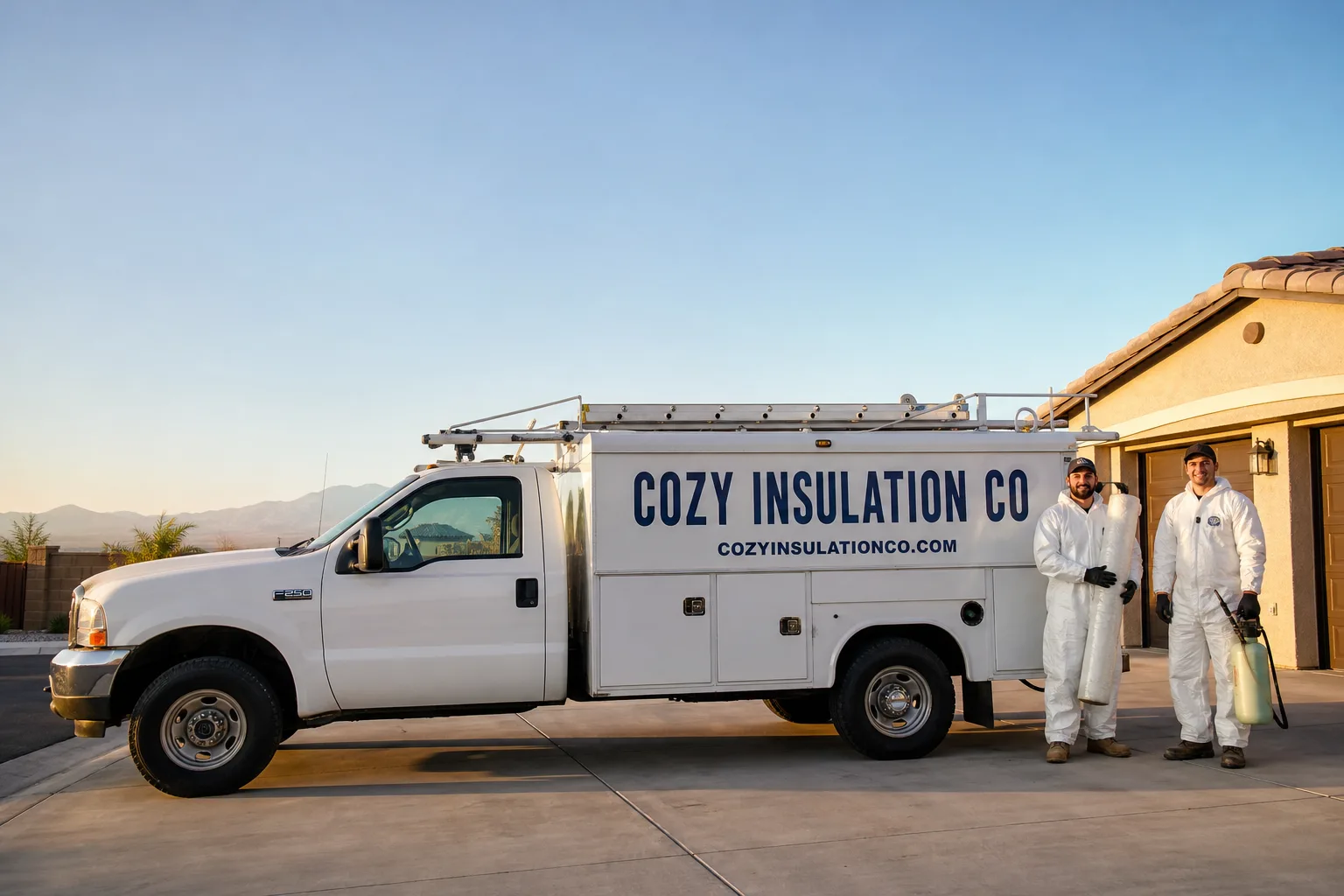
Fast, Reliable Spray Foam Insulation Across Bellflower
Spray foam insulation in Bellflower typically runs $2.50 to $6.50 per square foot installed, with most attic and rim joist retrofits landing between $2,800 and $7,400 depending on closed-cell or open-cell product and the condition of the existing attic. Most jobs in the 90706 and 90707 grid are completed in one to two days. If you’re tired of second-story rooms that bake in summer while the rest of the house stays mild, call Mike Callahan and the Cozy Insulation Co team at (855) 382-3925 for a free estimate. We know Bellflower’s postwar tract housing, and we’ll tell you honestly whether foam, blown-in, or a venting fix is actually the right move.
Why Cozy Insulation Co Is Bellflower’s Preferred Spray Foam Insulation Company
Bellflower homeowners call us because we don’t show up with a one-product pitch. We install Icynene and Demilec spray foam systems, and we also work with Owens Corning and GreenFiber when a different material fits the house better. That matters on a street of 1950s stucco bungalows where every attic is a little different. Mike Callahan has walked enough Bellflower attics to know that a tight vent path off a narrow 90706 lot changes the whole job.
Our crews respond to Bellflower calls quickly, usually within one business day for an inspection, and we keep common foam and air-sealing materials stocked for fast turnaround. We’ve worked in the neighborhoods around Bellflower Boulevard, the blocks off Artesia Boulevard, and the older tracts south of the 91. That local repetition means we know which houses tend to have blocked eave vents, which attics hold heat the worst, and which retrofits inspectors flag.
Our Spray Foam Insulation team handles everything from a single garage ceiling to a full attic roofline. Homeowners appreciate that we’re the same crew doing the blower-door planning, the air-sealing, and the foam application. No subcontractors, no finger-pointing.
Closed Cell Spray Foam Insulation in Bellflower
Closed Cell Spray Foam Insulation is the most common retrofit we recommend in Bellflower because it works as an air barrier, a vapor retarder, and an insulator in one application. On a 1,200-square-foot Bellflower bungalow with an attic roofline retrofit, closed-cell foam typically costs $3,800 to $7,400 for a finished, code-compliant job. That range includes prep, air-sealing of top plates, and the foam itself. Boards thicker than two inches push costs up.
Attic roofline retrofits
This is where Bellflower’s inland summer heat gets handled. Applying closed-cell foam to the underside of the roof deck moves the thermal boundary from the attic floor to the roofline. That means ductwork, stored items, and the air near the ceiling stay closer to the temperature of the living space below. In a 90s°F August week, that’s the difference between a ceiling you can touch and one that radiates heat down into the room.
Rim joist and garage ceiling sealing
Closed-cell foam also seals rim joists and garage ceilings, two places where hot outside air pushes into Bellflower homes. The foam stiffens the framing and blocks the air path that fiberglass batts leave open. For attached garages off a converted den or laundry room, this is often the single highest-leverage fix we can make in one afternoon.
Open Cell Spray Foam in Bellflower
Open Cell Spray Foam is our preferred choice for sound control and for interior wall cavities in Bellflower homes where the roof already has a functional vent path. It’s lighter and less expensive than closed-cell, typically $2.50 to $3.80 per square foot installed. A whole-attic open-cell application in a 1,000-square-foot Bellflower home usually runs $2,800 to $4,200. It expands dramatically, so it fills odd-shaped cavities in older framing better than batts ever will.
Interior wall and ceiling cavities
Older Bellflower tract homes have framing that’s settled and uneven. Open-cell foam conforms to those cavities and quiets rooms noticeably. Homeowners near Bellflower Boulevard and the 91 freeway corridors often ask about traffic and train noise, and open-cell foam does real work there while still allowing the wall assembly to dry if moisture gets in.
Attic floors in vented attics
If your attic is properly vented and the roofline isn’t the problem, open-cell foam on the attic floor air-seals the ceiling plane and adds meaningful insulation. We still recommend fixing blocked or undersized vents first. Foam over a vented attic with no airflow solves one problem and creates another.
Trusted Brands We Service in Bellflower
For Bellflower retrofits we install Icynene closed-cell and open-cell foam systems, and we carry Demilec closed-cell products for high-heat attics and roof decks where a more rigid foam is needed. These are the two most performance-tested spray foam brands we offer. Where foam isn’t the best fit, we can pivot to Owens Corning fiberglass or GreenFiber cellulose without switching companies. Since we stock Icynene and Demilec parts locally, a Bellflower homeowner rarely waits more than a few days for material, even for larger attic jobs.
Common Spray Foam Insulation Problems We See in Bellflower Homes
- Foam sprayed over dead, compressed insulation. We open attics off the 90706 grid and find original 1950s fiberglass batts baked flat and buried in dust. Foam sprayed over that layer never performs. We remove or bypass it, air-seal the top plates, then apply foam to a clean surface.
- Blocked or undersized eave and ridge vents. Bellflower’s tight-lot postwar homes often have roof vents that were adequate in 1962 and are now partially blocked by debris, repainted soffits, or old bird screens. Foam applied before vent correction traps heat and moisture. The job has to start with airflow, not foam.
- Open-cell foam in wall cavities without a moisture plan. Some older stucco bungalows in Bellflower have wall cavities that collect condensation. Open-cell foam is vapor-permeable, which is good, but only if the exterior side is detailed right. We check the stucco condition and drainage plane first.
- Exposed foam failing inspection on occupied attics. On remodeled Bellflower homes with attic living space, foam needs an ignition or thermal barrier. We’ve seen jobs where a previous contractor skipped it. The inspector flags it, and the homeowner pays twice. We handle barrier coverage as part of the original scope.
Pricing for Spray Foam Insulation in Bellflower, CA
Closed-cell spray foam in Bellflower ranges from $3.50 to $6.50 per square foot installed, with attic roofline jobs on 900 to 1,400-square-foot homes typically landing between $3,800 and $7,000. Rim joist work on a typical crawlspace runs $900 to $1,900. Open-cell runs $2.50 to $3.80 per square foot, with whole-attic applications between $2,800 and $4,200. Garage ceiling foam usually comes in at $1,200 to $2,600. These are Bellflower market numbers for 2026, not national averages. An estimate from us is free, and the number we quote is the number on the invoice. Call (855) 382-3925 and Mike Callahan will walk the house with you before any foam goes in.
We Also Serve Cities Near Bellflower
Cozy Insulation Co works throughout southeast LA County. Beyond Bellflower, our spray foam crews regularly serve homeowners in Paramount, Norwalk, Artesia, and Cerritos. If you’re a few miles out, call (855) 382-3925 and ask about scheduling. In most cases we can reach your area within a day or two.
Serving Bellflower, CA — Our Local Coverage Area
We’re based in the Bellflower area and know this community well. Use the map below to see our service coverage — if you’re nearby, we can almost certainly help.
FAQs About Spray Foam Insulation in Bellflower
Because Bellflower’s postwar tract homes were built with tight-lot roof venting that’s now undersized or blocked, and foam applied over a vented-but-dead attic traps heat and moisture instead of solving the problem. We correct or add eave and ridge venting first, then apply foam. On the small stucco bungalow off the 90706 grid, our crew opened the attic to find original thin insulation baked flat and compressed, with a blocked eave vent and a ridge vent undersized for the roof. We air-sealed the top plates and penetrations, corrected the vent path, then applied closed cell foam to the attic roofline using Icynene so the 90s°F summer heat stayed out of the living space instead of radiating down through the ceiling. Call (855) 382-3925 and we’ll check your vent path before quoting anything.
For attic rooflines and rim joists in Bellflower’s summer-heat climate, closed cell is usually the right call. It adds structural stiffness, blocks air and vapor, and delivers more R-value per inch. Open cell makes more sense for interior walls, sound control between rooms, or a vented attic floor where the roofline isn’t part of the thermal boundary. We’ll evaluate the individual cavity and tell you which one fits. A free inspection with Mike Callahan settles it fast.
Yes, in most cases. Open-cell foam is injected into the wall cavity through small access holes from the exterior or interior. The key is checking the stucco condition and drainage plane first on Bellflower’s older bungalows. If the wall has a history of moisture, we address that before injecting anything. Many 1950s tract homes here have empty wall cavities, so the improvement is immediate. Call (855) 382-3925 to schedule a wall cavity inspection.
We install Icynene open-cell and closed-cell systems and Demilec closed-cell products, two of the most performance-tested spray foam brands in the professional industry. For homeowners who want a non-foam option, we also carry Owens Corning fiberglass and GreenFiber cellulose. The brand depends on the cavity and the house, not on what’s easiest for us to spray.
For most attic and rim joist jobs, no. You’ll need to stay out of the work area during application and for a few hours afterward while the foam cures. Occupants with respiratory sensitivities, infants, or pets should plan for a longer airing-out period, typically 12 to 24 hours. We’ll give you a specific re-entry window for your house and your product before we start. Call (855) 382-3925 with any safety or schedule questions.
Written by Mike Callahan, Owner at Cozy Insulation Co, serving Bellflower and southeast LA County.