
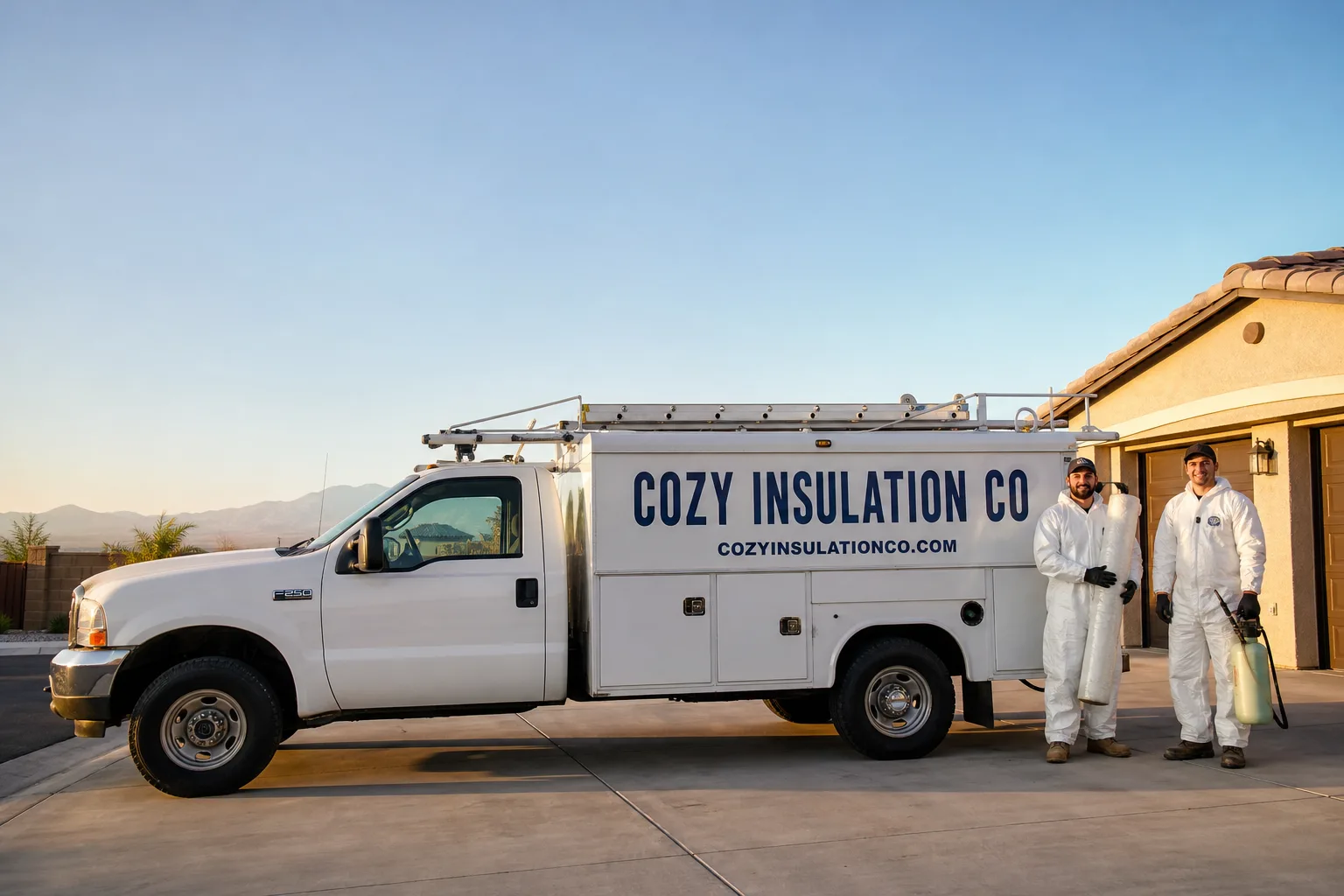
Fast, Reliable Spray Foam Insulation Across Artesia
If you’re dealing with a back bedroom that bakes every afternoon or a garage conversion that never quite feels like part of the house, spray foam insulation in Artesia is usually the answer. Cozy Insulation Co works on the 1950s – 70s wood-frame homes that dominate this city, and we know exactly where these houses leak air. We’re based in Corona and can usually reach Artesia within an hour. Call us at (855) 382-3925 for a free estimate.
Why Cozy Insulation Co Is Artesia’s Preferred Spray Foam Insulation Company
Artesia homeowners don’t just need insulation, they need someone who understands how houses on 183rd Street were built differently from houses on Pioneer Boulevard. Our team has worked across the 90701 and 90702 zip codes long enough to recognize the patterns: stucco exteriors hiding unsealed framing gaps, original attics stuffed with a thin layer of compressed fiberglass, and garage conversions that were never properly insulated when they were permitted back in the 1980s and 90s. Mike Callahan built Cozy Insulation Co around one principle: match the material to the house. For Artesia’s aging wood-frame stock, that often means closed-cell spray foam from Demilec or Icynene, applied after we’ve actually looked inside the wall cavities. We don’t guess. We probe, scope, and confirm where air is moving before we spray a single board foot.
Spray Foam Attic Insulation in Artesia
Spray Foam Attic Insulation in Artesia homes from the 1950s and 60s almost always means upgrading an attic that currently has settled fiberglass batts or loose-fill that’s compressed to the point of being useless. In this part of LA County, the bigger issue is heat gain during long sunny stretches, not freezing winters. A poorly insulated attic can push afternoon temperatures in a house up by 10 – 15 degrees. We see it all the time in Artesia’s pitched-roof stucco homes. The fix is usually open-cell spray foam applied directly to the underside of the roof deck, turning the attic into a conditioned space. For older homes where the roof deck has existing ventilation, we’ll recommend closed-cell foam or a hybrid approach. Typical costs for an 1,100 – 1,400 square foot attic in Artesia run $4,200 – $6,800, depending on the foam type and depth.
Radiant Barrier and the Artesia Sun
Artesia gets more than 280 sunny days a year. That sun pounds the roof deck from May through October. Open-cell spray foam slows radiative heat transfer far better than fiberglass, which is why we recommend it for attics in the 90701 area. We install baffles at the soffit vents first so the foam doesn’t block airflow and create moisture problems later. Skipping that step is how DIY jobs go wrong, and it’s a mistake we correct on a regular basis for homeowners who tried it themselves.
Air Sealing the Attic Floor
Before we spray, we air-seal the attic floor penetrations: recessed light housings, plumbing vents, and the gaps around chimney chases. In older Artesia homes, there are always more leaks than the homeowner expects. A full attic spray foam job in Artesia typically takes one day for open-cell and two days if we’re doing closed-cell with drywall removal.
Spray Foam Wall Insulation in Artesia
Spray Foam Wall Insulation in Artesia is most often requested for converted garage walls that were drywalled over without any insulation behind them. These are the thermal weak points nobody thinks about until the room is uninhabitable for half the year. If a garage was converted in the 1980s or earlier, the wall that used to be the exterior garage wall is now an interior wall with empty cavities. The soffit above it is empty too. Applying spray foam here means removing the drywall, spraying closed-cell foam into the cavities, and re-drywalling. This is a bigger job than attic work, but it’s the only way to actually fix the temperature imbalance. For a single shared wall and ceiling in a converted garage, Artesia homeowners can expect to pay $2,800 – $4,600.
Closed-Cell for Shared Walls
We use closed-cell Demilec foam for garage conversions in Artesia because it adds structural rigidity and acts as its own vapor barrier. That matters in a city where many garages sit on slabs that wick moisture upward. Open-cell foam would hold that moisture against the wood framing. Closed-cell doesn’t. It’s the right material for this specific condition, and it’s one of the reasons we don’t just offer fiberglass and call it a day.
Retrofitting Without Full Remodel
You don’t need to tear the whole room apart. We cut access into the drywall, spray the cavities, and patch cleanly. Most converted-garage jobs in Artesia take 2 – 3 days total, including drywall repair and texture matching. The temperature difference is noticeable the same week, not after some long break-in period.
Trusted Brands We Service in Artesia
We’re authorized to install spray foam systems from Icynene and Demilec, two of the most performance-tested brands in the residential spray foam industry. For Artesia homeowners who prefer blown-in options, we also install GreenFiber cellulose. The brand matters less than the application, and Icynene’s closed-cell formula works well against stucco-backed wall cavities. Demilec’s closed-cell foam delivers the air-sealing and rigidity older Artesia framing needs. We keep standard roof deck, rim joist, and wall cavity kits stocked for fast turnaround when an Artesia job is scheduled.
Common Spray Foam Insulation Problems We See in Artesia Homes
- Uninsulated garage conversion walls. Converted garages in Artesia often have no insulation behind the drywall. Spray foam applied directly over old drywall traps moisture and misses the thermal boundary, so the drywall has to come off first.
- Hidden gaps behind stucco. Stucco exteriors hide unsealed penetrations from decades of remodels. A crew that doesn’t probe with a scope will spray foam and miss the air leaks, leaving the homeowner wondering why the room still gets hot.
- Soffit vent blockage in 1950s – 60s attics. Attic spray foam in older Artesia homes can block soffit vents if baffles aren’t installed. That leads to poor attic ventilation and moisture buildup in the roof deck, a problem we correct on homes where a previous contractor skipped the prep.
- Rim joist air leaks. The rim joist where the first floor meets the foundation is a major air leak in Artesia’s raised-foundation homes. We spray closed-cell foam there to stop drafts that sneak up through the floor.
Pricing for Spray Foam Insulation in Artesia, CA
Attic spray foam in Artesia typically runs $4,200 – $6,800 for a standard 1,100 – 1,400 square foot home, depending on open-cell or closed-cell foam and the existing attic condition. Converted garage wall insulation runs $2,800 – $4,600 for the shared wall and ceiling. Rim joist spray foam work usually totals $1,100 – $2,300 depending on foundation perimeter and access. The main cost drivers are whether drywall needs to come off, how much air sealing is required before spraying, and square footage of the cavities. Every Artesia estimate we give is free, and we walk the house with you before quoting anything. Call (855) 382-3925 to schedule a walk-through.
We Also Serve Cities Near Artesia
Cozy Insulation Co works throughout the Artesia area, including Cerritos, La Palma, Hawaiian Gardens, and Norwalk. If you’re in a neighboring city and need Spray Foam Insulation, we’ll bring the same material-matching approach we use across Artesia. One company, one call, and an honest answer about what your house actually needs.
Serving Artesia, CA — Our Local Coverage Area
We’re based in the Artesia area and know this community well. Use the map below to see our service coverage — if you’re nearby, we can almost certainly help.
FAQs About Spray Foam Insulation in Artesia
Yes, spray foam can fix the temperature imbalance without a full remodel, but only if the drywall on the garage side is removed so the foam goes directly into the wall cavities and against the ceiling framing. We did this recently on a 1962 stucco home near Pioneer Boulevard and 183rd Street. The back bedroom was overheating because the shared wall between the garage conversion and the house had zero insulation. Our tech removed the drywall, applied 2 inches of closed-cell Demilec foam to the shared wall and ceiling, and air-sealed the rim joist. The homeowner reported the room holding 8 – 10°F cooler during the next heat wave. Call (855) 382-3925 for a free evaluation of your garage conversion.
In Artesia’s semi-arid climate with warm summers, spray foam outperforms fiberglass primarily by trapping less heat gain and sealing the air leaks that let conditioned air escape. Fiberglass only slows conductive heat transfer. It does nothing for air movement. Spray foam does both. That’s why we recommend closed-cell foam for converted garage walls and open-cell for attic roof decks in Artesia homes. The comfort difference shows up in summer afternoons when the sun is beating on the roof.
It can, if the soffit vents are blocked and the attic isn’t conditioned properly. A 1960s Artesia attic usually has soffit vents built into the eaves. Before we spray any foam, we install baffles to keep those vents open. So the short answer is no, spray foam does not cause roof deck moisture when installed correctly by a crew that preps the attic. We look for existing signs of moisture on the roof sheathing before we start. Call us for a free attic inspection at (855) 382-3925.
Yes, drywall needs to come off before we spray foam in a garage conversion. Spraying behind existing drywall leaves voids and can trap moisture against the old framing. The removal is part of every converted-garage quote we write in Artesia, and we handle the patching and texture matching so you don’t have to hire a separate drywall contractor.
We use Demilec and Icynene spray foam systems, both of which carry strong independent test data for air sealing and aged R-value retention. For older Artesia construction, closed-cell Demilec is often the right call because it adds rigidity to 2×4 framing and acts as its own vapor barrier. Icynene’s open-cell formula works well for attic roof decks where ventilation and drying potential are important. The brand matters less than the formulation matched to your specific walls and attic.
Written by Mike Callahan, Owner at Cozy Insulation Co, serving Artesia and surrounding LA County communities.