
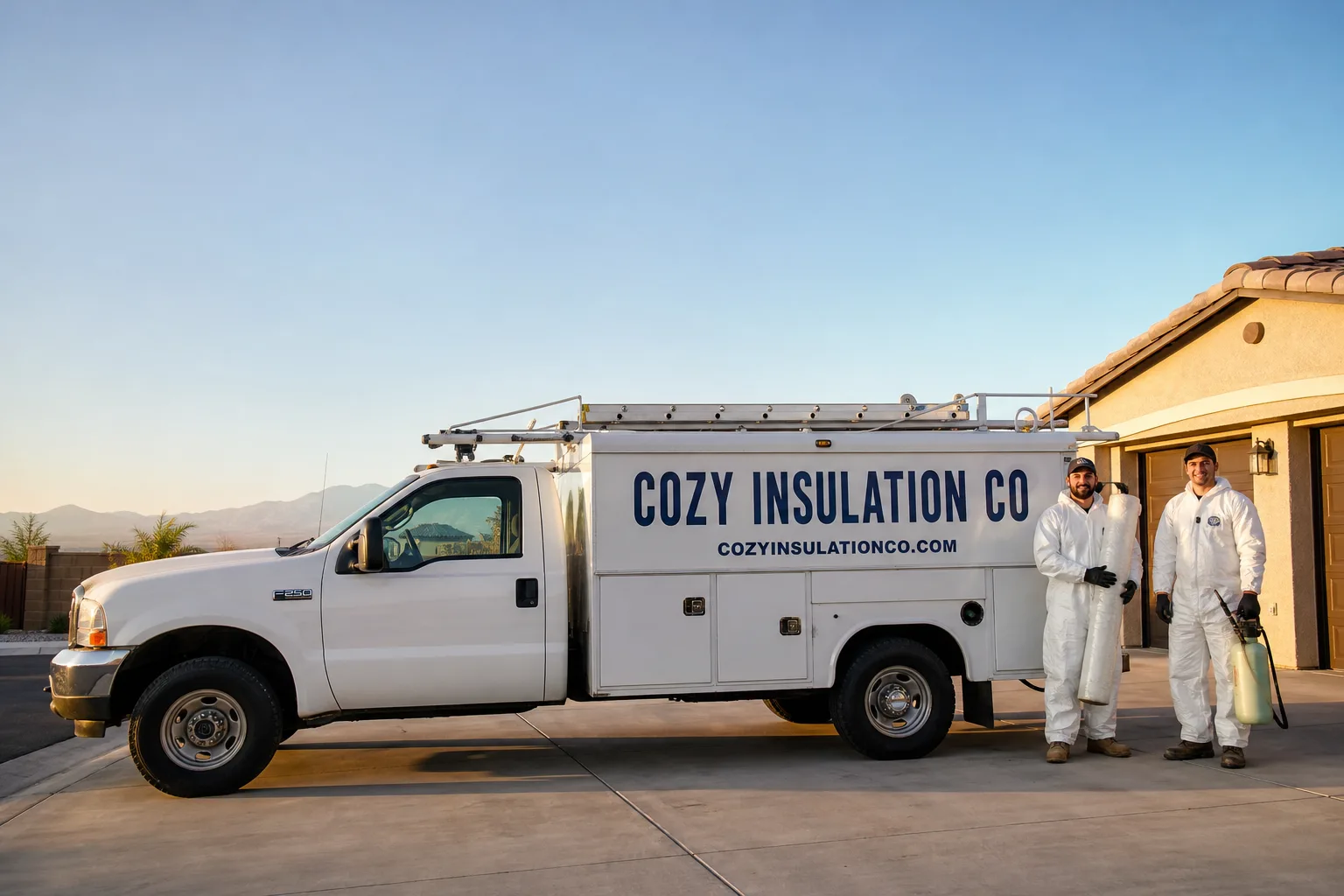
Fast, Reliable Attic Insulation Across San Fernando
Attic insulation in San Fernando usually means a full retrofit job: air-sealing a dust-choked attic floor, then blowing in new insulation to bring a 1920s – 1950s home up to something that actually holds temperature. Most houses here were built before wall cavities were standard, so the attic is doing more thermal work than it does in newer Valley cities. We serve every block in San Fernando, from the bungalow streets around San Fernando Road to the apartment courts south of the 118, and we usually have a crew on-site within 48 hours of your call. If you’re tired of rooms that won’t hold a set temperature, call (855) 382-3925 for a free estimate. We’ll come look at what’s actually under your roof.
Why Cozy Insulation Co Is San Fernando’s Preferred Attic Insulation Company
We’ve spent years working in San Fernando’s housing stock, and we know what that means: knob-and-tube-era stucco bungalows on narrow lots, low-pitch roofs that bake from June through October, and attics full of dust that’s been settling since the Eisenhower administration. Homeowners here don’t need a generic blow-and-go. They need someone who understands that a 1948 bungalow on a tight lot near the 210 freeway has different insulation needs than a 2005 tract home in a newer Valley subdivision. Mike Callahan built our approach around that: match the material to the house, not the other way around.
Our San Fernando customers tell us the same things: summer bedrooms that hit 85°F by 4 p.m., winter drafts that move curtains, and power bills that spike every July and August. We fix the attic first because that’s where most of the heat exchange happens. San Fernando’s urban heat island, with its asphalt-heavy streets and low tree canopy, makes attic performance matter more here than in shadier parts of the Valley. A sealed, properly insulated attic is the single biggest lever you can pull on a San Fernando home’s comfort.
We quote response times to San Fernando in days, not weeks. Calls from 91340 and 91341 go straight to our scheduling team, and we keep crews routed through the northeast Valley consistently enough that most estimates happen within two business days. Insulation work is noisy, dusty, and disruptive, and we plan around that. When we work on a San Fernando apartment court or a bungalow with a shared driveway, we stage materials to minimize the footprint. We know that on these narrow lots, there’s no room for a sloppy job site.
What sets us apart is the material range. We’re authorized installers for eight major insulation brands, including Owens Corning, Johns Manville, Demilec, and GreenFiber. Most insulation companies in the Valley push one product line because it’s easier for them. We stock and install fiberglass batts, blown-in cellulose, mineral wool, and both open- and closed-cell spray foam. When we walk a San Fernando attic, we’re not trying to fit your house into one product. We’re matching the product to your house.
The Right Insulation for Your Home, Not Just the Easiest Install
San Fernando’s housing stock is dense and varied. A 1920s bungalow with no wall cavities needs a different approach than a 1960s apartment court with a shared attic. Our Attic Insulation team starts with a full attic assessment: existing insulation depth and condition, air leaks, ventilation, and any unpermitted room additions that might have broken the air barrier. Many San Fernando homes have added-on bedrooms or enclosed porches that were never properly sealed, and those additions funnel hot air straight into the attic. No amount of new insulation fixes an air leak that bypasses it.
We frame outcomes first. Rooms that stay the temperature you set them. Lower summer bills. Less dust. A cozy home isn’t luck. It’s the right insulation, installed correctly. R-values matter, but they’re a spec, not a promise. A proper retrofit is about air-sealing, ventilation, and material selection working together. That’s the job.
Insulation Contractors in San Fernando
Insulation contractors in San Fernando are doing a different job than they do in most of the Valley. This is the only city in the region where attic insulation permits run through the city’s own building department rather than LA County, and most of the housing stock is 1920s – 1950s stucco bungalows with knob-and-tube-era walls and essentially no cavity insulation. That combination means most attic jobs here are full retrofits: air-sealing an uninsulated, dust-choked attic floor before blowing new insulation. A typical attic retrofit in San Fernando runs $1,800 – $3,400 for a 1,000 – 1,500 square foot home, depending on existing insulation depth, access, and whether we’re also addressing baffles and ventilation.
When a San Fernando homeowner needs an insulation contractor, it’s usually because they’ve noticed one of three things: rooms with wildly different temperatures, summer power bills that hit $300, $400, or $500 a month, or a faint dust film that keeps settling on furniture. All three trace back to the attic. We start every job by assessing the existing attic floor, checking for knob-and-tube wiring that needs to be handled before insulation goes over it, and locating every air leak that’s been quietly working against you.
Attic Retrofit and Air-Sealing
A proper San Fernando attic retrofit starts with sealing the attic floor. Older homes here have plumbing chases, electrical penetrations, and framing gaps that leak conditioned air into the attic year-round. We seal those before any insulation goes down. If you blow new insulation over an unsealed attic, you’ve insulated the leak, which helps almost nothing. San Fernando homes built before the 1960s almost always need this step. Skipping it is the most common mistake we see from other contractors.
Knob-and-Tube Attic Work
Many San Fernando bungalows still have active or abandoned knob-and-tube wiring in the attic. Blowing insulation over knob-and-tube is a fire hazard if it’s still live, and it’s a code issue either way. We flag it during our assessment and coordinate with a licensed electrician to handle the wiring before we insulate. That’s not a delay, it’s a safety requirement. We don’t blow insulation over live knob-and-tube, period.
Attic Ventilation in San Fernando
Attic ventilation in San Fernando works harder than it does in most Valley neighborhoods. Summer highs routinely top 100°F, the asphalt-heavy streets hold heat into the night, and the low tree canopy means attics bake from late morning until sundown. Without proper ventilation, a sealed and insulated attic still cooks. A typical ventilation upgrade in San Fernando runs $600 – $1,800, depending on whether we’re adding baffles, ridge vents, or powered exhaust. Most older homes here are under-ventilated, and that’s a big part of why attic temperatures hit 140°F in July even before you factor in the insulation problem.
San Fernando homeowners need attic ventilation addressed at the same time as insulation. The two work together. Insulation slows heat transfer; ventilation moves built-up heat out of the attic so it doesn’t radiate into living space all night. If you insulate without ventilating, you’ve created an oven. If you ventilate without insulating, you’ve created a wind tunnel. We handle both on the same visit.
Flat and Low-Pitch Roof Ventilation
San Fernando’s flat and low-pitch roofs don’t ventilate like a standard gable roof. Many were built with minimal eave vents and no ridge vent at all. We use baffles to maintain airflow channels at the eaves, which keeps insulation from blocking the limited venting these roofs have. That detail matters. On a low-pitch roof, a blocked soffit vent can trap enough heat to warp shingles and send attic temperatures past 150°F.
Dust and Debris Sealing
We talked about the soot-darkened attics near the 210. Decades of freeway and diesel traffic leave a film of gray-black dust that works its way into every crack. Sealing the attic floor against that legacy dust is part of the ventilation and air-sealing work, not an afterthought. When old fiberglass comes out looking gray-black, that’s not age. That’s the 210. And it means the attic floor needs sealing before new insulation goes in.
Trusted Brands We Service in San Fernando
We install products from eight vetted manufacturers, and for San Fernando jobs we typically lean on Owens Corning and Johns Manville for blown-in fiberglass, with Demilec open- and closed-cell spray foam for homes that need air-sealing and insulation in one step. GreenFiber cellulose is a strong option for homeowners who want recycled-content insulation and solid sound damping, which matters in San Fernando’s dense, apartment-court-heavy blocks. Because we carry material across these brands, we can quote San Fernando jobs with the right product for the house, not whatever is on the truck. Most attic retrofits use one primary material; it’s the matching that matters. We keep our most-used San Fernando materials stocked locally so turnaround stays fast.
Common Attic Insulation Problems We See in San Fernando Homes
- Legacy freeway and diesel dust in attics near the 210. Homes in 91340, especially the blocks north of the freeway, often have insulation that’s gray-black with embedded road dust. Blowing new insulation over that without sealing the attic floor first just puts a clean layer on top of a dirty problem.
- Unpermitted room additions that break the air barrier. San Fernando’s narrow lots led decades of homeowners to add bedrooms, enclosed porches, and bump-outs. Many were never properly tied into the attic air seal, so conditioned air leaks straight through the framing.
- Knob-and-tube-era walls with no cavity insulation. Most 1920s – 1950s stucco bungalows here have no wall insulation at all. Attic-only work helps, but the envelope is still half-open. We always flag this during the assessment so you can plan accordingly.
- Under-ventilated flat and low-pitch roofs. These roofs don’t breathe like gable roofs, and most San Fernando homes were built when ventilation standards were looser. The result is attics that hold heat late into the night, radiating into bedrooms long after the sun goes down.
Pricing for Attic Insulation in San Fernando, CA
Here are honest ranges for San Fernando’s market. A basic attic top-up on a 1,000 square foot bungalow with existing insulation usually runs $800 – $1,200. A full retrofit with air-sealing, baffles, and blown-in insulation to proper depth typically runs $1,800 – $3,400 depending on attic size, access difficulty, and whether knob-and-tube wiring needs to be addressed first. Spray foam jobs start around $3,000 for a small attic and go up from there; foam is the most expensive material, but it’s also the only one that insulates and air-seals in a single step. Attic ventilation work adds $600 – $1,800 in most San Fernando homes. Every estimate is free, and we’ll give you a line-item quote before any work starts. Call (855) 382-3925 and we’ll come measure.
We Also Serve Cities Near San Fernando
Our crews cover the entire northeast Valley, so if you’re in North Hills, Shadow Hills, Northridge, or Van Nuys, we can usually get to you just as fast as we get to San Fernando. The housing stock changes from block to block, but the attic problems are familiar: old stucco, minimal insulation, and summers that punish an underperforming attic.
Serving San Fernando, CA — Our Local Coverage Area
We’re based in the San Fernando area and know this community well. Use the map below to see our service coverage — if you’re nearby, we can almost certainly help.
FAQs About Attic Insulation in San Fernando
San Fernando runs its own building department, separate from LA County, and most attic insulation jobs that include structural changes or ventilation upgrades need a city permit. Basic insulation top-ups often don’t, but any job involving baffles, venting, or air-sealing that touches framing should go through the city. We handle permit paperwork for every San Fernando job that requires it. Call (855) 382-3925 and we’ll tell you whether your project needs one.
No. If you live near the 210, especially in 91340, that gray-black color is decades of freeway and diesel dust that worked its way into the attic. It’s not just cosmetic. That dust keeps migrating into living space until the attic floor is sealed. We pull the old material, seal the floor with foam, then blow in fresh insulation. That sealing step is what actually stops the dust.
Yes, and that’s most of what we do in San Fernando. These homes have no wall cavities, so the attic is the main insulation envelope. We air-seal the attic floor, blow in Owens Corning or GreenFiber to a high R-value, and address ventilation. Wall insulation is a separate project on knob-and-tube-era homes, and we’ll flag it during the estimate. But attic work alone makes a major difference in comfort and bills.
For older San Fernando homes, a properly sealed and insulated attic is the single most effective thing you can do to lower summer cooling costs. The attic is where most heat enters the living space. Sealing the floor before insulating is what makes it work. A retrofitted attic won’t make a 1950s bungalow perform like new construction, but most homeowners see the difference in the first full summer.
Flat and low-pitch roofs need ventilation just as much as gable roofs, but they get it differently. We use eave baffles to keep airflow channels open, and we assess whether a powered exhaust makes sense for your roof. Without ventilation, a sealed attic becomes an oven. We include ventilation in every San Fernando attic assessment, not as an upsell but because it’s part of the job.
Get Your San Fernando Attic Assessment Scheduled
If your San Fernando home has rooms that won’t hold temperature, dust that won’t stop settling, or summer power bills that make you wince, the attic is almost certainly part of the problem. Call (855) 382-3925 and we’ll send a crew to look. Estimates are free, and we’ll give you a straight answer about what your attic needs and what it doesn’t. No pressure, no generic pitch. Just the right insulation for your home, not the easiest install.
Written by Mike Callahan, Owner at Cozy Insulation Co, serving San Fernando and the northeast San Fernando Valley.